
‘We’re here, just in a new location’
County Extension staff now in brand-new facility
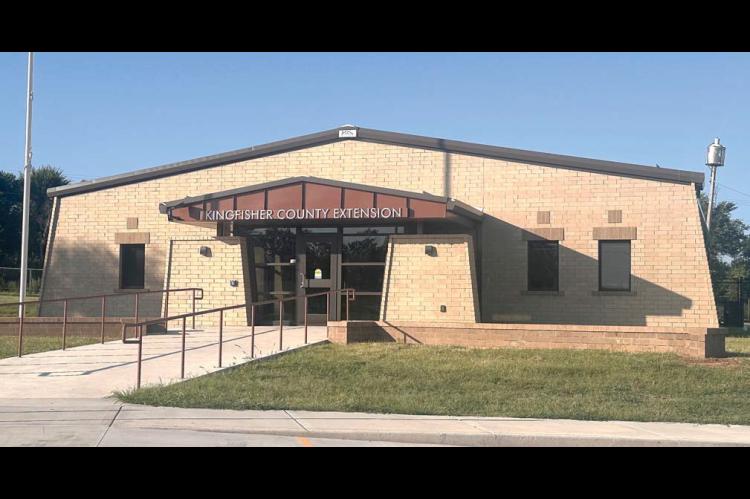
The OSU Extension Office in Kingfisher County finally has a permanent home.
The extension staff is operating out of its new office at the Kingfisher County Fairgrounds in Kingfisher.
The Extension Service operated out of the Kingfi sher County Courthouse for many years, followed by an extended stay in the Courthouse Annex Building.
That building was torn down last year, prompting a stay in a rented temporary building near where the permanent office is now located.
The staff has been working out of its new headquarters on the Kingfisher County Fairgrounds since late spring.
The new building has separate offices for the entire staff including Extension Director/Agriculture Educator Bryan Kennedy, Family and Consumer Services Educator Lindy Peterman, 4-H Educator Heather Leitner and Support Specialist Marci Johnson.
The new quarters also provide a meeting roomwork room for Extension groups and storage for program files.
Kennedy related that the change in location has caused some confusion.
He recalled an incident in which a county resident seeking some help with a water test called another local agricultural service and was told the Extension Office could provide the information needed.
“But they’re gone,” the resident said, citing the removal of the old courthouse annex building.
“We’re here, just in a new location,” Kennedy pointed out, inviting those needing help with extension services to visit the fairgrounds office now.
Kingfisher County’s Oklahoma State University Extension Service has had an office in Kingfisher almost from shortly after OSU’s founding on Dec. 25, 1890.
The new headquarters, built without the need of a bond issue due to the Extension staff’s conservation of revenue from the county half-cent sales tax, provides convenient access to the MAC Center and Exhibit Building on the fairgrounds where many of the Extension staff’s efforts on behalf of county residents are conducted.
“The residents of Kingfi sher County deserve the credit for the Extension headquarters,” Kennedy said, noting it was their tax dollars that built the $1,069,666.80 office.
The story of Oklahoma State University began on Christmas Eve, 1890, at the McKennon Opera House in Oklahoma’s territorial capital in Guthrie and later in a rented structure near the spot where the permanent office is now located when Territorial Governor George W. Steele signed legislation establishing an Oklahoma Agricultural and Mechanical College (OAMC) in Payne County.
Kennedy invited those needing help with Extension services to visit the office on the fairgrounds daily Monday through Friday from 8 a.m. to 4:30 p.m.
Cooperative Extension provides research-based resources (many free) residents can use to improve their home, workplace and community.
“This office’s programs and services are specifically designed to solve the problems county residents face. It’s a service of Oklahoma State University and functions as part of a nationwide network of university extension offices dedicated to providing trustworthy public education and service”, the extension website points out.
The new site improves convenience for staff when working on county events, like the county fair, coming up Aug. 20-21, spring stock show and numerous events for youth, farm groups, organizations and others.
A brief history of the Extension service on the U.S. Department of Agriculture website states: “In 2014, NIFA (National Institute of Food and Agriculture) and our partners in the Land-grant University System celebrated 100 years of Cooperative Extension in the United States. In the century since its creation, this nationwide educational and outreach network has made significant contributions to American agriculture — particularly in rural areas — and improved lives across the country. NIFA plays a key role in the land-grant extension mission by distributing congressionally appropriated formula grants annually and by providing national program leadership.
Extension’s roots go back to agricultural clubs and societies, which sprang up after the American Revolution in the early 1800s. In “1819, a pioneer agriculture journal entitled American Farmer encouraged farmers to report on their achievements and their methods of solving problems.
“The Smith Lever Act formalized extension in 1914, establishing USDA’s partnership with land-grant universities to apply research and provide education in agriculture. Congress created the extension system to address exclusively rural, agricultural issues.
“At that time, more than 50 percent of the U.S. population lived in rural areas, and 30 percent of the workforce was engaged in farming.
“Extension’s engagement with rural America helped make possible the American agricultural revolution, which dramatically increased farm productivity, allowing fewer farmers to produce more food.”