
Dover’s Ingle family visits grave of Kingfisher namesake in Nebraska
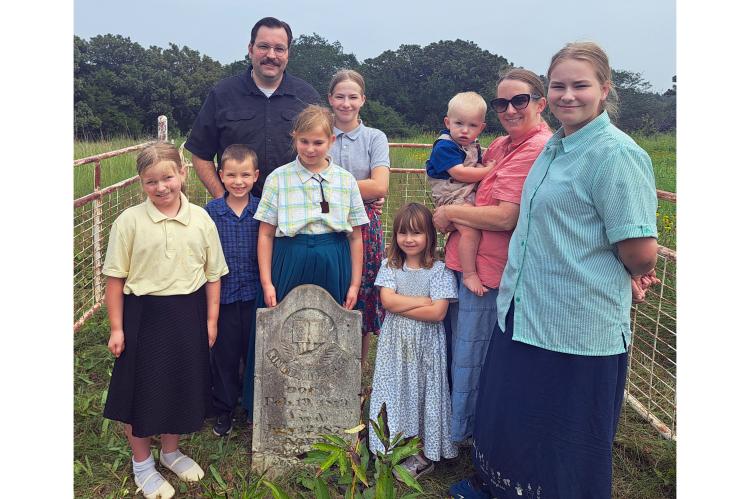
The Ingle family of Dover headed north for vacation last week and, along the way, visited the gravesite of the namesake of Kingfisher.
The city of Kingfisher was named for pre-Land Run frontiersman King David Fisher (1812-1871).
He is buried on private land near Hebron, Neb.
The Ingles were on a multi-state road trip vacation and made arrangements along the way with landowner Alan Kenning to visit the site where Fisher is buried.
Kenning said he has a couple of visitors a year. Most are folks who are related to Fisher, he said, but he had not yet welcomed people specifically connected to the city or county of Kingfisher.
Kenning Farms maintains the site and its protective fencing on his 700 acres of prairie, cropland and woods which Kenning books out for hunting excursions via LandTrust.com The Kingfisher Free Press 60th anniversary issue of 1949 and the Times & Free Press state Centennial Edition of 2007 featured a photograph of Fisher’s great-great-grandson King David Fisher III posing at the gravesite, along with the following historical narrative, although the dates mentioned in the story differ from those on the headstone:
[King David Fisher] was born somewhere in the east in 1812, a member of a family of 13 or 14 children, and died in Nebraska in 1869.
He met his wife Sophia Pritchard near Louisville, Kentucky, and they became the parents of seven sons and two daughters. One son, Isaac, was killed by Indians.
Fisher, a horse trader and sometimes gambler, was also an Indian fighter when necessary although he was a friend to all civilized Indians.
Long before the opening of the country to settlement, he traveled through Indian Territory, buying and selling cattle, and also had a line of stallions.
One of his camping places was on the banks of what came to be known as Kingfi sher Creek, and when a stage station later was built there, it likewise received the name of Kingfisher.
An unusual circumstance occurred in connection with King Fisher’s death. He foretold of his passing two weeks before he died, although a physician summoned by his wife could find nothing wrong with him at the time.
At his own request, he was buried on a hill on his ranch where frontiersmen had used a telescope to watch for marauding Indians. His old musket hangs in the courthouse at North Platte, Neb.
His old log ranch house still stands and is the only original building left on the ranch.