
Harvest halted before it starts?
Early cutting begins, but forecasted rain expected to hinder progress
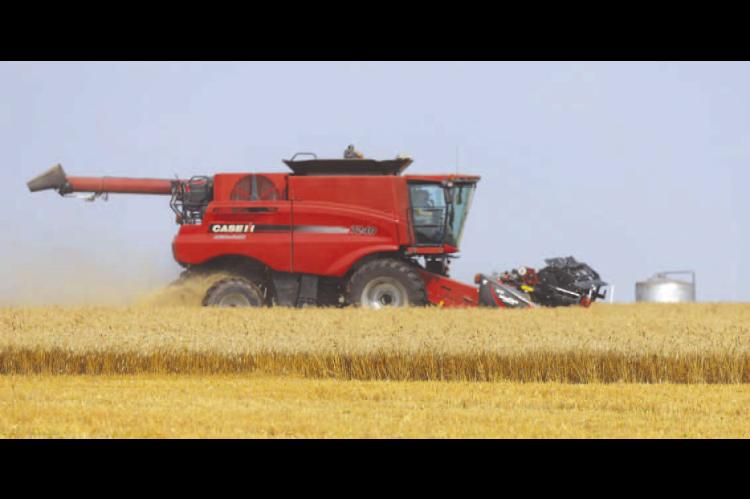
The 2025 Kingfisher County wheat harvest made a light start over the weekend and forecasted rains are likely to halt producers’ progress before it gets started.
Grain was received at Wheeler Brothers Grain Elevator in Kingfisher, CHS Elevator at Omega and CHS Elevator at Okarche over the weekend.
In each case the wheat tested high in weight and low in moisture.
Michael Pierce, southeast of Okarche brought in the first load to Okarche CHS. It tested 63 pounds per bushel (No. 1) with a moisture test of 12.5%.
Dennis Fisher delivered the first load to CHS at Omega.
Two producers delivered grain to Wheeler Brothers Grain in Kingfisher, both testing above 60 pounds and dry enough to store.
The wheat arriving at CHS Elevator at Omega tested 62 pounds in weight and 13.1% in moisture.
Other county sites all reported too wet to harvest as of early Monday.
The Omega area received another 1 inch of rain Saturday night, halting the early harvest efforts there.
The Mesonet station at the Mueggenborg Farm west of Kingfisher recorded .25 inch for the weekend.
Some concentrated areas of the county received more than 2 inches with that storm.
The CHS Elevator in Kingfisher, Cashion Grain and Feed, Okarche Grain and Feed, Hennessey CHS and Wheeler Brothers Elevator at Omega all indicated two weeks of sunshine and dry weather would put harvest in high gear.
However, Mother Nature said that’s not likely to happen anytime soon.
The National Weather Service issued a flood watch for a large swath of Oklahoma, including Kingfisher County, from Tuesday into early Wednesday (June 4).
Multiple rounds of showers and storms were forecast with rainfall totals projected at 2 inches with up to 5 inches possible in some areas.
On Tuesday, the Oklahoma Mesonet’s seven-day rainfall forecast had the extreme northwest corner of Kingfisher County receiving 3 inches of rain with the amount increasing as it went south and east.
Some areas of the county are projected to receive close to 6 inches.
The NWS has rain in the forecast every day for at least the next week.
Wheat Crop Report
The Baking Business website reported that the state’s wheat crop would be lower than the 2024 crop.
Mike Noltemeyer wrote: Estimates resulting from a recent crop tour suggest Oklahoma winter wheat production in 2025 will be down from 2024.
Farmers and others in the wheat value chain in the nation’s third-largest winter wheat state were relieved that April and May rains threw a lifeline to a crop that had been heavily stressed by drought.
After an annual tour of wheat fields in the Sooner State, the Oklahoma Wheat Commission (OWC) projected winter wheat production this year at 101.2 million bushels based on a projected average yield of 35.9 bushels per acre.
If realized, production would be down 7% from Oklahoma’s 2024 production of 108.3 million bushels. The projection was issued May 6 at the annual meeting of the Oklahoma Grain & Feed Association.
A separate survey of attendees’ projections for Oklahoma’s crop averaged 103.3 million bushels, which would be down 5% from last year.
Despite the downtick from 2024, production looks to be in line with historical averages, said Mike Schulte, executive director of the OWC.
“The crop is certainly not going to come in as strong most likely as we did last year based on those predictions,” he said. “But they are right on par for an average crop compared to the past 5- or 10-year averages. I’m anxious to see what the USDA numbers will be.”
Schulte said most producers were pleased with production close to average considering the drought period endured earlier this spring.
“A month and a half ago it was thought that we weren’t going to have a crop at all in Oklahoma just because of the challenges we had had from (fall) planting up until April where we hadn’t received any moisture up until that point,” he said. “The crop was really stressing in southwest and central Oklahoma, so they’ve had a large amount of rain now down in that part of the state over the past three weeks, certainly very unusual compared to what we’ve seen over the past 15 to 20 years in that region of the state.”
Rainfall did not bless all parts of Oklahoma equally.
Some beneficial moisture was received across the state and was favorable to areas that received less rain in the northern parts of the state and the Panhandle.
Southern areas were dowsed most thoroughly, some areas to the point of flooding, which will likely reduce production.
“In discussions with our producers in southern Oklahoma, the thought is that we probably have overestimated production in that part of the state due to crop loss that we are seeing with flood damage and then wheat just laying down in the field and lodging in other places,” Schulte said.
“I suspect that far-southern regions of the state may be off quite a bit compared to even a week ago when those counts and those calculations were made in the field. I still think that having the moisture rather than not having the moisture has been far more favorable for the crop and so I think we’re probably going to offset flooding losses, just based on observations and other places where maybe it wasn’t as good.
“For instance, I think that the stands probably are not as good across the state as what we generally are accustomed to, but if producers did make the management decisions to put top dress down this spring, what we are seeing is that it’s really just been worked right through the soil and I really think it’s going into the development of the head of the crop.
“We may not have as many tillers, but it does seem like the heads are larger in most fields in most instances.”
Overall, wheat quality was looking favorable from the OWC’s standpoint, although agronomists and other crop watchers were concerned about potential stripe rust and leaf rust issues.
“I think we are starting to see might be some of that show up along the Oklahoma- Texas line based on the research plots, but the thought is that we’re going to be so far along in the crop development that it’s really going to be a moot point that we’re not going to have to be concerned about it having an overall real large impact on the crop that’s out in the field,” Schulte said.
“Last year, stripe rust for us was a big issue for us across the state of Oklahoma. Producers knew it was an issue because we were detecting it early already in Texas, those conversations were happening, and most producers made the decision early on to put foliar fungicides down and it really paid off last year.
“This year it just doesn’t seem to be like it’s going to be an issue. I think we’re going to get the use of the flag leaf in time for grain fill before it becomes an issue.”