
Solar savings
If you had the opportunity to potentially save nearly $1.8 million over the next 30 years, would you take it?
Dover Public Schools said “Yes.”
A ribbon cutting ceremony is set for 2 p.m. Tuesday, Feb. 25, at the school in which its new solar energy system will be unveiled.
“We were presented with a proposal and, from a financial standpoint with almost no risk, it was something the administration and the board felt was worth taking a part in,” said Dover Superintendent Jay Wood.
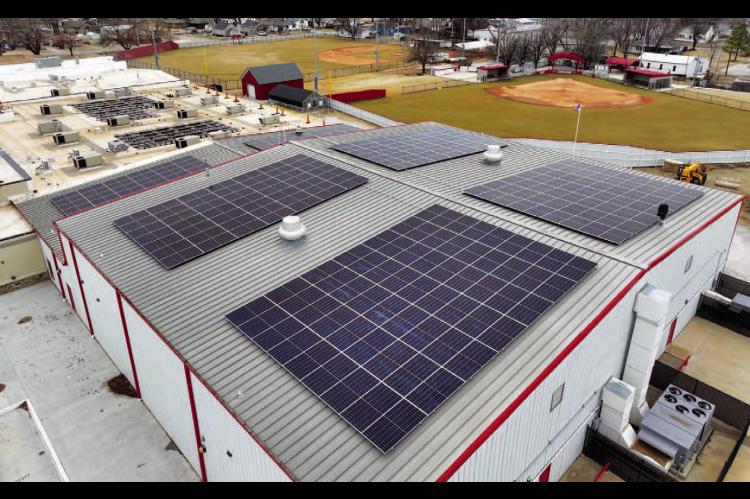
The project has been under construction at Dover since last October when the installation of a 335.5 kilowatt solar system began.
It includes 671 panels that are projected to produce 483,983 kilowatt- hours annually.
According to Brightwell, a solar capital partner based out of Oklahoma City that spearheaded the project with the school district, it’s estimated that the solar energy system will offset 87.46% of the school’s main facility energy consumption and generate $1,784,424 in projected savings over 30 years.
Brightwell also touts the environmental impact, stating the system “will reduce 755,352 pounds of carbon emissions annually, equivalent to planting 174,234 trees each year.”
“Reducing our energy costs and creating longterm savings allows us to reinvest more into our students and faculty,” said Wood.
Even more appealing to the school?
There are no upfront costs to the district.
How?
•••
The proposal was made about a year ago by Brightwell, which came to Dover with its tax equity investment model in which it finds “impact investors” to pair with schools and nonprofits.
Its model was made possible through the Inflation Reduction Act of 2022, which created $369 billion of uncapped money for solar development through 2034.
Investors use the incentives to transform taxes headed to the government into an investment that supports establishments like nonprofits, schools and churches.
“At Brightwell, our mission is to unlock generosity by enabling investors to repurpose their tax dollars and direct them into solar projects that empower schools like Dover,” said Tony Capucille, founder and CEO of Brightwell.
“Schools deserve energy solutions that save money and enhance student opportunities. This project ensures that dollars once spent on utility bills can now be reinvested into classrooms, teachers, and educational programs.”
Brightwell lists four requirements for its “impact investors.” They are:
• Desire to impact your community;
• “Hold” the project for six years in order to realize the value of tax credits and asset depreciation;
• Have active or passive tax liability to participate in order to fully leverage the tax incentives and benefits behind the model; and,
• Current, future or past tax liability.
It pairs those investors with entities that fit its model.
To determine if its a cost-efficient move to make, Brightwell runs the potential entities’ utility bills through its model, which allows its team of solar experts to develop a plan specific to its needs.
“They will make sure its a worthwhile effort,” Wood said. “Some schools looked into it and realized it wasn’t a good match for them.
“When they ran our numbers, they determined it was a good match.”
Brightwell executives met with Wood and school board members multiple times before the move got the green light.
“They answered all the questions we had,” Wood said.
Wood also talked with leaders at other schools, including Oklahoma Bible Academy in Enid, that have instituted the solar system.
Other entities that have used Brightwell to set up a solar powered system include the Hope House and Regional Food Bank of Oklahoma in Oklahoma City.
With all the data and the fact that Dover wouldn’t have to front any money - Wood said the deal appeared financially viable.
Dover became the first county school to sign on with the project, though Brightwell has been in contact with others, with Hennessey being the most recent.
A large portion of the solar panels are installed on the roof of Dover’s gymnasium.
There are also some on the roof of the high school and a smaller amount installed on the new elementary building.
According to Brightwell, the cost of systems the size of Dover’s varies due to a number of factors, including existing electrical infrastructure. The cost for systems that size can vary from $500,000 to $1.5 million if purchased outright.
The “impact investor” for Dover’s project currently opts to remain anonymous.
Wood said it’s projected the district will see a 15 to 20 percent decrease in energy costs in the first year.
“And every year after that, a little bit more,” he said.
And, after six years, Dover will have the option to purchase the panels from the investor.
“The investor gets all the tax credits and breaks for the first six years,” Wood said. “After those six year, they lose the incentives.
“At that time, we will have the option to purchase the solar panels at the depreciated rate. There have also been instances where investors have donated the panels after the six years.
“But, it also won’t hurt us to not purchase them. We just won’t get the full energy costs savings if we don’t.”
Wood said the lack of the financial commitment by the district was appealing when added to the potential energy savings.
“There’s no cost for us to try it,” he said. “Even if it doesn’t fully deliver everything they project, it’s not going to hurt us.”