
‘Challenging’ situation ahead for small grain crops in county
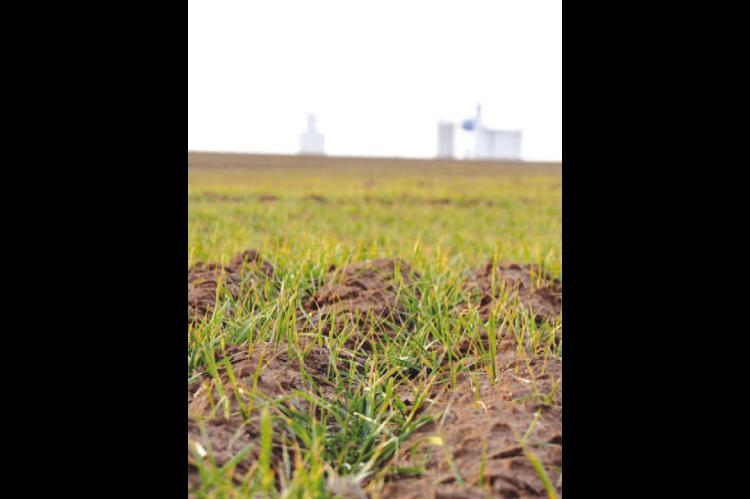
Kingfisher County Extension Director-Agricultural Educator Bryan Kennedy calls the county’s small grain crop situation challenging.
The hard freeze in late December stressed late-emerging wheat to the extent some fields appeared to be going backwards.
“It’s a challenge,” Kennedy said.
He added that a good rain or wet snow that stayed on the ground for awhile might turn the crop around.
Kingfisher County isn’t the only area hurting.
Kennedy said he received a report last week stating that 78% of the western United States is experiencing major drought, including Oklahoma, Kansas, New Mexico and western Texas.
Kennedy said he planned to check a field near Kingfisher that was sown on Dec. 5 to check the plant condition.
“If it’s tillered and we get rain, it could change overnight,” Kennedy said.
While the county has received a number of light showers during the late fall, it has not received the soaker that would definitely send the crop soaring, Kennedy added.
The USDA’s National Agricultural Statistics Service (NASS) reported: First Oklahoma Winter Wheat Condition Rating for 2023 Crop Rates 11 Percent Good to Excellent. Dry conditions this fall in the winter- wheat- producing Southern Plains are already taking a toll on the newly planted 2023 crop.
The High Plains Journal gave this summary for Oklahoma’s crop: Winter wheat condition rated 20% very poor, 23% poor, 41% fair, 15% good and 1% excellent.
The picture was dreary in other wheat-growing areas.
Colorado: Winter wheat condition rated 14% very poor, 46% poor, 40% fair, 20% good and 0% excellent.
Nebraska: Winter wheat condition rated 8% very poor, 11% poor, 45% fair, 33% good and 3% excellent.
South Dakota: Winter wheat condition rated 3% very poor, 6% poor, 60% fair, 30% good and 1% excellent.
Texas: Winter wheat condition rated 50% very poor, 21% poor, 20% fair, 9% good and 0% excellent.
New Mexico: Winter wheat condition rated 14% very poor, 33% poor, 26% fair, 19% good and 8% excellent.
Wyoming: Winter wheat condition rated 7% very poor, 26% poor, 49% fair, 17% good and 1% excellent.
Montana: Winter wheat condition rated 19% very poor, 46% poor, 21% fair, 14% good and 0% excellent.
About the only positive point for small grain producers is that market prices are holding up. A column in Southwest FarmPress by Kim Anderson reports: “The projected 2023 wheat harvest price (Medford, Okla.) is $8.25, but it has the potential to be as low as $6.50 or as high as $13.”
He adds: “While today’s price is the best predictor of a future price, the actual price at some future date will either be above or below the current price. The potential price range may be estimated by reviewing current supply and demand conditions and potential changes in supply and demand.
“Changes in the world’s wheat supply and demand conditions caused Medford, Okla., wheat prices to rise from $3.84 (August 2020) to $13.13 (March 2022). The $4 to $8 price increase was mostly driven by demand and was correlated with COVID. The price increase from about $8 to $13 was mostly driven by supply and was correlated with the Russian- Ukraine war.”
The supply of grain in 2023 is expected to determine price at harvest.
He added: “For the 2022-23 wheat marketing year, world wheat production is projected to be 28.6 billion bushels (Bb) and use is projected to be 29.0 Bb. For the third consecutive year, use is projected to be higher than production, and ending stocks are projected to decline from 11 Bb in 2019/20 to a projected 9.8 Bb for 2022/23.
“After Argentina and Australia’s 2022 wheat harvest (already included in current supply numbers), the next exportable wheat to be harvested is the 2023 U.S. winter wheat crop. Thus, the world’s tight wheat stocks situation probably won’t change until the U.S. winter wheat and the world’s 2023-24 crops are being harvested. This implies that wheat prices should remain relatively high into the summer of 2023.”
He predicted below average world wheat production could drive wheat prices up to $13, but said projected above average 2023 U.S. winter and world production could cause 2023 wheat harvest prices to be around $6.50.