
‘I just love being up in the air’
Longtime Army pilot Kale nears completion of 4th ‘home-built’ plane
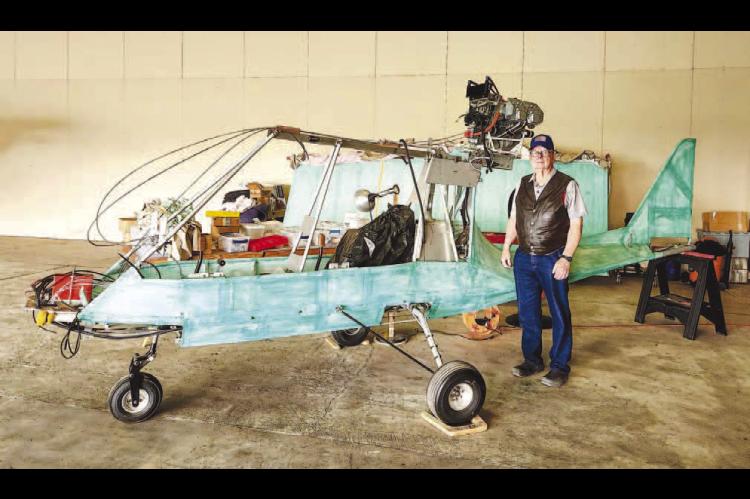
What began decades ago on a little grass airstrip north of Kingfisher led to a lifetime of adventures over three continents for Dover native Jim Kale.
At the time, the airstrip and a flight school were owned and operated by local aviation pioneer Irvin Bollenbach and his wife, Eloise.
As a young boy, Kale developed his love of flying from his father, Raymond Kale, who learned to fly on the G.I. Bill after World War II under the instruction of Bollenbach, a veteran Army flight instructor.
After graduating from Dover High School in 1963, Kale went on to obtain a bachelor’s in education at Southwestern Oklahoma State University, while also taking 30-minute flight lessons as he could afford them.
Earning his degree at the height of the Vietnam War, Kale said he was going to be drafted and wanted to enlist in the United States Air Force, but ultimately was accepted into the U.S. Army.
As a 28-year veteran Warrant Officer Pilot flying helicopters for the U.S. Army, Kale has flown missions around the globe including two tours in Vietnam, was stationed in Korea and Germany as well as many other places.
Now, he and his wife of 56 years, Georgia (Endres), have come back home.
His passion for flying is as strong as ever and most days you’ll find him at that same airstrip meticulously working on his fourth “home-built” airplane.
Years ago, the City of Kingfisher purchased the airstrip from the Bollenbachs and it has since undergone many upgrades, including the addition of a paved runway.
As an aviation enthusiast, Kale isn’t refurbishing an old aircraft…he’s essentially building a new one from the ground up.
Starting from a kit which supplies the basic aluminum framework, Kale said, “They build just enough of it that you can’t build it crooked or anything… the basic framework is there.”
The Excalibur is a Federal Aviation Administration approved experimental open-air (with front wind screen) aircraft with a tandem two-seat configuration and an 80 horsepower pusher engine which cruises at approximately 80 miles per hour.
“Most airplanes have an engine out front which are called tractor airplanes and pull the aircraft forward,” Kale said. “The pusher engine and propeller are mounted above and behind the wing and pushes the airplane forward.”
With a 34-feet wingspan and 20-feet-long body, Kale has covered the aircraft with Dacron fabric which he said was ironed down to shrink up taut and followed it with an application of primer called “dope.”
Currently, Kale is installing the wiring and will next apply the paint and complete a list of “small last-minute things,” before the plane is ready for flight, he said.
With the goal of creating high visibility, Kale said he’s not planning a designer-type paint job, but will cover it in an acrylic-based white paint with day-glow orange trim making it highly visible to other aircraft.
A type of acrylic paint which can be purchased at a local hardware store is approved by the FAA and is what Kale plans to use, but he said, “You don’t go down to Ace (Hardware) and buy bolts for this.”
“Where structure is important, you use aviation bolts which are not necessarily super strong, but are a known quantity,” he said.
With years of aviation experience in flying, maintenance and instruction, Kale said he researched this particular aircraft carefully.
“The FAA specifies what parts are required…this thing is not just something I came up with and built, it’s been engineered and there are many of these already in the air.”
He said there have been virtually no problems with this aircraft and any crashes that have occurred were likely due to individuals attempting stunts, which it’s not designed for, or running out of gas.
“As a life-long commercial pilot, I’ve never run out of gas,” Kale jokingly said.
Once all aspects of construction are complete, Kale said the plane must be balanced, moving the battery or other components as needed to achieve that aspect.
“The plane must be kept in balance or it won’t fly,” Kale said. “The passenger sits just below the wings and although the aircraft gets heavier with a passenger, the balance doesn’t change.”
With no intention of flying in the clouds, Kale said, he will have a small computerized flight system which will allow him to do so if necessary.
Before the “experimental aircraft” takes to the sky, it must first be inspected by the FAA to be deemed flight-worthy.
Upon receiving that certificate, the FAA also requires 40 hours of flight time in the aircraft by a licensed pilot, before a passenger is allowed on board, Kale added.
During his career in the military, Kale said he had the opportunity to fly through the Grand Canyon, over Niagara Falls, down the Riviera, missions in the Swiss Alps and lots of other experiences.
He also recalled flying at a low altitude along the Hudson River, past the Statue of Liberty, Central Park, over the Pentagon and even has a photo of him in flight within 50 feet of restricted airspace near the Washington Monument with the White House visible in the distance.
“I’ve flown all over this country,” Kale said. “You see things flying you’re just never going to experience any other way.”
In other service to his country, Kale said he flew supply missions on his first tour of Vietnam, medevac assignments in his second tour, primarily peacetime supply missions in Korea and later specialized in transporting nuclear warheads in varying locations throughout the globe.
“To me it wasn’t a job,” Kale said.
“Everywhere I went when I was flying, I loved it.”
On one of those missions moving nuclear warheads and operating out of a Greek Air Force Base, Kale said he observed crop dusters with what appeared to be military paint designations.
He discovered that the Greek Air Force is in charge of spraying the crops there and that general aviation is not allowed, which is the case in many other countries as well, he said.
“It’s interesting when you go places and don’t see a lot of civilian airplanes,” Kale said. “We have a lot of freedoms in this country a lot of people don’t realize.
“As a licensed pilot, on a clear day here in the United States I can get in my airplane and go from here to California or wherever I want with few restrictions.”
Achieving the highest rank of Chief Warrant Officer 5 (CW5), Kale retired from active duty in 1996.
He then went to work as a U.S. Army contract flight instructor for 10 years and a U.S. Air Force classroom instructor at the Army Aviation School for another eight years prior to his full retirement in 2016 at the age of 71.
Before returning to Kingfisher, Kale also volunteered at the U.S. Army Aviation Museum in Ft. Novosel, Ala. (formerly Ft. Rucker), where he also researched and developed various aviation programs, including one entitled “Flying the Presidents” which he presents to civic or social groups free of charge.
As a pilot in the Army, Kale said a medical exam is required every year in order to continue flying and commercial and civilian pilots also are required to pass medical exams in varying timeframes.
You’re always one medical exam away from having to change careers, he added.
“My whole life has been about aviation and I feel very blessed that I’ve been able to do this,” Kale said.
With over 15,000 flight hours under his belt, Kale put that number into perspective.
“There are 8,760 hours in a year,” he commented.
“I could tell you that I’m 78 years old and that’s correct, but I could also tell you I’ve been on this earth for 76 years, because I’ve been off of it for two.
“It’s something I really enjoy.” He and his wife have two daughters, Shelley, who is deceased, and Karen (Davenport) and husband Sean.
Serving in the military and moving from place to place can be hard at times, Kale said.
Reminiscing about his daughters, he recalled that they were like night and day when it came to the frequent relocating of military life.
He said Shelley was always ready and excited for the next move, but Karen preferred setting down roots in a familiar place and when she graduated high school in Delaware, she stayed there where she got married and has three daughters.
The Kales also have a grandson, Shelley’s son, who lives in Texas.
With his airplane approximately 90 percent complete and designed for warm-weather flying, Kale said hopes to be up in the air by fall.
Before it hits the runway, Kale said he’ll go over every nut and bolt at least twice to make sure everything is just right, because “when you’re up in the air it’s not like you can just pull over to the side of the road when something goes wrong.”
“I just love being up in the air,” Kale said.
“As a pilot, I was very fortunate. I got to fly 28 years active duty and I’m still flying as a private pilot today, so I feel blessed.”