
‘You work while there’s still sunshine’
Senator Lankford says country’s issues, while difficult and complex, aren’t too big to overcome during recent town hall visit to Kingfisher
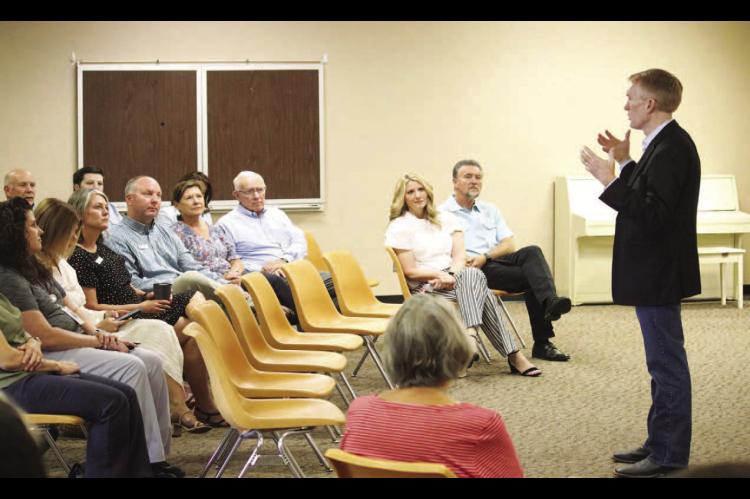
U.S. Senator James Lankford admits the present doesn’t always appear to be promising.
The Republican who has represented Oklahoma since 2015 cited a poll that asked Americans if the country is on the right track or the wrong one.
Of the respondents, 72 percent answered “the wrong track.”
Lankford, though, said he disagrees with people who say the track can’t be reversed.
Speaking Thursday to a group of about two dozen people at a town hall meeting setting at the Inter-Bank Community Room in Kingfisher, Lankford said he recently received a text message from someone that read: “It’s over. It’s done.”
The message was essentially referring to the current state of affairs in the country.
“I was like, ‘Really?’” Lankford told the group. “It’s like we’ve forgotten we’re Americans. We’ve been through lots of hard times and lots of difficult issues and we’re Americans and we figure it out.”
Lankford was joined at the meeting by his wife, Cindy, as well as Peyton Burns, one of his field representatives and also a Kingfisher High School graduate.
He was introduced by State Rep. Mike Dobrinski of Okeene.
“I don’t think we could ask for a better partner and leader to represent Oklahoma,” Dobrinski said.
As the country often finds itself in turmoil over a variety of issues, Lankford reminded the group that it’s nothing new.
He brought up the Civil War, multiple massive economic downturns, the civil unrest of 1960s and 1970s and more recent events.
“So my challenge to us around the Fourth of July is to pray more than we complain and get back to work, because we are going to figure things out,” he said. “We’ve been through tough elections before and we’ve been through time periods where we watched transitions on things.
“OK, we’re Americans. We’re going to figure this out.”
He took questions from the audience on issues that ranged from local to national to international:
Medical Costs and Care
“I’ve been working a lot on pharmacy benefits and management issues that hits independent pharmacists the most and it hits the consumers the most,” he said.
“Interestingly enough, when the Affordable Care Act passed and Obamacare Act passed, they didn’t deal with the pharmaceuticals at all. That is the power and the influence that pharmaceutical companies have on the Democratic senators and House members is they literally dealt with the price of medicine, but wouldn’t deal with the price of drugs at all.
“They just ignored that part completely. It’s a major part of the cost of healthcare for us firsthand. So, I actually have several bills that we just dropped on this that we’ve been working on. It’s incredibly complicated when you get into the drug marketing on how it’s actually done.”
Lankford discussed “tiering” that takes place in the industry between insurance providers and pharmaceutical manufacturers where companies try to force consumers to pay the same price for the generic drug as they do the original.
“So, I have a bill that’s going to fix that - that generic drugs have to be put on the generic tier,” he said. “They can’t go on the branded tier, when it’s actually a generic drug. That shouldn’t be rocket science, but that’s one of the ways that they actually (rig) the system on this. We’ve got a whole series of bills that we’re dropping out to be able to take on some of these loophole issues to try and get a lower price on the access of drugs.”
One of the hot topics has been the price of insulin, which Lankford said he’s been working on for several years now.
When quizzing leaders at the FDA, he was told it was against the law to create a “bio-similar” of a complex molecule such as insulin.
“So, there’s actually a law that prohibits that. I said, ‘OK, what do we need to do to fix that? How do we actually solve this issue of complex molecule and bio-similar?”
Lankford said that was six years ago.
“It takes a while for the companies to be able to go in and do the testing and do everything else on it,” he said.
“The first of those generic insulins will be on the market by this year and next year. That will drop the price dramatically for insulin to have a generic on the market competing against the branded.”
Border Security
“This is a fixable issue,” Lankford said. “It’s a mess right now, but it’s a mess of the administration’s design.”
He said millions have crossed the border.
“They will tell you in the border control, ‘The border is secure, it’s just secure on the south side not on the north side.
“You don’t cross from south to north without paying the cartels. You just don’t. I’ve been in that river in the patrol area and have literally seen the bodies of individuals floating face down in the river, because you do not cross the cartel on the south side. They’ll kill you. They’ll use your body as an example to everyone else.” During a recent trip, Lankford said he learned other disturbing news.
“They (border patrol) told me directly, just about two days before I was there, that they picked up a group of Russians and one of them actually pinged on our terror watch list,” Lankford said.
“So they detained him, but they had to release the others into the country.”
Lankford said he continues to attempt to address the issue, but will need bi-partisan help.
“So while there are lots of things I’d love to be able to do, I’ve got to get 60 people to agree to it,” Lankford said. “So I’m actively working, in fact I’ve got another call later on today and one yesterday, dealing with asylum, how do we process this, where can we meet people on the other side of the aisle to try to get to a point of agreement so we get something passed.
“We can’t just say it’s bad and we’re going to do nothing about it. We’ve got to say it’s bad, then what can we agree on so we can actually get it done?
“So, that’s an ongoing project.”
National Debt
“There’s a lot of folks that talk about we should have a smaller debt, but don’t want to do the work to actually do it,” Lankford said.
“You’ll hear a lot of talk about it, but there’s not a lot of effort.”
He relayed conversations he had with the two presidents prior to President Joe Biden, imploring them to work at reducing the national debt. Donald Trump, according to Lankford, told him during his presidency that with interest rates where they were, it was time to borrow, not put back.
“He could have made a bigger impact on that, but chose not to,” Lankford said.
In a similar conversation, he said President Barack Obama told him that he (Obama) wasn’t elected to reduce the deficit.
“It’s the nature of leadership,” Lankford said. “We’ve got to be able to do hard things. It has to be done. We’re $32 trillion and climbing in total federal debt. We have more debt than what we make as a country across the country with every single income combined. That’s a bad spot for us.”
Like most every major issue, it’s not necessarily a simple one to solve, said Lankford.
One way, he said, is changing the way the budget is created.
Lankford for several years has pushed for reform in the budget process, namely the issues caused by the Budget Control Act of 1974.
While the act was intended to create more transparency and provide Congress more input, Lankford has said it hasn’t been effective.
“It created a process so complicated and so slow, although it makes sense on paper, in legislative language, it doesn’t actually work here, and it pushes us into what’s called Continuing Resolutions or as commonly thrown around here, CRs,” Lankford said on the Senate floor in 2018.
“We have a major problem with the way we do budgeting.”
Fixing it won’t be easy... or fast, he told the audience in Kingfisher.
“For me, this is a generational issue,” he said.
“It’s going to take years of hard votes to actually solve it. But it does need to be done, because we’ve got to change the trajectory.”
Election Integrity
While the legitimacy of some presidencies have been called into question, Lankford said there’s no doubt the nation is seeing progress.
“We are literally getting better every election at this,” he said, when asked about voter fraud and other instances that have led some to question the true outcome of elections.
Lankford recalled the 2000 election controversy when George W. Bush defeated Al Gore, but not before “hanging chads” on ballots in Florida became a part of the national lexicon.
“No one uses that election system anymore,” he said of those types of ballots. “No one.”
Lankford said there will always be people trying to cheat elections and “we’ll always be chasing this.”
But, he said, the progress is there.
“Our elections are better now than what they were in 2000, they’re better than what they were in 2016, they’re better than what they were in 2020.”
Lankford said that’s the case in most every state, mostly because political parties - leary of being cheated - are engaging more and are physically there to watch the processes take place even more.
The issue of the alleged widespread fraud in California was brought up, but Lankford said - in a national election - that state and its electoral votes are going to go to a Democrat.
“It’s going to be the fight over Wisconsin, Michigan, Pennsylvania, Ohio, North Carolina...that’s where the presidential election is going to be determined,” he said.
“So my focus is what Wisconsin is doing, what Michigan is doing, what North Carolina is doing.”
He brought up recent major oversight changes in Kentucky, which he calls progress for the good.
“There are a lot of positive things that are happening,” he said. “That we’re continuing to get better.”
Changes include moving away from systems that allow for outside interference.
Oklahoma uses paper ballots.
“As a matter of fact, our system in Oklahoma is one of the best systems in the entire country,” he said.
Broadband Infrastructure
Among those in the audience was Pioneer General Manager Blake Callaham.
Callaham thanked Lankford for “all your support of rural telecommunications in Oklahoma.”
Callaham pointed out the recent announcement that Oklahoma will receive nearly $800 million in federal funds through the Broadband Equity Access and Deployment (BEAD) program.
That announcement was made by the Oklahoma Broadband Office, which is headed by Mike Sanders of Kingfisher.
Callaham asked Lankford his thoughts on the prospects of continuing the Universal Service Fund, which is designed to assure that all Americans should have access to communications services.
Originally, those “services” were telephone services, but the scope has been expanded in the years since it was created.
“I think we’re going to keep it for a long time and it’s going to continue to be used not only for phone service, but for the broadband piece as well.
“I just don’t see it going away.”
Lankford said a key in the USF “is to ensure that it’s universal service.”
He noted people in larger, urban areas were pushing for more options in broadband service.
“My push has been that everyone needs to get their first option first,” he said.
The OBO has been tasked with ensuring 95 percent of Oklahomans have reliable broadband service within the next five years.
But, again, it’s not always easy.
Lankford told the story of being in Kenton, which sits on the far western edge of the state’s panhandle.
He was reviewing a company’s plan to get fiber to its customers and noticed a red pin on the map and inquired about its meaning.
“That’s the last house we’ll get to,” he was told.
“It will cost $10 million to get to that house.”
There are similar scenarious across the state that offer roadblocks in delivering broadband services.
Isolation and terrain are among them.
Lankford said at some point, satellite connections may prove necessary for some residents, even if temporary.
“At what point do we start focusing on getting that house on satellite connections knowing that it’s secondary to having broadband?
“We’re still unresovled on that issue. How do we get assistance for satellite there while we’re still laying fiber?
“It’s going to be a while to get to that house in Kenton.”
Other Topics
Lankford was also asked about the attempted coup in Russia among other things.
After offering his thoughts and facts on a wide range of topics, Lankford was asked how he balances and prioritizes his workload.
“He doesn’t sleep,” offered his wife.
Lankford said - in the grand scheme - his time in Congress will be short.
“This is my responsibility. I take this task seriously,” he said. “While you have that, you should be wise with both the time and responsibility you’re given and there’s 4 million people counting on me to actually study and do my work.”
Lankford later paraphrased a verse from the book of John.
“You work while there’s still sunshine,” he said. “And we’ve got to get some work done.”
He referred back to his opening comments about being able to get back on the right track.
“We’re not too far gone, so let’s get to work,” he said. “We’ve got hard issues we’ve got to work on. A lot of these issues are issues we didn’t personally do. They landed on our desk.
“Let’s go figure it out. We’ll get through this.”