
Decisive wins from national to local level
Trump swings battleground states to reclaim presidency; 1 of 3 justices narrowly voted out
No delay.
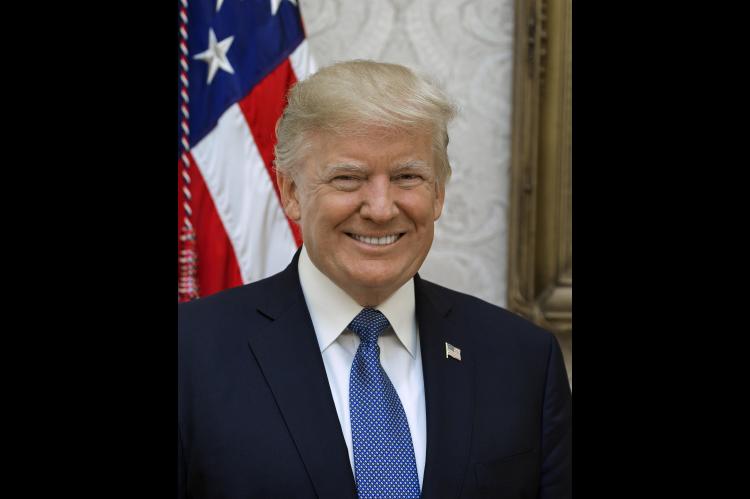
No recount. No doubt about it. Republican Donald J. Trump will return to the offi ce of President of the United States after a resounding victory over Vice President Kamala Harris in last Tuesday’s general election.
Trump, the 45th U.S. president after winning the 2016 election who was unseated in 2020 by Joe Biden, will be sworn in as the 47th president on Jan. 20, 2025.
Unlike his win in 2016, Trump not only gained the presidency with the Electoral College, but is also going to win the popular vote.
While final votes were still being tallied at press time, Trump and running mate J.D. Vance had garnered more than 72,669,000 votes to just over 68,012,000 for Harris and Tim Walz.
Trump’s victory was established in the early-morning hours Wednesday when he was declared the winner of Pennsylvania, one of seven “swing” states in the election.
Those 19 electoral votes put Trump over the 270 needed to win.
Of the seven battleground states - Arizona, Georgia, Michigan, Nevada, North Carolina, Pennsylvania and Wisconsin - Trump won five of them.
Votes were still being counted in Nevada, where Trump is currently projected a narrow winner, and Arizona, which is still considered a toss-up.
In 2020, Trump lost all of those key states except North Carolina.
There was no drama in 2020 or 2024 in Oklahoma.
Once again, Trump carried all 77 counties.
He collected 1,035,217 votes (66.17 percent) to Harris’ 499,043 (31.90).
Independents Robert F. Kennedy Jr., who endorsed Trump after being placed on the ballot, Chris Garrity and Libertarian Chase Oliver accounted for the remainder of the 1,564,573 votes cast in the state.
Trump’s support in Kingfisher County was nearly 20 points higher than the state’s total.
Of the 6,752 votes cast in the county, 5,743 of them or 85.06 percent - went to the president-elect.
Harris picked up 923 votes, or 13.67 percent.
Another hot button issue in Oklahoma this election cycle was the retention of three state Supreme Court justices.
And, for the first time in Oklahoma’s history, one of them was voted out.
Voters chose to oust Yvonne Kauger, 87, who was appointed to the seat by Gov. George Nigh in 1984.
There were more than 1.4 million votes cast, but Kauger only received 49.76 percent approval.
Two other justices narrowly kept their judgeships.
Justice James Edmondson (District 7) and Justice Noma Gurich (District 3) were retained.
Edmondson was able to pick up 51.01 percent “yes” votes while Gurich’s was a closer 50.26 percent.
County voters were in favor of ousting all three. of the 6,378 who marked their ballot on her District 4 judgeship, 63.19 percent moved to vote out Kauger.
Gurich only received 37.51 percent approval in the county while Edmondson had 39.13 percent approval.
The issue brought in a lot of outside money leading up to the election.
At least two political action committees (PACs) ran ads encouraging voters to vote “no” on all three justices, labeling them as liberals.
Gov. Kevin Stitt, who ultimately will select Kauger’s replacement, also voiced his support to remove the justices.
A 15-person Judicial Nominating Commission will narrow Kauger’s list of possible replacements to three people before Stitt makes his selection from that trio.
All other judges on the ballot - three on the Court of Criminal Appeals and six on the Court of Civil Appeals were retained.
County voters disagreed on one judge in each court.
For the Court of Civil Appeals District 5-Office 2 seat, Robert “Bobby” Bell only picked up 49.01 percent approval in the county.
Bell, who was appointed by Gov. Brad Henry in 2005, received 58.75 approval statewide.
County voters only gave David B. Lewis, who sits on the Court of Criminal Appeals District 5 bench, 49.79 percent approval. He was retained with a statewide vote of 59.11 percent. Lewis also was nominated by Henry in 2005.
One state question was resoundingly shot down while another was overwhelmingly approved and Kingfisher County reflected the state’s wishes on both.
Voters rejected State Question 833 as 61.61 percent of the 1.46 million votes cast on it going against it.
The measure would have amended the state’s constitution to allow cities to create public infrastructure districts and authorize property taxation authority.
In the county, 66.33 percent of the 6,413 votes cast said “no” to the measure.
Meanwhile, SQ 834 received approval of the 80.73 percent of the 1.49 million votes.
This measure replaces “all” with “only” in the article of the state’s constitution regarding voting. It will now state “…only citizens of the United States…” can vote.
In Kingfisher County, 88.23 percent of the 6,544 votes cast were in favor.