
Drought conditions improve
May, June, July rains have county drought-free, at least for now
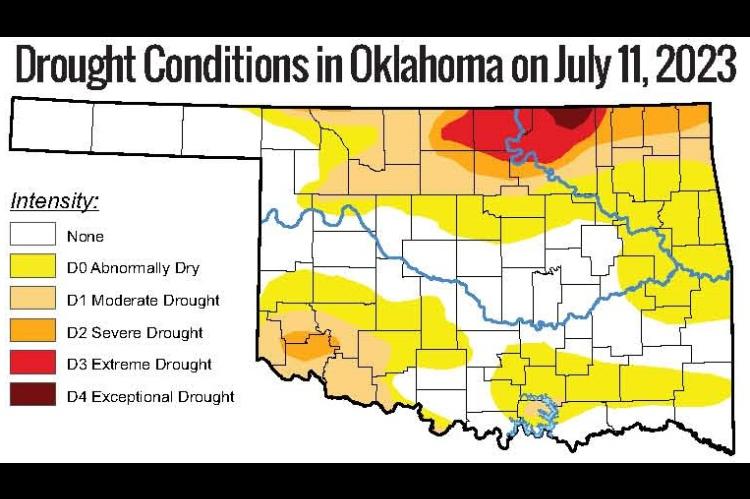
It’s sweltering hot in Kingfisher County this week, which is nothing new for the third week of July.
What is new, however, is that the grass is green and the ground isn’t cracking from extended dry periods.
That’s because the end of April and beginning of May sparked a massive turnaround in Kingfisher County’s drought outlook.
The U.S. Drought Monitor each Thursday releases data concerning drought conditions across the country. That data can be broken down to the county level.
On April 25, that data showed 100 percent of the county fell into the D3 category.
Categories on the monitor range from D0 (abnormally dry) up to D4 (exceptional drought).
D1 is moderate drought, D2 is severe drought and D3 is considered extreme drought.
Every inch of Kingfisher County had been in at least the second-worst category (D3) since Oct. 18, 2022.
It was during September 2022 when the county’s outlook started to trend in that direction.
On Aug. 30, 2022, only 10.23 percent of the county was in D3.
On Sept. 6, it jumped to 52.38 percent.
By Sept. 27, it was 95.80 percent.
Some parts of the county had it worse than others.
From Sept. 27, 2022, until Feb. 7, 2023, the monitor showed 44.1 percent of the county in the D4 category, the most extreme of drought categories.
February moisture dropped the county out of D4 by the second week of that month, but 100 percent of the county still remained in D3.
That began to turn around in late April.
City-County Emergency Management Director Steve Loftis reported 2.28 inches of rain in Kingfi sher in April.
Of that, 1.78 inches fell April 26-29.
That trend continued into May.
By the end of the month, Kingfisher had experienced 8.31 inches of rain.
In the May 30 U.S. Drought Monitor Report, none of the county was in either D3 or D4 while only 56.23 percent was in D2.
It was the second straight week of those percentages.
Nearly four more inches of rain fell in June and, so far in July, we’ve seen nearly nine more inches.
In last Thursday’s report, 38.76 percent of the county was experiencing no form of drought while the rest of the county was abnormally dry (D0).
That’s the first time since Sept. 14, 2021, that at least a portion of the county was not in some form of drought.
To date, Kingfisher has recorded 25.86 inches of rain in 2023.
Just 22.32 inches was recorded in all of 2022, including 0.37 inch last July.
A year ago, more than 62 percent of the state was experiencing some form of drought while none of the state was in an exceptional drought.
At the start of 2023, that number was up to 89.73 percent experiencing some form and 11.65 saw exceptional drought. On April 11, more than 53 percent of the state fell in the D1-D4 range with 16.53 in that D4 category.
Now, only .42 percent of the state is in D4 while 43.04 percent has no form of drought.
As always, that could quickly change.
The Climate Prediction Center releases monthly “seasonal drought outlook” discussions.
Included in the forecast for the southern region, which includes Oklahoma is a line that says “several weeks of hot, dry conditions are favored to overspread Texas and Oklahoma, which would promote rapid drying of soils.”
According to the U.S. Drought Monitor, here are some of the historic impacts of the different categories of drought:
D0 - Crops are stressed; winter wheat germination is delayed; stock pond levels decline
D1 - Lake recreated activities are affected; deer reproduction is poor; seasonal creek and rainfed pond levels are lowering; summer crop and forage yields are reduced; wildfire risk increases
D2 - Burn bans begin; cattle are stressed; dryland crops are severely reduced; pasture growth is stunted; springfed ponds are slow to refill; trees show significant wilting
D3 - Air quality is poor, with dust storms and smoke; cattle have little water and feed; fishing is down; boating is hazardous with low lake levels; game bird populations decline; grasses are dormant and hay is nonexistent; planting is delayed; fields are spotty; emergency CRP grazing is authorized; lakes are critically low; producers are hauling water for cattle; wells are drying; wildfires are increasing in number and severity
D4 - Burn restrictions increase; cost of hay and water is high and supplies are scarce; producers are liquidating herds; fire season is long; rural fire departments are running out of finances; ground is cracking; farmers are bailing failed crops or abandoning fields; pastures are bare; land is abandoned; ranchers and farmers are desperate and experiencing huge economic loss; water lines are breaking; reservoir levels are nearing intake; mandatory water restrictions are implemented; water quality is poor.