
Earthquakes shake Dover residents
Area fracking operation shut down indefinitely, OCC spokesman says
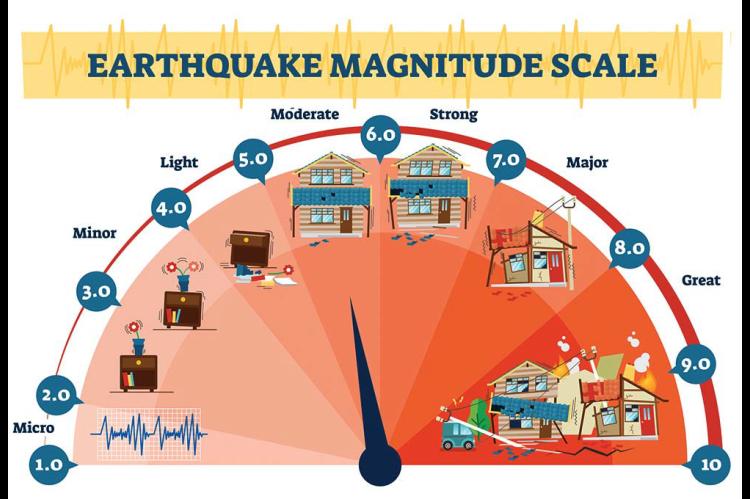
An Oklahoma City based oil and gas production company has shut down fracking operations at a site southeast of Dover after mitigation steps failed to stop a series of induced earthquakes.
Canvas Energy Inc. (formerly Chaparral) “did several (fracking) pauses and took other mitigation steps during about a four-day period” before halting operations indefinitely after a 3.1 magnitude quake Wednesday evening, Matt Skinner, public information manager for the Oklahoma Corporation Commission, said.
Beginning Sept. 29 and continuing through Friday, more than 30 earthquakes were recorded by the U.S. Geological Survey in an area centered about two and a half miles southeast of Dover.
The earthquakes have varied in intensity from 1.1 to 3.4, which is strong enough to cause noticeable shaking of objects and furnishings inside houses.
The largest cluster so far included 14 quakes recorded between 6 a.m. and 6 p.m. Sunday, ranging in magnitude from 1.1 to 2.6.
The quakes have been recorded at depths of two to five and a half miles.
Skinner said that Canvas had access to seismic sensors, required by the OCC’s Induced Seismicity Department for all fracking operations, and paused operations several times when seismic activity was detected, according to ISD protocol.
“Some of the events occurred when Canvas was paused,” Skinner said Friday morning. “After a 3.1 quake on Wednesday evening, Canvas halted operations and ‘rigged down,’ meaning removal of hydraulic fracturing equipment.”
While Canvas is continuing to put wells into production where fracking has been completed, “the shutdown of well completion operations is indefinite, and the understanding is that hydraulic fracturing will not be resumed without approval of the Induced Seismicity Department,” Skinner said.
However, earthquakes are continuing even after the shutdown, with at least two strongly-felt events and several smaller quakes recorded as of Friday morning.
“Pending further research, these events are being viewed as aftershocks,” Skinner said. “There is no other oil and gas activity in the area that would account for those quakes.”
The sharp seismicity increase in Oklahoma during the last decade largely has been associated with oil and gas wastewater disposal, according to the journal Science.
Such induced quakes have become less common since the OCC adopted mitigation protocols.
So far this year, only nine earthquakes of magnitudes between 3.0 and 3.5 have been recorded, according to USGS.
The most powerful event was a 4.5 magnitude earthquake northwest of Medford in late January.
Dover resident Beatrix Barr brought the most recent earthquakes to the attention of the Times & Free Press, noting in an email Friday that “some have been strong, shaking houses.”