
Growing up in the County Jail
Demolition triggers memories for sheriff’s child
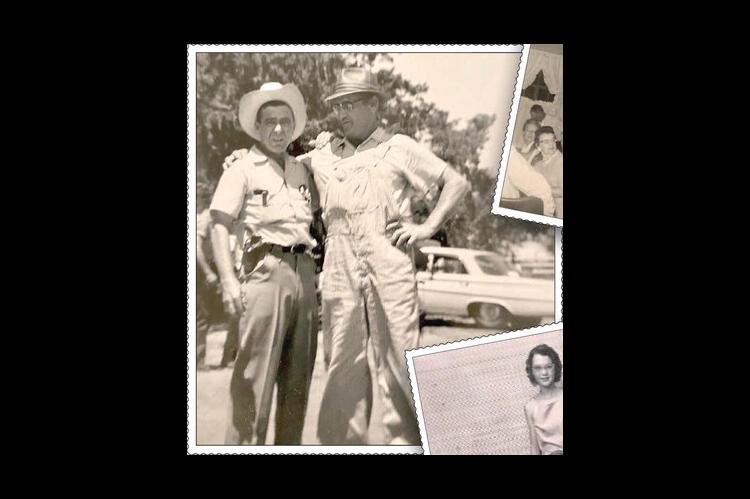
The empty lot where the old Kingfisher County Jail used to sit might be a welcome sight for the thousands of men and women who found themselves involuntarily housed there over the course of its 87-year-history.
But for the facility’s youngest and longest term resident, watching the month-long demolition of her childhood home was a bittersweet experience.
“Definitely a different time back then,” remembers Debi Trout of the nearly five years she lived in the jail from age 9-14. “Watching the jail come down was like putting a chopping block on my childhood because it’s just gone. That era of innocence will never come back.”
Trout’s parents are the late C.J. “Chod” Kelly and Vivien Kelly Vincent, who lived in the jail with their young daughter while they served as sheriff and jail matron, respectively, beginning in 1960.
(Their older daughter, the late Wanda Claunch, 12 years Debi’s senior, was married and living out of the home by that time.)
Kelly, who was a farmer and worked as a motor grader operator for the county before being appointed to succeed retiring sheriff Miles Williams, moved with his wife and little Debi into a small room on the ground floor of the jail in November 1959.
“It was one room and a bathroom and was originally intended for the night jailer,” Trout said. “The book-in room was right outside and the drunk tank was right next door.”
In addition to serving as jail matron, Mrs. Kelly cooked meals for the jail inmates and ran the dispatch radios at night.
Debi, then just 9, also learned to run the radios, push food trays through slots in the cell doors and operate the jail’s system of locks, which she said were state of the art, even in the 1950s.
“Absolutely everything we had done up to that point, we did as a family,” she said, including farming (where her mom taught her to sew in the cab of a wheat truck) and living at a boys’ home near Perkins, where her parents served as house parents.
“We just naturally treated Dad’s job as sheriff and running the jail the same way,” she said. “We were all in. Everything our family did, we did together.”
Kelly served as an appointee until November 1960, when he won election to his first full term as sheriff, with his daughter helping with door-to-door campaigning.
Meanwhile, Kelly built a larger apartment for his family (in the area where the jail’s administrative offices would eventually be located) with a large living room, bathroom and bedroom on one floor and a kitchen (which also served as the jail kitchen) and another small room with a window seat upstairs.
“It was still adjacent to the drunk tank,” Trout said. “And the upstairs window seat is where my mom would send me to practice my bassoon.”
The jail had more of a “Mayberry RFD” vibe back then – including a jailhouse “regular” who would call the sheriff to say “Chod, I’m drunk. Come get me.”
“I had the run of the place and I never felt unsafe,” Trout said. “Kingfi sher in general felt much safer back then.”
But at the same time, Trout’s tiny staff – consisting of an undersheriff and two deputies – had plenty of crime to keep them busy.
“It was the oil boom and the county was bursting at the seams,” she said. “People were paying locals money to sleep on their couches because there was no available housing.”
Active brothels, moonshine operations, cattle and oilfield thefts kept the jail hopping, along with federal prisoners who were frequently housed there temporarily, she said.
“Sometimes we had as many as 50 inmates and my mom had to feed them on $1.50 a day,” Trout said.
The Kellys never put their daughter at risk, but “they were always open and honest with me about what was going on,” she said.
“It was kind of like living in a ‘Scared Straight’ program because I saw people at their worst and knew I didn’t want to end up like that.”
But Trout said she also learned compassion and respect, watching her “small, feisty Irishman” of a father relate to the prisoners in his care.
“Dad was an ornery kid and I don’t think he ever forgot that,” she said. “He believed in second chances and had to be a counselor a lot of times.
“I also saw a side of policemen that people don’t talk about now – that drive to do what’s right, even if it’s not what’s popular.”
When Kelly took over the sheriff’s office, he discovered the county’s only black deputy was paid considerably less than his white colleagues – just $50 a month.
“He was a hard worker and Dad got him a raise to $150 a month,” she said.
Her regular interactions with inmates also taught Trout to see the good in people struggling to overcome alcoholism and other addictions.
“I took art lessons from a guy named Cueball Brown, who was serving a longhaul county sentence of six or nine months,” she said. “Dad bought a masonite board and I would sit outside Cueball’s cell and he would teach me to draw.”
Other prisoners did beadwork and other intricate handmade crafts, which Trout frequently purchased as gifts for his daughter.
She still has a pair of beaded moccasins made by a female inmate – one of the last local artisans who practiced the traditional craft – as well as charcoal and colored pencil drawings created by other prisoners.
All things considered, Trout described her family life in the jail as “pretty normal.”
She kept a pet dog there, frequently had friends over for sleepovers – including her good friend Sheila (Schwarz) Diesselhorst.
“We were birthday twins and we celebrated our 12th birthday with a dance with our classmates in the jail basement,” she said. “I think my friends would say they loved coming to visit me in the jail.”
That followed her 11th birthday, which fell during a roadtrip to pick up two prisoners in California in the family car – which also was the sheriff’s car, equipped with lights and sirens.
Debi and her mother went along on the trip and they all stopped for a roadside birthday picnic on the way back – including the two young prisoners.
Those fond memories outnumbered the rare times when Trout felt scared in the jail.
“Once we had a guy on hard drugs in the drunk tank who pulled all the plumbing out of the walls,” she said.
Operating the jail was such a family affair that when Trout’s dad died from a massive heart attack while transporting a prisoner in November 1963, her mother was offered the sheriff’s job.
She turned it down and took a job at a local bank, but remained on for a time as the jail’s matron.
“We joke that she was probably the only person in town who ever had keys to the bank and the jail at the same time,” Trout said.
Debi and her mother stayed on in their jail apartment through the summer of 1964 so that Debi could finish out the year at Kingfi sher schools before they returned to the family farm east of Dover.
Once she moved out, Trout never returned to the jail until her son Chod, a sergeant at the Kingfisher Police Department who is named for his granddad, brought her back to tour the aging facility before the demolition began in November.
“Everything had changed so much, but the cells were still the same and the booking room was in the same place,” she said.
“Watching the jail come down made me sad in a way, but it also reminded me about what wonderful parents I had and my wonderful childhood being raised by such caring, godly people,” she said.
“I wouldn’t trade any of it.”