
Harvesting in Hauser Family’s ‘Genes’
Unwilling to ‘sit down,’ 95-year-old hits the fields when it’s time to work
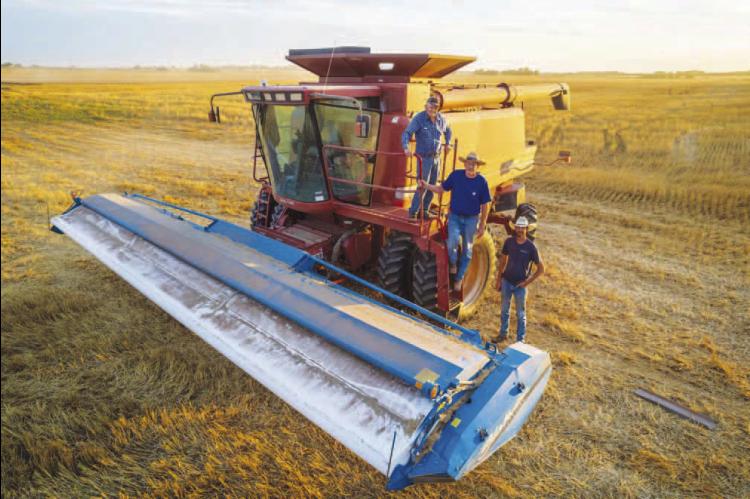
At 95 years old, he’s passed the torch to his son and grandson...well sort of.
A wheat farmer for almost all his life, Gene Hauser no longer farms the acreage he grew up on northeast of Omega.
Though he and his wife, Nan, still live on the homestead, his son, Doug, farmed it for awhile, then Doug’s son, Brian, took over his senior year of high school and has been farming the family land for almost 10 years now.
That doesn’t mean Gene is spending his days at the lake or golf course though... or given up farming altogether.
When the fields turn that golden hue and it’s time to fire up the combines and roll out the wheat trucks, Gene can’t just sit back and watch.
You can still find him behind the wheel of a combine helping his son and grandson harvest approximately 1,300 acres of wheat, canola and triticale (a hybrid of wheat and rye).
Some days he might put in six hours and others he’s in the field all day long, his wife, Nan said.
Involved in the harvest since he was a child, Gene recalls the early days of his father threshing wheat on the homestead, progressing to a pull-type combine, then a self-propelled combine.
“I grew up in the harvest back when they were using the threshing machine and my mother cooked for the harvest crew…back in ’35 or ’36, I would have been 6 years old,” Gene said.
Toward the end of the decade, and the beginning of World War II, Gene said his father bought his first combine.
“It was a pull-type combine with an engine on it and you would pull it along with a tractor,” Gene said.
Holding the responsibility of tractor operator at the age of 12 years old, Gene said, “To this day, I can still hear my dad telling me to speed up or slow down.”
As self-propelled combines began to be manufactured during the war, Gene said his dad purchased a Massey Harris in 1947, the year he graduated from Omega High School.
“That year we went custom combining in Monument, Kan., and the first job we had, we made enough money to pay for the combine, but it was tough cutting that year,” he said.
With two years of college under his belt, one at Oklahoma State University (then Oklahoma A&M College) and the other at Cameron University, Gene enlisted in the U.S. Navy during the Korean War.
After four years of service to his country, Gene returned home in 1954 and began his own farming operation.
“In the ‘50s there was a terrible drought and I still remember going down Main Street in Kingfisher and, when the dirt storms would come in, you couldn’t see a city block,” Gene said.
“It was so dry and the crops had thistles…my first year I didn’t have a very good crop,” he added.
That led to his landing a second occupation as a rural mail carrier, in which he would later retire with 32 years of service.
“I started carrying mail in January of 1956 and I still remember my salary was $4,044,” Gene said.
During that time, Gene carried mail primarily for Omega, with a couple of years on a route east of Kingfisher and two years in Stigler from 1976 - 78.
“Gene would get up to carry mail early, then come home about 2:30 p.m., take a 15-minute nap and then go farm,” Nan said.
Always farming wheat and raising stocker calves, Gene said, “Wheat is all I’ve ever known and what I enjoyed most were sowing and the harvest.”
With a successful crop always at the mercy of the weather and various other factors, Gene said even when the crop fails the Lord has a way of providing.
“My dad never had hail insurance, but the good Lord has a way of making up for it,” Gene said.
“When my dad would have a crop failure, he would plant a summer crop of something like milo. A lot of times if he had a bum wheat crop he would have a good milo crop that would offset it.”
In the earlier days, Gene said 18 bushels an acre would be considered a good wheat crop.
“In my dad’s day, they didn’t use fertilizer and the only people that could raise a 40-bushel crop were those who had creek bottom land,” he said.
Gene said he always had a goal to bring in a 40-bushel crop and he recalled a friend telling him about a really good wheat variety, Jagger, and that he should give it a try.
Being a little tight with his money, as he puts it, Gene said he only wanted to plant enough to get a start, but his friend loaded him up with a full load (which cost him a good bit) and it turned out to be his best crop ever.
“It was always my goal to make 40 bushels and he did me the biggest favor that year….I made 42 bushels an acre,” Gene said.
Happy that his son and grandson are continuing the family farming legacy, Gene said they’ve got it in their blood.
And they still rely on the patriarch of the family for his wealth of knowledge and experience.
“The guys are always asking Gene for advice,” Nan said. “They depend on him.”
Reflecting on the years past, Gene said he never expected to live this long and he partially credits that to his son, Doug.
“He’s probably part of what’s kinda kept me alive as long as I have been,” Gene said. “He keeps telling me, ‘Dad you can’t sit down’ and I know he’s right.
“I’ve seen too many guys retire and sit down, then they don’t live very long.”
As with most farming families, harvest time has always been a family affair for the Hausers. In the earlier years, Gene and his late brother Keith worked together to bring in the harvest alongside their families as they ran machinery, drove wheat trucks to the elevator, cooked meals, made trips to town for parts and a host of other tasks.
With the legacy continuing today, Gene said, “Everybody’s got a job and you do that job and do it well.”
As this year’s wheat harvest winds down, Gene said it’s been a good year with yields ranging from 40 to 70 bushels an acre.
When questioned about why he still puts in hours in the field during harvest, Gene said, “It’s in my blood.”
Chiming in, Nan added, “He can’t stand not to be out there.”
Married for almost 64 years and still living on the family homestead, Gene and Nan have three grown children, John (Filese), Doug (Karen) and Diana (Darren) Heusel, eight grandchildren and 17 great-grandchildren.
“Its been a good life on this farm with my husband and all of our children and family,” Nan said. “We’ve been blessed and the good Lord has been good to us.
“If I had to do it over, I’d do it the same.”
In agreement, Gene said, “I would too.”