
The heat is (still) on
And so are the worst drought conditions in 4 years as temps remain high and rain totals next to nothing
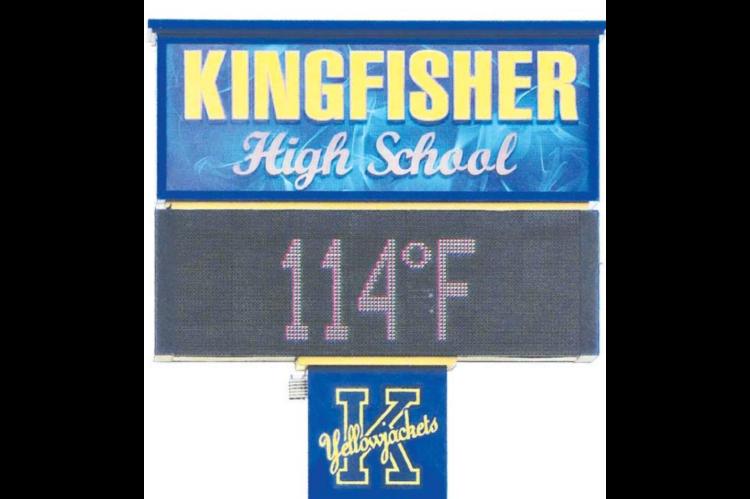
The drought of 2022 is in full swing in Kingfisher County.
Kingfisher County Oklahoma State University Extension Director/Agriculture Educator Bryan Kennedy said he gets calls every day for people looking for hay to purchase.
So, it’s not just Kingfisher County that’s affected.
He recalled a recent call where a stockman in eastern Oklahoma bought the entire cutting of a bermudagrass field in Kingfisher County at a price of $125 per bale – in the field.
Cattlemen in particular are behind the eight ball, said Kennedy.
Many are going to have to consider selling their cattle due to lack of pasture and lack of hay, Kennedy speculated.
Producers have been cutting waterways in their cultivated fields to get some hay.
The only cure will be a widespread rain, Kennedy said.
The immediate forecast calls for more hot, dry days.
The last week has featured blistering heat, including a high temperature of 113 degrees on Tuesday, bringing an excessive heat warning from City-County Emergency Director Steve Loftis, who advised staying under the air conditioner, if possible, especially for older residents, and drinking plenty of water while being aware of signs of heat-triggered disability.
Local residents are recalling the drought years of 2011-12, a prolonged period of high temperatures and low precipitation.
The National Weather Service stated Thursday:
2011 will go down in the record books as being one of the hottest and driest summers in history for the Southern Plains. Extremely hot and dry conditions plagued the region, with numerous all-time high temperature records broken, along with record drought conditions across much of the region.
The prolonged heat and drought had drastic effects on the region’s agriculture and farming communities, as well as causing numerous wildfires and heat-related illnesses and deaths.
The National Weather Service added:
Dangerous heat (was forecasted) to continue impacting portions of the southwestern, south-central, and eastern U.S.
Loftis, local weather observer, recorded only .01 inch of rain Thursday, bringing the July total to .26 inch, not enough to make a difference.
It will remain quite warm and humid across much of the region, with heat advisories continuing to cover portions of eastern Oklahoma and Texas, as well as much of the lower Mississippi and parts of the Tennessee valleys.
Temperatures are expected to remain above average through the period, with daytime heat indices expected to climb above 100 degrees across much of the region each day.
In fact, Loftis reported late Friday morning that a heat advisory was in effect from noon to 8 p.m. on both Saturday and Sunday (July 23 and 24).
Heat index values were expected to reach 106 on Saturday and then 108 on Sunday, according to the report issued by Loftis.
Kennedy said the impact of the drought could have a lasting effect as pastures will take time to recover.
He said a wet fall would be necessary to recover from the current drought.
An article in the Journal of Applied Meteorology and Climatology had this comment:
“The 2011 drought over this region Southern Great Plains (which includes Oklahoma) is a prime example, with the state of Texas experiencing its driest year since 1895, when modern precipitation record keeping began …The 2011 drought continued into 2012 and 2013…According to the National Climatic Data Center (NCDC), the cost of the 2011 drought and excessive summer heat over the SGP is estimated at $12 billion, with 95 human deaths reported.”
The National Weather Service added:
After about 30 years of above-average rainfall, Oklahoma is three years into a drought that could rival the dry years of the 1950s.
Depleted topsoil and subsoil moisture reserves are being reported across the Midwest. The U.S. Department of Agriculture’s Weekly Weather and Crop Bulletin showed topsoil moisture 74% short in Oklahoma (Kansas 62%, Texas 84% and Arkansas 90%).
About 90% of Oklahoma was in a drought at the beginning of 2022, according to the National Drought Mitigation Center.
Three months ago, 72.7% of the state was experiencing “moderate drought” or worse.
The week of July 12 saw that number dip to 62.75%, but in the last two weeks, it has soared.
Now, 99.69% of the state is considered to be experiencing at least a moderate drought.
Kingfisher County has portions in both the moderate and severe drought categories.
The U.S. Drought Monitor, started in 2000, showed the longest duration of drought in Oklahoma lasted 239 weeks beginning on November 2, 2010, and ending on May 26, 2015.
The current drought conditions are the worst since February 2018, according to the U.S. Drought Monitor.
Several warnings were issued about burning.
Kingfisher County Commissioner Heath Dobrovolny said the county will look at possibly issuing a burn ban during its weekly meeting Monday.
A wildlfire in Blaine County burned ove 10,000 acres starting late last week and contining into this week.
While 2011 will go down as one of the hottest and driest summers in history, local residents are hoping the summer of 2022 doesn’t beat it.