
Kingfisher part of OMRF 77 for 77 tour
Schulte, others laud accomplishments of renowned medical foundation
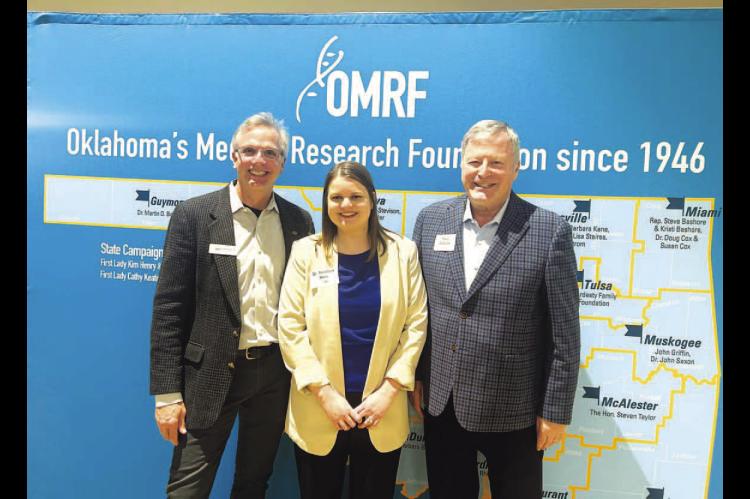
The Oklahoma Medical Research Foundation, an independent biomedical research institute, paid a visit to Kingfisher Thursday evening.
The event was part of OMRF’s “77 for 77.”
It’s a campaign launched in August 2023 to celebrate the foundations 77th year of operation.
The stop in Kingfisher was one of 25 such events across the state to acquaint residents with the successes of the internationally- known institute.
The aim is to reach all 77 counties through these events.
Thursday’s stop included guests not only from Kingfisher County, but Blaine and Logan counties as well.
Kingfisher attorney Paul Schulte, a 30year OMRF board member, served as master of ceremonies for the event, which was held at Cimarron Electric Cooperative.
Schulte introduced OMRF’s president since 2022, Andrew S. Weyrich, Ph.D., who Schulte noted was the unanimous choice to head OMRF from a large field of noted applicants.
Schulte also commented that the esprit de corps of OMRF surpassed all biases including OU-OSU, Republican-Democrat and others as it keyed on understanding and developing more effective treatments for human disease.
Schulte recognized former Kingfisher directors of OMRF, the late Merrill Burris, banker, and Ralph Enix, pharmacist, for their mentorship in leading him into a director’s position.
Weyrich said OMRF was established in 1946, beginning from discussions among alumni of the University of Oklahoma Medical School in 1944.
Several doctors began to develop the idea of an independent research organization adjacent to - but separate from - the medical school.
Led by Dr. Mark R. Everett, a Harvard Medical School grad who rose from professor to become dean of the OU Medical School in 1947, they agreed on Aug. 3, 1946, to incorporate as the Oklahoma Medical Research Foundation (OMRF), a private, nonprofit, independent research institution in Oklahoma City.
In April 1947, Oklahoma Governor Roy J. Turner became general chair of a statewide fund drive for OMRF that spanned all 77 of Oklahoma’s counties.
By May 1949, 7,000 Oklahomans had donated and pledged $2.35 million and construction of OMRF began.
The foundation officially began operations on July 3, 1949.
Sir Alexander Fleming, the British scientist who discovered penicillin, made his first visit to the United States to give the keynote address at the dedication.
An estimated 2,500 people attended the ceremonies, where Fleming pronounced the future “bright,” even though the first building was at the time, in the Nobel laureate’s words, “just a big hole in the ground.”
Dr. Edward C. Reifenstein Jr., became the foundation’s first director.
OMRF opened the doors of its first building on Dec. 17, 1950.
Since that time, OMRF has grown from five principal scientists to 50 and its staff has grown from roughly two dozen employees to almost 500.
Securing more than $30 million annually in competitive research grants from the National Institutes of Health and other granting agencies, OMRF is a member of the Association of Independent Research Institutes.
Its scientists focus on research in the areas of immunology, cardiovascular biology and diseases of aging.
Also speaking to the large crowd at the Cimarron Electric meeting room was Dr. Heather Rice, an Alzheimer’s investigator who discussed her work with mice to identify a molecular mechanism that links an Alzheimer’s susceptibility gene (known as E4) to the process of disease onset.
Dr. Rice, a Watonga native who earned her undergraduate degree in biology at the University of Oklahoma before attaining her M.D. at Harvard University, then doing post-graduate work in Belgium, said that Alzheimer’s is the leading cause of dementia in older citizens.
A large group of Watonga residents attended the local gathering, including Dr. Rice’s parents and other relatives who were introduced at the meeting.
OMRF scientists have created an inhibitor that, in vitro, stopped the enzyme thought to cause Alzheimer’s disease. The biotechnology company CoMentis has since built on that discovery to create an experimental drug for the treatment of Alzheimer’s, according to the OMRF website.
Weyrich commented on the education programs OMRF has created in addition to its clinical studies.
In 1956, OMRF established its Sir Alexander Fleming Scholar Program, a summer research training program for Oklahoma high school and college students.
The “Teen Leaders in Philanthropy” class was created in 2012 to let up to 40 high school sophomores, juniors and seniors develop hands-on leadership skills and an understanding of what a nonprofit organization does.
The program gives participants a chance to learn from a variety of charitable organizations, donors and volunteers during nine sessions throughout the school year.
OMRF also provides the training ground for graduate and postdoctoral students each year in the M.D./Ph.D Program at the University of Oklahoma Medical School.
OMRF maintains numerous core facilities, including: • A 7-tesla MRI, which uses a 10,000-pound magnet to generate a magnetic field that is 140,000 times stronger than the earth’s and allows researchers to study the cells and organs of genetically engineered living mice and rats at microscopic levels without harming the animals;
• BIACore to measure affinity and binding kinetics of macromolecular interactions; • DNA Sequencing, with the daily capacity to run 90 sequences;
• Flow Cytometry with three instruments: the FACScan and FACSCalibur cytometers, capable of three and four color fluorescence analyses, and the MoFlo cytometer capable of high throughput cell sorting;
• Imaging, to assist researchers with imaging needs ranging from basic light and electron microscopy to digital image processing and analysis;
• In Situ Hybridization, including tissue sectioning, slide mounting, and hybridization histochemistry;
• Mouse Genome Manipulation Facility, providing microinjection services of DAndrew S. Weyrich, president OMRF
• A into zygotes for the generation of transgenic mice, and of ES cells into blastocysts for the generation of knockout mice;
• Molecular Biology Resource Facility, for protein and peptide sequencing and mass spectrometry analysis; and
• Signal Transduction Core, to assist research involving intracellular Ca2+ measurements and protein- protein interactions.
• Weyrich noted that the musical “Oklahoma!” contributes to the work of OMRF.
• OMRF is funded through grants and independent contributions. One of the more unusual contributions is a share in the royalties of the musical “Oklahoma!” Oklahoma born playwright Lynn Riggs wrote the original play, “Green Grow The Lilacs,” on which the musical was based. Upon his death, he willed his 1% royalty to his four siblings. When his brother William Edgar Riggs died, OMRF received rights to that one-quarter share. As of the end of 2018, it has generated over $700,000 in earnings.