
Life Lessons From a Third World
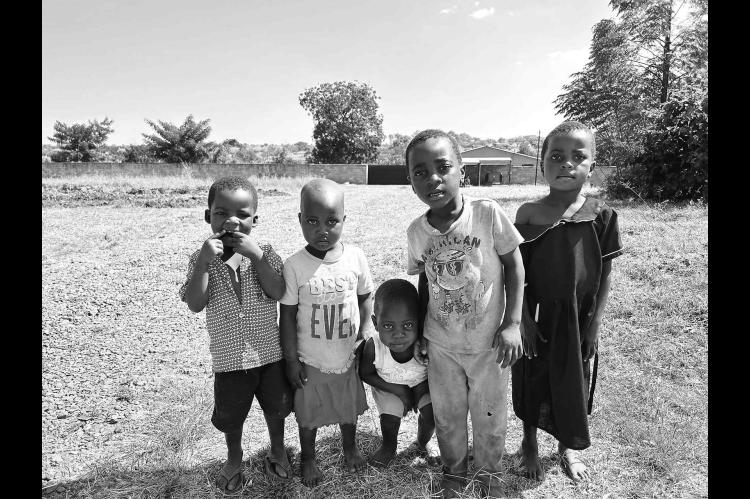
( Ed. note: Daniel Mayfi eld is the minister at the Kingfisher church of Christ and recently completed a mission trip in Africa. Mayfield shared the following experiences with the Times & Free Press readers.)
In a well-used Land Rover from a time gone by, I sat atop a custom and rickety stadium-style bench, bouncing left and right as we took on tree roots and dirt ruts made by the recent rains.
The African sun disappeared before my eyes on the Shire River in southern Malawi’s Liwonde National Park.
I could hear the blast of a nearby elephant and the cartoonish honks of a large hippo family.
A Kingfisher hovered several meters above the water with drone-like stability, locked in on a small fish beneath him. In an instant, his rapidly shaking and fluttering wings drew back and went still.
And just then, in a graceful dive-bomb, he plummeted into the water, snatching his unsuspecting prey.
“It’s ironic that I’m in Africa looking at Kingfisher,” I said with a smirk to my friend.
Following the setting sun, our safari guide drove us deep into the bush. A spotter sat on the front end of the Rover where an iron stool had been mounted to its rigid frame.
He swept his light back and forth in search of whatever creatures the night jungle contained.
A young bull elephant, recently dismissed from his herd, snacked on the leaves and branches of a small tree.
In the distance, we heard the deep and unsettling roar of a lion. I was disappointed that we didn’t see him, but his roar was powerful and primitive — unsettling, even, if I’m being honest.
Along the drive, we saw a number of creatures, most of whose names I can’t recall.
But when we were nearly finished with our safari, our driver drove us out into the open Savannah, turned off the lights and asked us all to get out of the vehicle.
When we got out, we looked up at a night sky unlike anything I’ve ever seen.
The Milky Way was stark and white. Every part of the sky was dotted with diamonds, most of which I’ve never seen before.
The “dark continent” finally made sense to me.
With no trace of light pollution, we could see the heavens, unadulterated and pure.
As I marveled, I looked to the gentlemen in my compa-ny and said, “This is better than any of the animals we’ve seen.”
Everyone agreed. Something about the sky proclaims God’s glory in a way that nothing else does (or can).
Perhaps it’s the magnitude of it, or the expanse of it.
Perhaps it’s that the glory can’t be drawn in with a single glance.
I don’t know. But I do know that God’s eternal power and divine nature have been revealed in this creation; and somehow this is acutely observed in the sky.
Indeed, “The heavens declare the glory of God, and the sky above proclaims his handiwork. Day to day pours out speech, and night to night reveals knowledge” (Psalm 19:1-2).
That brief and impressionable encounter with nature was just a highlight of the trip, not the reason I was in Africa.
It was merely the intermission between my two weeks spent teaching the book of Romans in a seminary setting.
I’ve been studying Paul’s letter to Rome for the past three years and I was asked by my alma mater to present my research in a couple of our overseas locations.
It was an honor and a privilege to do so.
I first visited Malawi 10 years ago and it left on me so great an impression that I can honestly say a paradigm shift occurred.
On one hand, the culture shock alone left an impression. Every sight, every sound, every smell, every taste, every custom… is different.
Truly. In the streets, vendors are boiling finely ground maize, making the staple food in much of East Africa, Nsima.
Imagine boiling cream of wheat for way too long, then leaving it on the counter for a while, allowing it to take on some density and texture.
Nsima is a lot like that. Street vendors are peddling sticks of roasted field mice.
The people living nearby are burning heaps of trash on the side of the road or in large barrels.
Motorcycles and diesel trucks are zipping past one another, weaving in and out of potholes, dodging school children and bicyclists commuting here and there.
Women are dressed in colorful wraps, called Chitenjes, carrying atop their heads large buckets of water or heavy sacks of maize, carrying on their backs tiny babies.
Life is happening everywhere.
The sights and sounds and smells compose a cacophony of culture and it is simultaneously overwhelming and amazing.
All at once, I’m overcome by the simplicity and poverty that I see all around me.
Barefooted children play football (soccer) with a ball that they’ve made from tightly wound pieces of plastic, melted down by a flame, and wrapped again with more plastic.
Mud homes with grass roofs dot the horizon.
In the villages, electricity is completely absent. So is running water.
And quite obviously, so is air conditioning and television and microwaves and fridges and ovens.
Virtually every creature comfort I’ve ever known is gone in an instant.
In northern Malawi, we rolled into a township near Mzuzu called Ekwendeni.
A young boy held out to me a stick of field mice — a mouse-kabob, I dubbed it.
Fascinated, I asked him for a photograph, and to my surprise, he waived me on and walked away in a subtle kind of distrust, perhaps even disdain(?).
I’d not had this experience in the south, so I asked the director of the local seminary what had just happened.
“The boy is used to NGOs, who use these photographs to raise money,” he told me.
NGO is the acronym for “non-government organization.”
There are gobs and gobs of these.
Perhaps many of them are motivated purely. But ignorant compassion can do more damage than good.
For example, several years ago, one NGO donated thousands of mosquito nets in hopes of curbing the annual Malaria breakout. But the people didn’t use the nets for mosquitos.
Fishermen stitched them together and they fished the already overfi shed Chambo population on Lake Malawi, a fish endemic to this massive freshwater lake.
While I was sitting in London Heathrow, waiting on a connecting flight to Ethiopia, I spoke with a man who worked for one of these NGOs.
His organization was on the financial side of things, bringing monetary aid to underdeveloped nations.
Somewhere in our chat, he mentioned the imperative of progress for these “third world” locations. So much is implied, I believe mistakenly, by that term progress.
Why is a nation’s GDP the measuring stick of its success?
I told the gentleman, “Sure, the technological advancements of the West are nice, but are we really any better off for having them?”
We are the richest of all people…and also the saddest.
Our fiscal progress hasn’t really made us any happier, has it?
Don’t get me wrong – I enjoy our amenities and our advanced healthcare has saved the lives of those dear to me more than once.
I am truly grateful for these things we often take for granted. But arguably, this generation is entitled and complacent, having no perspective for our historically unprecedented riches.
Materialism is not progress. Consumerism is not happiness.
In the words of Jesus, “Take care, and be on your guard against all covetousness, for one’s life does not consist in the abundance of his possessions” (Luke 12:15).
I was a missionary in the Caribbean for several years prior to moving to Kingfisher and I’ve had the privilege of working in a ministerial capacity in several “third world” settings.
And the lesson that I learn, over and over again, is that human joy – true joy – is not in any way bound to physical things or even physical circumstances.
Some of the greatest joy I’ve ever seen has been in the eyes of those who’ve had the most challenging lives.
Why am I always surprised by this?
Our King, Jesus, has said, “It is more blessed to give than to receive.”
He also said that the pathway to a truly fulfilled life is by self-denial (Matthew 16). Is this the message we are teaching our children? Self-denial?
When I first rolled into Lilongwe, the bustling capital city in Malawi’s central region, I witnessed schoolaged children, bare-footed and covered with dirt, wearing the largest smiles you’ve ever seen anywhere.
I can see why Jesus said, “Let the little children come to me and do not hinder them, for to such belongs the Kingdom of Heaven” (Matthew 19:14).
Little children – the unadulterated generation – understand inherently that joy does not come from riches or toys or status.
These children are content and they are joyful simply to have a mother and father and a close community of friends.
And it’s clear, in the case of Malawi, that this bond is held together by Jesus.
Some 90% of the country of Malawi professes some kind of Christian faith.
Every village has a church and most villages have a plurality of churches.
Malawians are people just like we are and they have sins just like we do, but the sheer presence of Christ’s Kingdom has yielded its fruit of peace and joy.
And this has greatly impressed me.
It leaves me with the question: How can we more fully bring Christ’s Kingdom in this community?
What things could we do without?
And what things should we make commonplace again?
How might we combat materialism?
And how can we give to our children the kind resiliency and well-roundedness of those who have very little?
Perhaps the answer is in knowing that those with “very little” often have a whole lot more than meets the eye.