
Local food pantries banking on Lomega junior’s project to beef up their shelves
Grant benefits Myers’ SAE as she carries on what older sister started
When Madi Myers started the “Beef for the Bank” project in 2020, it was a worthwhile endeavor.
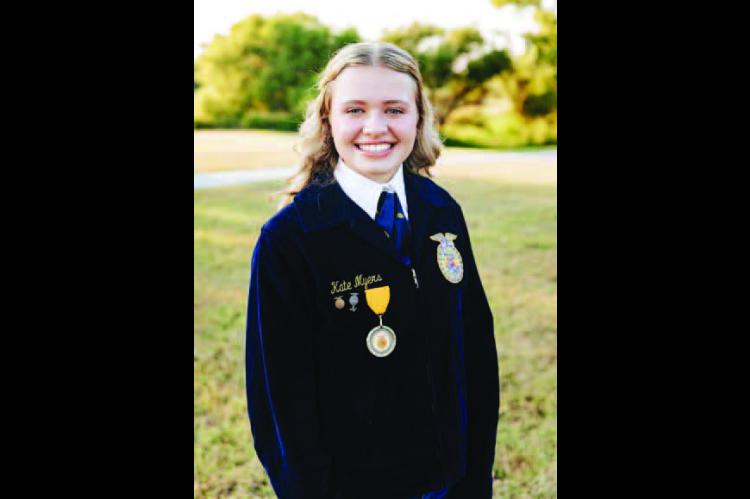
Thanks to some advice from a respected businessman, help from the community and now a pivotal grant, the project continues to flourish under the direction of Madi’s younger sister, Kate Myers.
The National FFA Organization announced earlier this month that the Lomega chapter has been awarded a $3,000 Yearlong Living to Serve Grant.
The nationwide program provides grant money to local FFA chapters to support yearlong service-learning projects that address needs related to community safety; environmental responsibility; hunger, health and nutrition; and community engagement.
The grant will benefit Beef for the Bank, a supervised agricultural experience (SAE) that aims to address hunger and food insecurity.
“Madi started the project in the spring of 2020 during COVID,” said Kate Myers, now a junior at Lomega who officially took over the project in January of this year.
“Our local food bank had plenty of canned food, but not much in the way of protein.”
A local farmer offered to donate a steer, but wanted someone to feed it out and handle the processing.
“That year, Madi raised and sold two calves, then donated a third one to the food bank.”
That was the beginning of an SAE that has donated more than 11,000 servings of beef to four feeding programs, including the Lomega Food Bank, the food bank run through Frontline Ministries in Kingfisher, Kingfisher County Meals on Wheels and the Jesus House in Oklahoma City.
The project now is in the hands of the next in line of Myers sisters, who are the daughters of Mike and Julie Myers.
“I am honored to have the opportunity to take what Madi started and help it grow,” said Kate, who is the Lomega FFA vice president this year.
Learning the ropes of such a project has been a process, Kate added.
“I’m learning as I go and am trying to work smarter,” Kate said.
She noted that in the project’s first year, a pallet of feed was stored in the family’s garage. Dozens of mice soon made that garage their home.
“My parents quickly helped me borrow a self-feeder,” Kate said.
That has helped cut down on feeding time, but Kate still works to check feed levels and fill water.
When beef is picked up from the butcher, it has to be weighed, priced and inventoried as well.
But the project isn’t just through the hard work of Kate. It’s a family, chapter and community affair. Members of the Lomega FFA chapter will assist Kate in various components of the grant. The help also comes from beyond the walls of the school. “The entire community has been great,” Kate said. “People have given their time, sold me great steers, helped me haul cattle and gave advice on feeding.” Some have even donated cattle, including this summer. “I fed it out, had it processed and was able to donate 420 pounds of burger,” Kate said, noting that since Beef for the Bank is a registered 501(c) (3) non-profit organization, all cattle donations are tax deductible. The community isn’t just helping by donating. They’re buying from Beef for the Bank. “A lot of people have purchased beef and stocked their freezers,” Kate said. “All of the proceeds go back into the project to pay for cattle, feed and processing costs.”
Much like Kate helped her older sister, she is now getting help from her own younger sister, Claire Myers, who is a freshman.
On top of feeding and watering duties, Claire and Kate are learning to build a website in hopes of finding new ways to increase sales.
That’s just one of the ways Beef for the Bank is thinking “bigger” which was a suggestion made to Madi Myers by the late Mike Johnson.
“Two years ago, Madi spoke at Rotary about the project,” Kate recalls. “Afterward, Mike Johnson came up to her and encouraged her to think bigger, expand to more food banks and get a board of directors.”
The website is a step in that direction.
Kate is also in the process of putting together a board of directors. “This will be a team of adults to advise me,” she said, noting that Johnson’s words stuck with her sister and were passed on to her.
“It has taken time, but we are getting there,” Kate said.
That’s on top of the major steps the project has taken over the years.
In addition to being a registered non-profit organization through the Secretary of State, it’s also an approved producer for the Oklahoma Department of Agriculture, Food and Forestry Local Food Purchase Assistance Program for participating food banks and schools, and its beef is USDA-inspected for distribution to feeding programs.
And there’s more “getting there” to do, Kate added.
She wants to see the idea of Beef for the Bank spread.
“I’d like to help other FFA chapters feed out a donated calf, conduct a food drive or volunteer at a local feeding program,” she said.
The idea is already catching on as Kate noted that Chloe Blair of the Kingfisher FFA - a friend of hers - has taken on a similar project and is donating to feeding programs in the county.
The work, Kate said, isn’t just rewarding, but necessary.
“Donating beef to those who need it gives you a great feeling. It is humbling to be able to help in this way,” she said. “Oklahoma is the fifth-hungriest state in the nation. That is something we can work to change.
“God has been so good to us and we want to bless others.”
[ Ed. note: This project by Kate Myers is helping fill a dire need in local food pantries, but there’s even more that needs to be done for the places that are helping feed our most underserved. Whether it’s by donation or by volunteering, the local food banks need help. The Times & Free Press will have an article in our next edition in which we talk with those who run the local food banks, discover what they need the most and how we can help.]