
More on the Horizon
Nine years after runway paved, local airport improvements continue
In June 2013, the county finally relinquished its status as the last of Oklahoma’s 77 without a paved airport runway.
That’s when Kingfisher Airport opened its 2,800-by-60 feet runway constructed of eight-inch-thick concrete, catapulting it ahead of many airports its size.
Since then, a number of other improvements have followed, through cooperative efforts of the city of Kingfisher and the airport board.
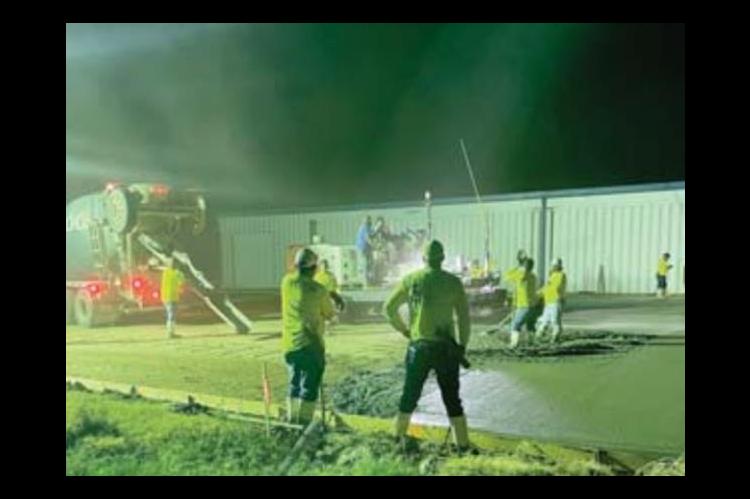
The most recent has been new concrete apron poured this summer to replace aging asphalt pavement leading from the taxiway to hangars and fuel pumps south and west of the runway, financed by an Oklahoma Aeronautics Commission grant.
“We intended when we planned the project four years ago that going north from the north edge of the airport building it would be all concrete,” airport board Chairman Bill Reitz said. “When it finally came around to starting the project, construction cost had increased to the point where we’ve only done a little over half of what we wanted.”
“Hopefully in the next four years we can get the rest of it done.”
Reitz was only half-joking with his last comment. The expense and bureaucratic red tape involved make any airport improvement a long game that Reitz knows all too well.
Perspective of History
When the city of Kingfisher purchased its municipal airport from a local landowner in 1998 for $170,000, the intention was already formed to pave its grass airstrip.
In fact, that was the second phase of an improvement plan announced by then city manager Reuben Pulis a year later.
The first phase involved installing aircraft fuel pumps and laying pavement around them so they would be accessible to planes for refueling.
Phase 1 was accomplished within the next year or so, but extending and paving the runway itself proved a far more complex and costlier proposition.
The project ultimately took a backburner to other city goals until 2008, when the first board was formed to get it off the ground.
The board included current board members Reitz, Tom Feagins and Mike Rosen, as well as then city manager Richard Reynolds, Jack Stuteville and Steve Neuman.
Nearly all the original board members (and all of the current board) are themselves pilots, but their motivations also extend to countywide concerns of public safety, agriculture services and economic development.
At the time, Neuman was a pilot for the Oklahoma State Bureau of Investigation, but forced to house his plane at the nearest paved airport, adding 45 minutes to his crime scene response time.
As then manager of Wheeler Bros. Grain Elevator, Rosen saw crop losses each year due to heavily loaded spray planes not being able take off and land on the grass runway.
Flood plain issues, property and easement acquisitions, engineering and re-engineering all added to the cost and time for development.
Then State Sen. Michael Johnson told the city about a $400,000 matching grant through the OAC and city commissioners voted to provide the match and the paved runway finally was completed.
Progress Continues
Through an ongoing cooperative effort with the city and state elected and adminstrative officials and the OAC, progress has continued at the airport.
“Hats off to the city over all these years,” Rosen said. “Dave (Slezickey, city manager) and the city council have been great to work with and so have (State Sen.) Darcy Jech and (former State Rep.) Mike Sanders.
“(State Rep.) Mike Dobrinksi also has reached out to us when he’s become aware of state money we can apply for.”
Improvements along the way have included an expansion of hangar availability through a private/ public lease/build program, added lighting and more user-friendly fueling upgrades.
Airport board members say increased usability has paid off in terms of agricultural savings and dollars spent in town.
Craig Michael has based his agricultural spraying operation at the airport for close to a decade, Rosen said, making spraying services accessible to the 35,000 acres of cropland under production in the county.
“Just being able to spray fungicide increases yields by five-10 bushels per acre,” Rosen said. “Countywide, that amounts to about $1.5 million in increased yields. It’s a big deal.”
Not just farmers have benefitted, he said.
“We’ve seen people flying in to purchase equipment at Rother Brothers and P&K ,” Rosen said. “We’ve had farmers from as far away as western Kansas fly in to buy pickup trucks at our local dealerships.”
Fuel sales and hangar rentals are the primary revenues generated by the airport, Reitz said.
The city provides a “courtesy car” (a retired police vehicle), available to pilots who fly in.
“People who come in for fuel like to use the car and drive into town to grab a meal, then they gas it up and return it and fly back out,” Rosen said.
The airport board recently hired Jill Gilbert to serve as a part-time onsite manager.
Gilbert operates a small machine repair service in the same hangar as Michael’s spraying operation and also helps Michael load his spray planes, Rosen said.
“During the last oil boom, we had a lot of people from the oil industry flying in and out and even since then, we see businesses utilizing the airport in addition to local pilots,” Reitz said.
“Pioneer Telephone had some contractors fly in from Minnesota just the other day and we have local oilfield ser vice industries who use the airport quite a bit,” he said.
Future Plans
“We’d like to get an instrument approach, which will make us more usable for people who fly in for business,” Reitz said.
“We’re looking at a nonprecision GPS system that doesn’t require instrumentation at the airport.
“Our long-range plans also include extending the runway another 800 feet, which would allow us to accommodate larger business style planes.
“We’re looking at more development on the east side, eventually adding a taxiway over there to open that up to more hangars on that side.
“All of that is quite aways down the road, but we’re not going anywhere.
“We’re proud of what we’ve accomplished out there with the help of the city and the OAC and we’re excited to see what can come next.”