
More Jail History: Life & Times of Sheriff Martin
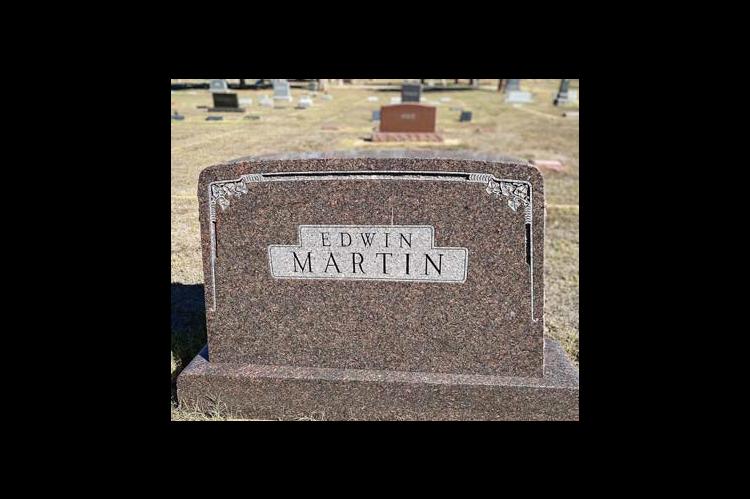
With demolition work beginning soon on the old Kingfisher County Jail, local newspaper archives revealed more information about the first lawman to preside over the now 85-yearold facility.
Edwin H. Martin was born July 2, 1886, in Wellington, Kan., and came to Kingfisher County with his family in the Land Run of 1889. His family settled in what was then the Downs Township in the southeast corner of the county, where he attended Silver Ridge School, which boasted a total enrollment of 36 pupils (20 boys and 16 girls), according to the Nov. 23, 1894, Downs Democrat.
He married Carrie Selzer, who died from pneumonia on Jan. 18, 1911, three days after they lost their infant son, according to the Jan. 19, 1911, Cashion Independent.
The same newspaper also reported Martin’s second marriage to Mrs. Mary Wells on April 1, 1913, when he was 26.
The couple resided on “the Wilson Farm” north of town, according to the article.
He was listed as a payee in published county payee in published county expenditures in 1921 for county and state road construction work and he also worked as a Kingfisher police officer and county bailiff before he was elected sheriff in 1930.
No Easy Transition
At the age of 44, Martin was sworn into office Jan. 5, 1931, along with county Judge C. Everett Murphy, county attorney Vern Firestone, county assessor George Dauner and court clerk O.B. Howard. The 1930 census showed 530,289 county acres under cultivation on 2,444 farms, 1,253 of which were operated by owners, four by managers and 1,187 by tenant farmers. The county may have been even more rural in the early 1930s than today, but it wasn’t far from its pre-statehood lawless roots that made sheriffing a high-risk profession. Bank robberies, safecracking and other highly planned crimes were not uncommon, in addition to boot-legging and other alcohol-related crimes. The day after Martin was sworn in, two prisoners “sawed their way from their cell in the county jail, knocked a bar from the front door and stalked forth to freedom,” according to the Jan. 8, 1931, Hennessey Clipper.
Six months later, a popular Blaine County undersheriff was shot and killed at a farm residence northeast of Watonga, according to the June 25, 1931, Hennessey Clipper.
In one week’s time in 1933, the Hennessey Clipper reported that Martin “assisted federal officers in a raid on the Lazy Woman place, about nine miles southwest of Kingfisher and seized 300 gallons of mash and a 40-gallon copper still,” testified in an Anadarko trial for two robbers of a Bridgeport store who Martin apprehended in Kingfisher, and assisted in the investigation of a Covington grocery store burglary.
In 1934, Martin and his men broke a counterfeiting ring, arresting a 24-year-old who was paying young boys to pass lead quarters and half dollars at a local rodeo.
“After prolonged questioning by Sheriff Martin and a U.S. Marshal,” the man took the lawmen to his “counterfeiting plant,” located across the line in Canadian County.
There, the lawmen found “a crude outfit consisting of a ladle, plaster paris mold and gas lantern found in heavy growth of blackjack timber,” according to the Aug. 16, 1934, Hennessey Clipper.
Re-elected to Four Terms
Martin was re-elected to a total of four two-year terms, including his final term from 1936-38 when the new jail was constructed.
Ironically, in announcing his last (and ultimately failed) bid for re-election, Martin did not mention the jail. Instead, he asked for re-election “on his record as a peace officer,” stating he had “made a study of laws which confront a sheriff” and had “attended conventions of peace officers in an effort to keep abreast of the times in his official work that he might better serve the county,” according to the April 21, 1938, Cashion Independent.
Martin was succeeded by Olin Wall on Monday, Jan. 9, 1939, when Norman Shutler was seated as county judge and William O. Breedlove as county attorney. Following his public service, Martin returned to full-time farming. He died Feb. 7, 1977, at the age of 90.
Others Who Served
A total of 10 successive sheriffs served over the 80-year life of the jail constructed under Martin’s tenure, including Wall, C.C. “Joe” Fisher, Francis Perdue, Clyde Sapp, Miles Williams, Chod Kelly, Phil Burns, Coye Barker, Danny Graham and current Sheriff Dennis Banther.
Sheriffs serving in the previous jail, constructed around the time of statehood on the north side of town, included J.P. Love, M.M. Tate, Clyde Smith, George F. Long, John Mize and Abe Block, Mar tin’s immediate predecessor.
Lawmen serving in the county prior to statehood included William Grimes of Kingfi sher, the first man to qualify for the office of territorial U.S. Marshal, and early day sheriffs Edwin A. Clump, B.W. Burchett, John A. Ratcliff and W.R. Kelley.