
National Politics 101
Lucas Talks Farm Bill, Midterm Prospects with County Leadership Class
What will the Farm Bill look like in 2023?
A lot of that may very well be decided in next month’s election, said the congressman who represents Kingfisher County.
“If we’re (Republicans) not in control, it could get really complicated,” said Rep. Frank Lucas, R-Cheyenne, on Monday.
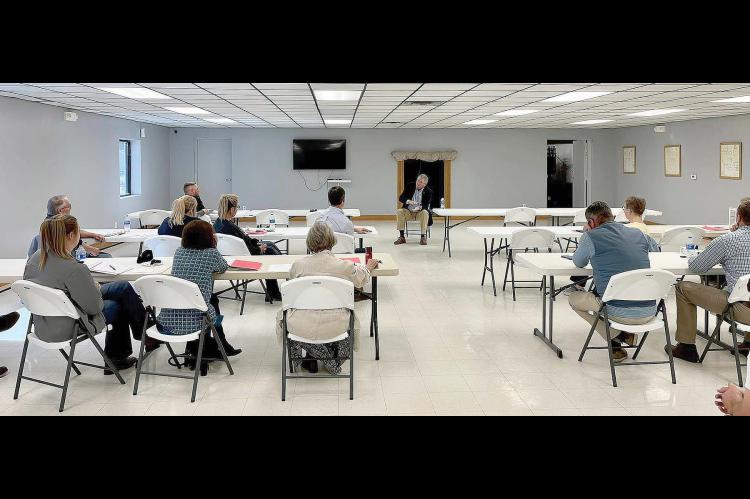
Lucas was speaking to the Leadership Kingfisher County Class VI at Dover Town Hall.
This was the second in a series of meetings for the group of selected county residents that includes bankers, school administrators, Pioneer employees, those in the medical field and more.
Lucas was joined at Monday’s meeting by Michael Kelsey, executive vice president of the Oklahoma Cattlemen’s Association.
The owner of a cow-calf operation “with some wheat,” Lucas was first elected to the U.S. House of Representatives in 1994.
His third district covers 32 Oklahoma counties and about 48 percent of its land mass.
It’s one of the largest agricultural districts in the nation.
“It’s the one industry that is everywhere in my district,” he said. “I’m particularly sensitive about ag policy.”
The biggest piece of ag policy, of course, is the farm bill.
The most recent bill, specifically the Agriculture Improvement Act of 2018, was enacted in December 2018 and expires next year.
Prior to that was the 2014 version, which had a large imprint from Lucas, who was named the chairman of the House Committee on Agriculture in 2011.
Among its highlights was reforming food stamps for the first time in several years and repealing or consolidating dozens of government programs, which ultimately saved taxpayers about $40 billion.
“If you go back to 1933, you can almost pick the nature of the Farm Bill by who the chairman was at the time,” Lucas said.
“We are all a reflection of our own constituents.”
The ag chairman overseeing the next Farm Bill will depend on how voters swing in a number of key races during the Nov. 8 general election.
Currently, Democrats have a majority in the House by five seats.
Lucas said he sees the pendulum swinging the other direction next month.
“I’m very comfortable in a 10seat pickup, which would take us from five down to five up,” he said.
“I think a 15-seat pickup is possible. That gets us to 10 above.”
If that’s the case, Pennsylvania’s Glenn “GT” Thompson will move from ranking member to chairman of the committee.
“I think we’ll be fine with GT,” Lucas said.
Thompson will have an experienced voice in his ear…that of Lucas himself.
Lucas is currently a senior member of the House Committee on Financial Services and a ranking member of the House Committee on Science, Space and Technology.
He said he agreed a few years back to take a hiatus from the agriculture committee to allow some junior members a place to serve.
Lucas said he did so only with the caveat that he got it in writing that he would return to the committee prior to the work on the next Farm Bill.
“So I’ll be right up there on the dais with GT,” Lucas said.
If Republicans don’t regain control of the House, Lucas said the work will be tougher.
“So many people I serve with are so far removed from anything that has to do with ag production,” he said. “It’s hard for them to understand it.”
Earlier in the summer, some pollsters had Republicans grabbing as many as 50 seats as inflation was a big headline.
Such movement is known as a wave election.
“It’s possible,” Lucas said. “But that’s a lot of movement. It requires usually something in the last 10 days to happen to really cause one side to stay home and the other side to turn out en masse.”
Lucas talked about the even more narrow margins in the U.S. Senate, which currently is 50-50 with Democrat Vice President Kamala Harris being the tie-breaker in split votes.
“On my side of the road, we have some really interesting Senate candidates,” Lucas said.
He didn’t mention specific names, but did highlight races in Pennsylvania, Georgia and Arizona in which Republican candidates have garnered not-so-positive headlines. He said it could prove difficult for Republicans to win those seats.
“It still matters,” he said in voting for candidates and not party. “The candidate does matter, because you’re voting for the candidate.”
Beyond the 2022 election, Lucas said he can even envision a world in 2024 in which Americans go to the polls to vote for a president and neither “Biden” nor “Trump” will be on the ballot.
“I offer you a little theory. President Biden’s wearing out at a pretty rapid clip and it’s not 1944 where our ancestors elected Franklin Roosevelt a fourth time and he never knew he was president a fourth time,” Lucas said.
“I’d like to think we have more scrutiny. I’m not entirely sure that Joe Biden runs.”
He then emphatically added: “Kamala will not be the nominee. So you’ve got to assume they’ll pick up somebody else.”
If Biden doesn’t run for re-election, Lucas said the Republicans might go a different route than nominating Donald Trump.
“I say this respectfully – because I’ve endorsed him twice and he’s endorsed me twice – Donald Trump’s best opponent is Joe Biden,” he said. “If Joe Biden is not there, that changes the lay of the land.”
He said he could see “a business decision made” after a thorough analytical poll by Republicans in about a year’s time.
“The first two times I ran for legislature, I got beat,” said Lucas, who was in the state House for just over five years before being elected to Congress. “That’s not a pleasant experience. Donald Trump did not enjoy not winning this last time. I didn’t say he got beat. I said he didn’t enjoy not winning.
“I don’t think he would enjoy it any more the next time. So there’s a really good probability – and I don’t know who they are yet – that you’ll have two entirely different candidates to pick from.” Lucas was asked if anything is being – or even can be – done about foreign entities buying up large chunks of land in the U.S., more specifically in Kingfisher County.
“There are a couple of efforts under way,” said Lucas, who noted that his own home county, Roger Mills, has seen a tremendous uptick in foreign ownership of land, which often turns into grow houses, many of which may or may not be following state regulations.
He noted that foreign ownership of land in Oklahoma is against the law.
However, he said, when speaking with officials, he learned that purchases and ownerships are being made by entities that are part of an elaborate web of LLCs.
“It’s almost impossible to figure out who is buying it,” he said.
One step Lucas said he is working on is getting agriculture included in laws and guidance under the Committee on Foreign Investment in the United States (CFIUS).
Formed in 1975, it includes representatives from 16 U.S. departments and agencies and studies foreign investment, with the authority to reject deals.
Agriculture, noted Lucas, isn’t one of the departments that falls under CFIUS, which he wants to change.
“It won’t undo everything that’s been done,” Lucas said. “But we’re trying (to make it better).”
Lucas was introduced by Dover’s Byron Yeoman, who is president of the Oklahoma Cattlemen’s Association.
Yeoman said he’s taken part in an OCA Leadership Class as well as a twoyear Oklahoma Agriculture Leadership Program.
He applauded those taking the current course in Kingfisher County and encouraged them to look into others.
“It’s wonderful. You need to venture out,” Yeoman said. “You meet all kinds of people and I’ve made some of my best friends in the world. It’s not something I would have done if my own dad hadn’t encouraged me to do it.”
(Ed. note: Kelsey also addressed the group. Some of his remarks will be in the weekend edition of the Times and Free Press.)