
New club not afraid to HAM it up
Group of amateur radio enthusiasts aims to spread ‘hobby’ to younger generations
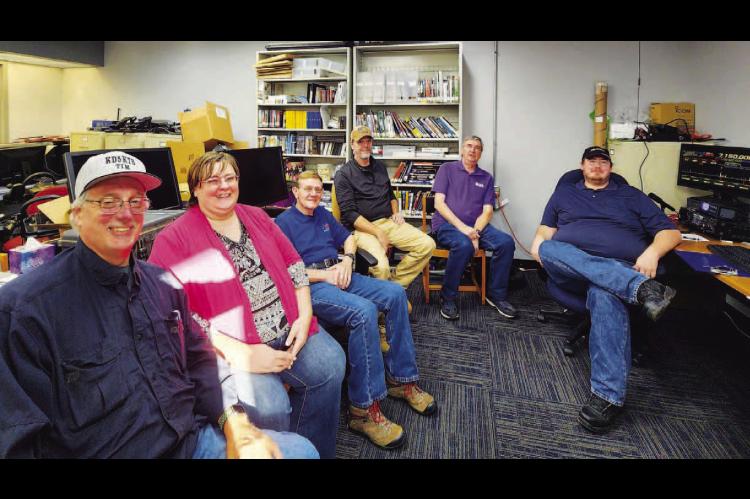
It’s not just a hobby.
HAM (or amateur) radio enthusiasts enjoy connecting with others worldwide, but also provide an important service to their communities.
In times of emergency, HAM radio service can operate on a generator or battery backup power even when internet and cell service are inoperable.
The newly formed Kingfisher Amateur Radio Society (KARS) recently received approval from the Federal Communications Commission to operate with the call sign KJ5DIV (Kilo, Juliet, 5, Delta, India, Victor).
The club is partnering with the Kingfisher Memorial Library to encourage the younger generation to become involved in amateur radio service.
Supported by the library and other sources, the base equipment is set up in the library and the club meets at 5:30 p.m. every second Monday of the month.
Elected as president of the club, Kingfisher Police Department Officer Chris McDaniel was instrumental in getting it off the ground, along with library Director Mike Tautkus.
“We like to emphasize the service aspect of it because we want to serve the community and be able to help in times of emergency and it’s also a fun hobby for us,” McDaniel said.
“Our goal in being in partnership with the library is to get kids and teens interested in the STEM (science, technology, engineering and math) aspects of amateur radio and foster that in the young kids.”
Working in conjunction with McDaniel, children and youth services librarian Audry Sanders said the plan is to start a class for teens this summer in which Mc-Daniel will provide instruction in the basic concepts of HAM radio and then build up from there.
With multiple children’s programs under Sanders direction, such as a flight simulator program, computer building program and other activities, she said the amateur radio program will be another great opportunity for the youth.
“We’re excited to partner with the group and bring this program to our teens,” Sanders said. “Once we get it going, we’ll branch off into the younger ones.”
As the teens learn the skills and get their licenses, then hopefully they can develop a mentorship with the younger kids, she added.
“This opportunity builds a bridge that allows the kids a hands-on way to develop their communication skills and it’s also something that is for all walks of life,” Sanders said.
Recently learning the ins and outs of HAM radio, Sanders is also working on obtaining her license.
Although HAM radio operators must obtain individual FCC licensure, Tautkus said the teens and kids will be allowed to operate under the KARS license while being supervised by a licensed operator.
With amateur radio in existence for over 100 years, club member and former Pioneer Telephone General Manager Richard Ruhl said, “In emergencies when infrastructure gets damaged, amateur radio operators can help communities put resources together while working with emergency services… sending health and welfare messages back and forth and communicating with local or international centers through HAM radio.”
In addition to the service aspect, there are many other activities and opportunities amateur radio hobbyists can be involved in which include communicating with the Internation-
HAM OPERATORS al Space Station and Fox hunts, which is similar to geocaching in which operators search for a hidden radio transmitter while using portable radios.
Other events include Parks on the Air (POTA) in which HAM radio operators try to make contact with as many designated federal and state parks as they possibly can in a certain time limit, Earth-moon-Earth (EME) communications, HamSat which is a communication with satellites, DX communications and various others.
With each individual operator having unique interests, club member Tim McAnally said, “A wide range of people enjoy amateur radio and there is no age limit.”
Some individuals in the club have had their licenses from the young ages of 11 and 13, while others only recently got involved in their 40s and 50s.
“Everyone is treated as equal,” club member Kevin Kale said. “You’re associated with your license, not your age, race, gender or anything else.”
Receiving his license at age 11, McDaniel agreed that there is a lot of respect between operators regardless of age or other factors.
“There’s a definite social aspect involved, which also helps people develop interpersonal skills,” he added.
It was the first social media, Kale said, …exploring the world one contact at a time.
“We all have different aspects of the hobby that we enjoy, but I think the one thing that all HAMs have in common is that they like to experiment with their equipment and work to achieve better communication.”
Much of the technology used today was developed and designed by amateur radio operators, Ruhl said.
As radio operators make contact with other HAM enthusiasts from places all over the world, they exchange customized postcards (QSLs) designating their call signal and location.
Additionally, many HAM radio operators utilize Morse code (the universal language of dots and dashes or dits and dahs) to communicate.
McDaniel said he has plans to help the students build their own Morse code oscillator.
“It’s the most reliable mode of communication you can have and why the military still uses it to this day,” Ruhl said.
In June, a nationwide field day occurs where radio operators set up an emergency field station running only on battery power or other noncommercial power.
The goal is test your emergency capabilities and make as many contacts as possible in a 24hour period, McDaniel said.
Setting up a station last summer in Newfield Community Park, McAnally and McDaniel were able to test their communication capabilities and contact other radio operators from New York, California, Florida and many other locales while using only a 20-feet antenna.
Additionally, Ruhl said now is the prime time to get involved in HAM radio.
“Right now we’re communicating with locations around the world that you can’t do but every 11 years with the peak in this solar cycle, which begins its decline in 2025,” he said.
The goal is to get kids really interested in amateur radio, get them involved and find places where they can really shine, McDaniel said.
“We want to encourage the camaraderie and get the kids involved and grow the hobby,” Tautkus added.