
No Greater Love
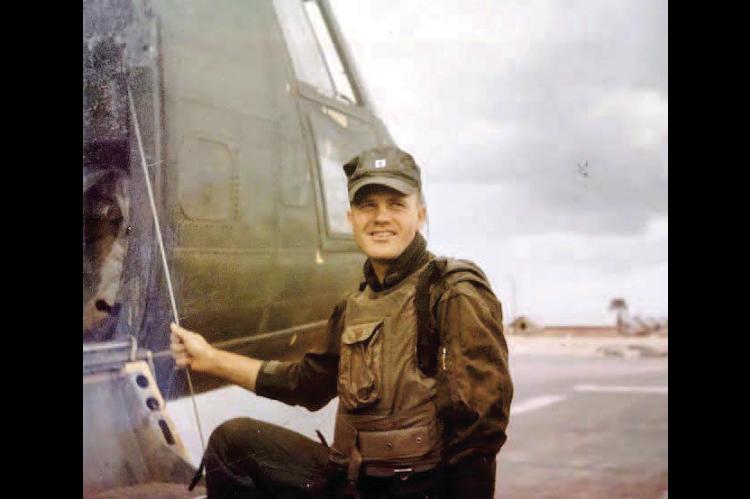
Looking back, Gene Massey said it was the greatest competition in life.
It wasn’t the path he had planned, but his love of God and country led him there.
What started as a normal progression for a young man from Coalgate, Massey and his high school sweetheart, Sally Smith, married after graduating from East Central University in January 1965.
Within less than a year, expecting his draft number to come up soon, Massey joined the U.S. Marine Corps.
Soon he found himself in Officer Candidate School in Quantico, Va., and then off to flight school in Pensacola, Fla., where he learned to fly both fixed-wing aircraft and helicopters.
Upon graduation, Massey was transferred to New River Air Station in Jacksonville, N.C.
Along with others from the flight school, he was selected to be a member of the USMC HM161 squadron which had been out of service since the Korean War and was being reformed.
“When they put the squadron back together, 24 brand new CH-46 helicopters, which were the latest and the greatest at the time, were included,” he said.
The squadron trained together for a year, Massey said, and then they flew the helicopters to California where they all boarded the USS Princeton aircraft carrier, headed for Vietnam.
Leaving Sally and their infant son Matthew behind, Massey said, “We boarded the USS Princeton in May of 1968 and within 10 days we were on the shores of Vietnam.”
Stationed at Quang Tri, the helicopters, equipment and crew unloaded just out of artillery range of the demilitarized zone near communist- ruled North Vietnam.
As part of the U.S. Marine Corps Provisional Air Group Mag39, Massey, an aircraft commander, began flying missions in the mountainous areas of the northern part of South Vietnam where the action was often fierce.
Massey’s first experience of the devastation of war came quickly on a mission to Khe Sanh, when he was flying as wingman to Capt. Scott Sharp, who was piloting the lead helicopter.
“We were flying in to resupply the troops when I just saw a huge cloud of dust ahead of me,” Massey said.
As he circled and landed, he witnessed the first casualty in their squadron.
A parachute, which had been used to drop supplies, had gotten wrapped in the front rotor blades of Sharp’s helicopter, sending the blades through the cockpit and killing Sharp, Massey said.
“He had come back into the Marine Corps to train us and died less than 30 days after we got there,” he said. “And he had a wife and two little girls.”
Seeing lots of action, Massey said they flew day and night for four or five months until their new helicopters had sustained as much damage as the older models.
“It got to the point when we would get shrapnel or bullet holes in the helicopters, they started patching them with beer cans,” he said.
Their missions would entail resupplying the troops with ammunition, food and water, performing medical evacuations and inserting reconnaissance teams into the jungle or performing emergency extraction of recon teams, Massey said.
Running on adrenaline, Massey said some of his favorite missions were action- packed – and highly dangerous – recon unit emergency extractions.
One cloudy, moonlit night, Massey’s team, including a copilot, crew chief and two machine gunners, was sent out to pick up a recon unit that was in trouble.
Unable to use cockpit instruments for recon missions, pilots worked with maps and learned the terrain, following valleys, ridgelines and such, he said.
“That night, these guys were being chased up the mountainside by the Viet Cong and we couldn’t land,” Massey said. “So I pulled up alongside the ridge, hovered in place, put down the ramp and pretty soon here came those guys all charging up this jungle trail and jumping into our helicopter.”
They were supposed to be picking up five men, but a sixth came running up. Afraid it was a member of the North Vietnamese Army who were known to attempt to jump on and pull a grenade pin to destroy everyone, Massey gave orders to shoot.
But in this case the initial information was wrong and before Masssey’s order was acted on one of his crew quickly informed him there really were six Marines getting on the helicopter.
“It all happens so fast,” Massey said. “Stuff like that happened and that was just the way we lived at the time.”
Thinking about another recon mission, Massey said it was broad daylight and these guys were running down the mountainside in elephant grass over their heads with the enemy chasing them and shooting at them.
As they let down the ramp, Massey kept the helicopter hovering until the men got on board and they flew off with people shooting at them.
“You would think we would be scared, but it was just part of the day…just lived that way every day,” he said. “You live on the edge… it’s just difficult to explain.”
Another time Massey was part of a large troop lift and he said he had never heard so much gunfire and watched a helicopter, which had been shot down in front of him, roll down the mountainside.
“We had armored seats and we would press into that seat as far as we could, hoping any bullets that entered the cabin would hit the armor instead of going through us,” he said.
All Marine Corps personnel had one assignment and that was to support and take care of the “grunts” on the ground fighting the battle.
“It was our job to supply them and if they were in trouble to go get them,” Massey said.
“No matter what, you don’t leave anyone behind.”
Adjusting from an adrenaline- fueled fight for survival to normal family life is often a difficult transition when battlefield soldiers return home, Massey said.
“You do that every day until you come home and it’s just like you’re in a brand new world,” he said.
A lot of bad things happen in combat and that’s the reason a lot of people can’t handle it when they come back, Massey added.
Loved ones back at home were fighting their own battles, not knowing what was happening far away.
Massey said he was able to communicate some with his wife and young son through letters and a tape recorder that they sent back and forth.
WhileinVietnam,Massey said he also received a couple of rest and relaxation reprieves from the war.
On one of those occasions, he attempted to relay a message to Sally from a Marine battalion corps to amateur ham radio operators to let her know where to meet him in Japan.
“It was a rainy night I sent the message to Sally with no confirmation or anything that she’d got the message and when I got to the hotel in Japan, I asked if there was a Sally Massey there,” he said.
“And the clerk replied, ‘Yes sir, she is.’” Looking back at photos of one of those times, Massey said, “Sally looked almost bewildered, as just two days ago I was in Vietnam flying helicopters and now here we are sitting together talking like nothing ever happened.”
One of the hardest times, Massey said, was losing his best friend, Capt. Joe Powell, in Vietnam.
Massey said he and Powell had trained together and attended flight school at the same time. Joe and his wife Karen also had a little boy, Sean, just like he and Sally did and the families spent a lot of time together.
“He became my best friend and we were in the same squadron and he flew with me a lot in Vietnam, until he became an aircraft commander as well,” Massey said.
Called out on a medical evacuation mission during bad weather, Powell was hit with enemy fire causing the helicopter to crash into a mountainside, killing the entire crew, Massey said.
“I got the news of that and that was probably the toughest time,” he said.
Despite the hard things they had to deal with, Massey said there were some funny and interesting times too.
In one instance, Massey said, they were called out on another medical evacuation which he labeled as one of his strangest missions in Vietnam.
On a dark night, the crew had to battle heavy cloud cover and, with assistance from a C130 Air Force transport aircraft dropping flares, they were able to make their way down through holes in the clouds and find the location to pick up the recon team.
As they were hovering with the ramp down for what seemed like forever and wondering who was out there in the cloudy, rainy, darkness coming to shoot at them, Massey said he yelled to the crew chief, “What’s going on back there?”
His reply came back, “Sir, it’s not only the wounded guy, but we’re loading the tiger that attacked him.”
“That was the first I heard of that…I thought it was a normal medical recovery mission up until that point,” Massey said.
Later he discovered that the recon team had decided to spend the night in a bomb crater and a tiger latched onto one guy’s head and attempted to drag him off before the other soldier shot it.
The wounded soldier had to be returned to the U.S., but he recovered and his unit sent him a package containing the tiger, which became a rug, Massey said.
Another time while dropping a recon unit off into the jungle, Massey said he had a brief time to admire the beauty of the country.
“Vietnam was beautiful with mountains and trees and the morning moisture would collect under the leaves of huge trees and soon a cloud would pop out of the forest,” he said.
After landing in a riverbed, Massey said, “While we were waiting to let the recon team off, I just took time to look around while sitting in the middle of this stream with monkeys playing in the trees and parrots flying around.
“It’s just like you’re in paradise. It’s like a two-minute vacation and just for a little bit you forget the whole thing is going on.”
After 13 months, Massey returned to his wife and son and completed his final year of service at Camp Lejeune.
While there, another son, Mitchell (Mitch) was born.
With the growing unpopularity of the war and protests in the U.S., many servicemen and women endured shameful treatment when they returned home.
Coming from Oklahoma, and a small town at that, Massey said he didn’t experience that aspect.
“It was different coming back to a small town where the people prayed for us and welcomed us home,” he said.
Massey returned to work in the insurance business for a short while and felt the Lord calling him into ministry.
Following that calling, he graduated from seminary at Phillips University and has served in various ministerial capacities for approximately 50 years.
A daughter, Amanda, was also born to the couple while Massey was attending seminary.
Massey and his wife currently serve at Kingfisher First Christian Church where he is the pastor.
Their three children – Matthew, Mitch and wife Tamara and Amanda and husband Mike Matthews – live in Kingfisher and they have six grandchildren.
Massey completed his service in the Marines as a captain and received a Distinguished Flying Cross, two single mission Air Medals, 33 Air Medals and a Navy commendation for his service.
Even as the war became more controversial and politicized, Massey said their mission was still to support each other and take care of every marine who needed their help.
Reflecting on Jesus’ words, “Greater love has no one than this: to lay down one’s life for one’s friends,” Massey said they were there to live (or die) for each other and, as Marines, to never leave anyone behind…no matter what.
After coming back, Massey said, “The hardest thing for me, and a lot of guys I know, is we can push things back out of our minds from the war, but when we go to a basketball game to watch our kids or grandkids play, we think about the fact our friends can’t see their kids or grandkids play.”
You get so wrapped up and involved doing the things you do in combat, it’s hard for people to understand how much of a physical and psychological endeavor it is putting your life on the line every day, Massey said.
As we celebrate Veterans Day, Massey said, “I think veterans and men and women who join the military today do it for the same reason I did…we love our country and when there is a call to duty, we answer it.”
Despite increasing discontent and division in America, Massey said as he and Sally travel around the country they encounter a lot of good people.
He said, it’s sad to see people intent on creating hatred in America, because there are lots of good people in America.
The average Americans are still Americans and we can get along, he added.
“All the men and women I knew in the military, and those in the military today, still risk their lives and fight for this nation because it’s still a great nation.”