
For our viewing pleasure. . . maybe
State, parts of nation prepare for Monday’s total solar eclipse
Dubbed “The Great American Eclipse,” it was the first total solar eclipse to pass from coast to coast over the contiguous United States since 1918 and the first of the 21st century.
That was seven years ago.
It’s back and even better. On Monday, April 8, a total solar eclipse will span from Mexico through the United States and into Canada.
Crossing through 15 states, and unlike the eclipse of 2017, this celestial event’s path of totality will trek over parts of Oklahoma and it promises to be even more spectacular with a window of darkness two minutes longer at its peak duration.
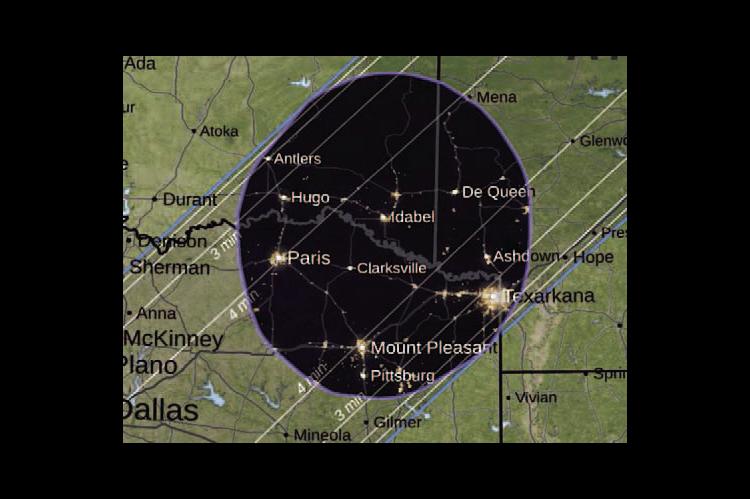
As the path of totality stretches across all of McCurtain County and partially covering Choctaw, Bryan, Atoka, Pushmataha, Latimer and Leflore counties, darkness will begin in the state at 1:44 p.m. and exit the state at 1:51 p.m., according to the Oklahoma Department of Emergency Management and Homeland Security website.
The town with the longest total eclipse viewing time in the state will be Shults, approximately three miles east of Idabel, with 4 minutes and 19 seconds duration of totality, the OEM website also states citing eclipse2024.org.
A total solar eclipse offers a rare opportunity to view the sun’s corona or outer atmosphere, usually obscured by the bright face of the sun, which appears as a ring of ethereal white wisps around the moon as it blocks the solar surface.
It’s important to note that it is not safe to look directly at the sun without specialized eye protection specifically made for solar viewing, except during the brief total phase of a total solar eclipse when the moon completely blocks the sun’s bright face, according to the National Aeronautics and Space Administration.
It also states that viewing any part of the bright sun through a camera lens, binoculars or a telescope without a special-purpose solar filter secured over the front of the optics will instantly cause severe eye injury.
Another option is to use an indirect viewing method, such as a pinhole projector, which projects an image of the sun onto a nearby surface.
Its peak duration will occur near Torreòn, Mexico, with a viewing time of 4 minutes and 28 seconds, with most places along the path of totality seeing 3 ½ to 4 minutes of darkness.
As the event marches upward through the U.S. and into Canada, it is projected millions of people will view the phenomenal event.
Although Kingfisher is not in the path of totality, it will experience a partial solar eclipse as well as every other contiguous state in the U.S.
( Ed. note: As of press time, the forecast calls for partly cloudy to mostly cloudy skies at the scheduled time of the event. If it’s mostly cloudy, the eclipse won’t be able to be viewed. Partly cloudy skies - or less - could open it up for viewing.)
With a large influx of visitors expected to flock to areas in the path of totality, state and local authorities are working to prepare for the event and to keep both visitors and residents safe, the OEM website states.
OEM is partnering with various other state agencies to prepare for the event and the Oklahoma Department of Transportation will provide live traffic information in southeast Oklahoma on its Eclipse Road Map.
Some of the things you can expect in the areas of the total eclipse path according to OEM are: Increased tourists and visitors; increased traffic and congestion; maximum capacity in hotels, cabins, campgrounds; decreased quality of cellular service; delays in supply chains and deliveries; and increased emergency response times. In addition to the millions of citizens preparing to fix their gaze on the skies during the extraordinary event, NASA plans to launch three sounding rockets at different time intervals to collect data about the effects of the eclipse on the ionosphere and potential interference with radio signals and other communications.
If you don’t get the chance to witness the complete solar eclipse in April, another one is on the way trekking from coast to coast once again.
It won’t happen until Aug. 12, 2045, but may be even more spectacular.
Projected to track right over central Oklahoma, its point of greatest duration will last for a total of 6 minutes and 6 seconds.
That’s only 21 years from now…but if you can’t wait that long you know where to go.
For a map of the path of totality and more information about the upcoming eclipse visit these sites:
• https://science.nasa. gov/eclipses/future-eclipses/ eclipse-2024/
• https://oklahoma.gov/ oem/ home/ 2024- solareclipse. html
• https://www.travelok. com/eclipse2024