
Sanders lays out expectations for new role
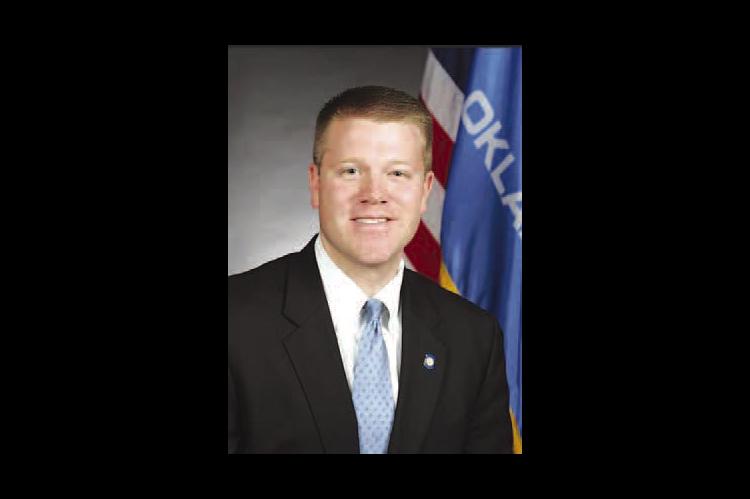
It was announced recently that Kingfisher’s Mike Sanders has been hired as the first executive director of the newly-formed Oklahoma Broadband Office.
The office was one of three entities established as part of House Bill 3363 in 2022 along with the governing board and expansion council.
Sanders was hired by members of that governing board to implement its aggressive plans.
The goal of the office is to “ensure at least 95 precent of Oklahomans have access to reliable, affordable high-speed internet service by 2028.”
Sanders and his staff will have at their disposal nearly $2 billion to disperse as providers will compete for project funding.
But even before the first dollar is awarded, Sanders said a lot of work must - and will - be done.
Though he doesn’t officially take charge as executive director until April 10, Sanders is already at work putting some staff and plans in place.
Sanders and Tim Allen, the Oklahoma Broadband Office’s director of policy and communications, visited the Times & Free Press last Monday and granted the first sit-down interview since Sanders was appointed.
Following are some highlights from that interview as Sanders and Allen touched on a number of different subjects:
Some of the first priorities as executive director Sanders:
We still have a lot of infrastructure that needs to be hired in place. That’s one of our top priorities, to bring in the technical expertise and those who will be able to fill the application side because there’s just such a tremendous amount of technical knowledge.
At least in the early going, we’re going to be putting together the best and the brightest. There are a lot of folks here in Oklahoma who I feel we can attract and bring on board. We’re going to do that first.
The second part, once we get that team up and running, I see my role as executive director as doing a lot of outreach, doing a lot of meeting with local exchanges, meaning ones that are privately owned, ones like Pioneer that are cooperatives, the electrical co-ops, tribal nations, the investor-owned companies...going to them and asking what their two- and threeyear plans are.
We are kind of like an ad hoc agency. We have five years to implement nearly $2 billion of funds to bring high-speed internet to 95 percent of the state. We’re going to meet with all the players.
There’s an application process, which is going to require time.
But also these carriers, we want to look at their two- and three-year plans because it’s that critical. Five years doesn’t do us any good because we have to get this money out.
It seems like a lot and it is a lot, but I think once we get our team assembled, we’re going to be able to hit the ground running and do this as efficiently and as transparently as we can.
The goal is to ensure 95 percent of Oklahomans have highspeed internet access. Where is that number now?
Allen: I’m hesitant to answer because it’s such a moving target. One of the key things we’re working on is a map that has all the data in it to show us where do we have service…an accurate map. It’s constantly evolving. The FCC has a map, but it has some limitations.
Sanders: They’ll say to some degree, Oklahoma’s map is totally covered because of Elon Musk’s Starlink.
Allen: By the FCC’s own rules, it doesn’t count satellite service as qualifying as high speed.
What does count as high-speed internet?
Allen: Currently the FCC considers you to have high-speed internet if you have 25 megabits per second (mbps) of download speed and 3 mbps of upload. That’s going to change. In fact, at least for some of the funds that we will be administering, the minimum will be 100 down and 25 up but scalable to 100 up.
What people get top priority in this program?
Sanders: The first thing we need to look at and be careful about is overbuilding. What I don’t want is for another company to come in and build on top of what Pioneer, for example, has built out with their own blood, sweat, tears and capital. This is where we need to see accurately the mapping aspect. Who covers this? Who covers that? What’s not being covered?
Because, ultimately, the governing board, the legislature, the governor have all agreed: The first priority is the unserved and there’s a lot of it, whether it be south of Okeene or Arcadia. Then there’s going to be areas where those underserved will come in second.
Unserved, underserved, then the rest will follow where we see fit.
Do you envision new companies forming to attempt to attain this funding?
Allen: I think current companies will have a better leg up. They’re going to expand. We don’t want fly-by-nights coming in and then they’re gone.
Sanders: One of the components we’ll look at as well is the time-tested Oklahoma companies. This is an Oklahoma project. We’ll be cognizant and aware of that.
Where is Mike Sanders lacking the most when it comes to this program?
Sanders: Just the knowledge based on the technical side of the industry. But, like anything I’ve ever done from my first days at the White House to my first days at the Department of Agriculture to my first days as a state representative, in every job there’s always going to be a steep learning curve.
How do you overcome that?
Sanders: I think my record of success and work ethic and ability completely caught me up to speed (in previous positions) and I always say this: I’m not so proud to assume and think I know it all. I’m going to put the best people around me that have the knowledge base and we’re going to make sure that we bring high speed internet to all of Oklahoma.
We’re going to listen, we’re going to learn and then we’re going to apply.
What sold the governing board on Mike Sanders?
Sanders: Understanding how federal government works. Understanding federal funds and how they’re distributed, but also having the state experience.
Having the relationship I have with the legislature is paramount as well as the executive branch. I also think my ability to communicate and to communicate my messages well and to build bridges between the urban and rural divide. I don’t think it’s as hard as what people think it is. I did it when I was in the legislature.
Going off my past record, because that’s what I have, is a record of hard work, building bridges, accomplishing things for my state, my district, my country and I didn’t care what political party you were from.
I really believe the opportunity we have with getting high-speed internet to places of the state that have never had it, I see it as a challenge and an opportunity. I think when all is said and done, we’ll have a product we’re all proud of.
Expand on the importance and the opportunity of this program.
Sanders: This may be as important as what the electrification was for Oklahoma in the 1930s and the interstate highway system in the 1950s.
This is a different type of infrastructure, but if COVID taught us anything, it’s that we can run a multi-billion dollar company from our living room and since we live in a global economy, we realized pretty quickly we had some major holes in connectivity.
We feel the program at hand is going to give Oklahomans every opportunity to be on the playing field as if I were living in New York City or Los Angeles or Chicago and we’re going to be able to get this done.
This is such an amazing opportunity. Oklahomans probably can’t even grasp the size of the program. But by 2028 they’re going to realize this was great for my farm, this was great for my business, this was great for my clinic.
It’s all encompassing - education, health care, telemedicine…everything. Words probably can’t describe how this program will change the lives of Oklahoma.
More on leveling the “playing field” when it comes to high-speed internet…
There’s no reason that people who live in rural Kingfisher County should not have the same access as if I lived in downtown Oklahoma City or downtown Tulsa. Just because you live geographically in a different part of the state doesn’t mean you should not have the same services provided to you as anyone else.
And this is their money. This is taxpayer money. We should be able to apply a service to them so they can compete globally or whatever the case may be. We’ll be good stewards of the taxpayer money, I can assure you that.