
State of state, schools both on tap Wednesday
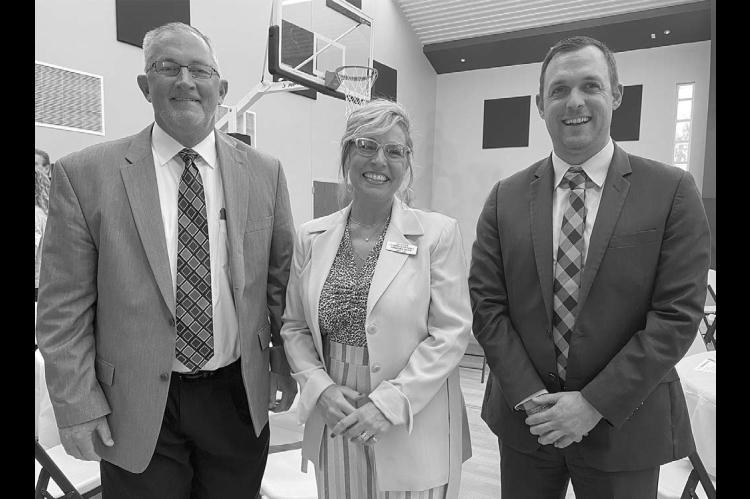
The state of the state and the state of the schools were both topic of discussion in two unrelated back-to-back events Wednesday in Kingfi sher.
Gov. Kevin Stitt visited Pioneer Telephone Cooperative, meeting with General Manager Blake Callaham and president of the board of directors Gail Parker and touring facilities before updating employees on the current state of affairs in Oklahoma.
Stitt was accompanied by State Sen. Darcy Jech (R-Kingfisher), State Sen. MikeDobrinski(R-Okeene) and former state representative and house majority leader Mike Sanders.
Dobrinski also is a member of Pioneer’s board of directors.
In a separate event, the Kingfisher Chamber of Commerce’s monthly Biz-Connect luncheon, Kingfi sher Superintendent David Glover and Chisholm Trail Technology Center Superintendent Kurt Thomas discussed the state of their respective schools.
Fortuitious Timing
Stitt’s appearance at Pioneer was well-timed, since the Legislature is slated to reconvene in special session this week to vote on dozens of proposals for use of the state’s American Rescue Act funds, many of which focus on the expansion of broadband services.
The proposals were advanced by a joint House and Senate Committee on Pandemic Relief.
“The Legislature will be working on passing appropriations bills to spend $1.87 billion in recovery funds next week that will then be put on the governor’s desk,” Stitt said.
A Pioneer employee asked a question from the audience about whether national telecommunications companies will have an advantage over Oklahoma- based concerns when it comes to how the additional broadband funds are invested.
“We’re going to be leaning toward Oklahoma companies rather than national companies for broadband expansion,” Stitt said.
In a news release issued Thursday, State Rep. Logan Phillips (R-Mounds), co-chair of the Transportation, Infrastructure and Rural Development Working Group called the state’s proposed investment in broadband “a once in a lifetime opportunity that will make Oklahoma a centerpiece for the next ‘Industrial Revolution.’” In addition to more funding to build out broadband infrastructure, the proposals include funds for Career Tech training for a broadband workforce.
Other State Indicators
In his talk to Pioneer employees, Stitt also discussed what he sees as positive economic indicators for the state.
“COVID was a beat down for governors across the country. I hope you’ve been proud of how we kept Oklahoma safe and open,” he said.
“I was one of the few governors who refused to do a mask mandate statewide.
“I don’t believe we put our constitution in the attic just because someone in Washington D.C. tells us to.”
Stitt said the state has $3 billion in savings, making it the fourth in the country in terms of overall savings, and posted recent unemployment numbers that were the lowest in state history.
He also praised what he called the state’s “all-of-theabove” approach to energy.
“No one is surprised that Oklahoma is fourth in the nation in oil production and second in natural gas, but we’re also second in wind energy,” Stitt said.
“That’s leading to lower electricity prices, especially when compared to Europe.”
Stitt said the state’s diversifi ed sources for electrical power also proved an advantage over Texas during last February’s sustained deep freeze.
“Typically, our electrical generation mix comes primarily 40% from wind and 40% natural gas, but during the polar vortex, all of that was frozen,” he said.
“But we still have coal production and it went from supplying 8 percent of our electricity to 55 percent during that time.
Stitt said that’s a point he likes to make with young people who think all coalfi red plants should be elimiated.
“I point out to them that if it wasn’t for coal, they wouldn’t have been able to watch TikTok for two weeks,” he joked.
The Governor said he’d also like to see the state become a leader in hydrogen energy production, which he said will require a separate system of pipelines.
Combatting Inflation
Stitt also talked about skyrocketing inflation and the pressure it’s putting on all Oklahomans.
“Because of inflation, I’ve asked the Legislature to do two things: Get rid of the sales tax on groceries, if not permanantly, then at least a moratorium until inflation eases, and vote another quarter-point tax cut,” Stitt said.
“Those are conversations we’re having at the capitol right now.”
State of the Schools
Glover and Thomas shared updates about their respective schools with a packed house at the chamber luncheon.
Each also brought with them and introduced members of their staffs.
Glover’s guests included the entire counseling staff that serves all school campuses: Paula Leffingwell and Tracy Baustert, high school; Lara Kostka, upper elementary; Kris Schaefer, Heritage, Teneille Rother, Gilmour Elementary, and Laci Redwine, contract mental health counselor.
“I can’t say enough about everything they do,” Glover said. “When kids are acting up in school, our first question needs to be ‘what’s wrong?’ “There are almost always underlying issues and that’s what these ladies help figure out.”
Glover, who’s in his first year as superintendent, said he counts himself fortunate to be at Kingfisher.
“We’re blessed financially and blessed with the best educators around,” he said.
“Little Stingers,” the new employee daycare center, is one way the district can keep and attract quality staff, he said.
“It’s not always about the money to get people to come here,” he said, adding that a supportive environment that makes teachers feel valued and respected is also crucial.
Glover highlighted a number of campus improvement projects in the works, including a goat barn adjacent to the ag building, renovating the concession stand at the football field, constructing a locker room for junior high football and soccer.
“Nothing over the top, but things where when people drive by they will say ‘this must be Kingfisher,’” he said.
Major renovations at Gilmour are also on the horison and Glover described replacing the grass football field with artificial turf as a “down the road” goal, making it more usable for sports and band.
Glover said that in his mind, supporting athletics and supporting academics are not either-or choices.
“It’s all the same thing,” he said. “If you don’t have extracurriculars, you can’t educate kids. That’s what gives them the motivation to do well.”
Career Tech Alternative
Thomas described Chisholm Trail Technology Center’s certification programs as a cost- and time-effi cient alternative to a pricy college degree.
“Our focus is skills based and certificate training and we hire the industry professionals to help students achieve that,” Thomas said.
“When you look at the cost of a four-year degree, that puts students under quite a bit of financial strain, with no guarantee of a job at the end.”
He gave the example of a high school student who completes a computer tech certificate before graduation.
“Those students can go to work immediately after high school making as much as $70,000 their first year,” he said. “There’s a high demand for those skills.”
Thomas said the tech school formula is so successful that four-year colleges are trying to “mimic the system” by offering shortterm “micro-certifications.”
He noted that one thing colleges don’t offer is local control. CTTC’s district, serves partner schools in Watonga, Kingfisher, Lomega and Dover, is governed by a locally-elected board of education.
Currently, enrollment in every program CTTC offers is “near, at or over capacity,” he said.
The center also builds relationships with local businesses and works to provide training and certification to meet local demand, he said.
Daniel Craig, former KPS superintendent who is now the small business manager at CTTC, also spoke briefly, discussing services the district offers to businesses.
Ronda Simpson, principal and program director, also spoke and introduced several instructors at the facility, who manned booths prior to the luncheon with promotional and educational materials about their various programs.
Chamber Executive Director Shauna Rupp closed the meeting.