
Taps: Haunting and Appropriate
Kale offers history of military funeral song during Memorial Day service
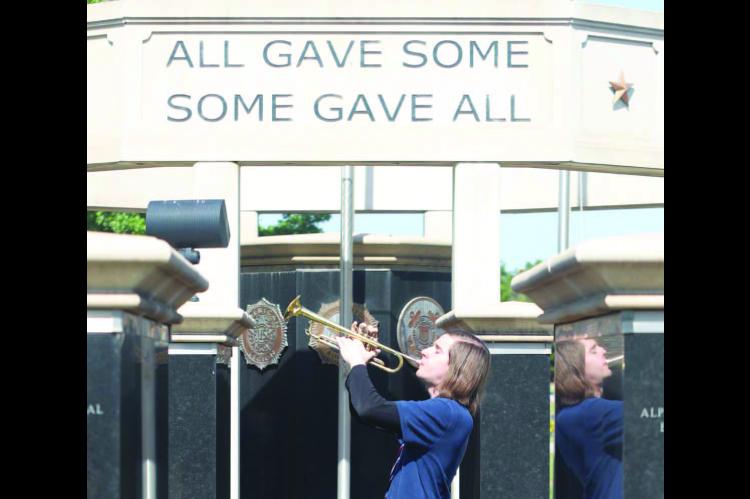
What was historically used to be a way for soldiers to communicate on the battlefield has become the instrument for one of the most recognizable pieces of music known today.
James R. Kale provided the history of “Taps” during Monday’s Memorial Day Service at Kingfisher Cemetery.
Kale is the commander of the Keith Lowry- Henry Ellyson Oklahoma American Legion Post 5 and provided the keynote address during the ceremony.
He retired from the U.S. Army after a 28year active duty career that saw him earn the rank of Chief Warrant Officer Five.
In ancient times of warfare, battle commanders used everything from waving hands to waving flags to transmit information, but it wasn’t reliable, Kale explained.
“There just was no good way to communicate from any distance on a battlefield,” he said. “Slowly, people began to realize that musical sounds played from horns or trumpets could be heard for relatively long distances.”
Therefore a trumpet or bugle ended up being that communications device.
During the Civil War, the trumpet or bugle was used to signal the end of day for troops.
The song played was referred to as “Tattoo” and it signaled that all light in squad rooms be extinguished and all loud talking and other disturbances be discontinued within 15 minutes.
However, explained Kale, General Daniel Butterfield didn’t feel “Tattoo” was quite appropriate.
It was July 1862 and his Union brigade was camped at Harrison’s Landing on the north side of Richmond, Va.
It was after a long, seven-day battle and “the troops were very weary,” Kale explained.
Butterfield was “unsatisfied” with “Tattoo.”
“He wanted something more solemn for the end of the day, so he called for his bugler, a private named Oliver Willcox Morton,” Kale said.
Morton couldn’t read music - he only played by ear - but the general could.
“So they sat into the late afternoon and evening that day working out a more appropriate piece to end the day,” Kale said.
“It turned out it was 24 notes. It’s a pretty short piece, but it is one of the most recognizable musical pieces around the world today.”
Morton played it that night and Kale said the troops heard it and felt it was appropriate.
It became the ceremonial end-of-the-day call, letting the troops know it was time to rest and sleep.
The music began to spread.
“As people heard this, it caught on and began to be played at other places,” Kale said. “Actually, even some of the Confederate troops who heard it began playing it at Confederate ceremonies.”
Soon, it’s purpose became more than that of a signal for the end of the day.
John Tidball was a captain in charge of a burial ceremony for a cannoneer who had been killed in battle earlier in the day.
Normal procedure at such a ceremony was a 21-gun salute by a military firing squad.
“But Captain Tidball was concerned,” Kale said. “Confederate troops were not too far away and he was concerned that if he did the 21-gun salute, the Confederate troops might think a battle was starting and we’d have an ensuing battle in the middle of a funeral.”
In a spur of the moment decision, Tidball had his bugler play “Taps” instead.
“People thought that was so appropriate and that caught on,” said Kale.
So did the name of the song, which happened organically.
“What we call ‘Taps’ - nobody named it that - it just became a name that caught on after the Civil War,” Kale said.
In 1891, “Taps” became mandatory at all U.S. military funerals.
“It’s only 24 notes, but it’s one of those haunting melodies that once you’ve heard it, you can’t forget it,” Kale said.
“Taps” is also played annually during the Memorial Day service.
This year’s rendition was presented by Blake Mayfield, a recent Kingfisher High School graduate, who stood near the base of the Kingfisher County Military Service Memorial.
That came after members of the Post 5 firing squad offered their “Salute to the Dead” with a gun salute.
Kale’s address was followed by the “Armed Forces Medley” performed by members of Vocal Sounds of Oklahoma.
They also sang the National Anthem as well as “America Medley” and “Grand Old Flag” during the ceremony.
Kale was joined by Auxiliary President Gladys Hopkins for the ceremonial laying of the wreath on the memorial.
Post 5 Chaplain Jim Butcher closed the service with a prayer.