
What about that METEOR?
What about that
An article in Wednesday’s Times & Free Press on the 1936-37 construction of the Kingfisher County Jail mentioned a related event that deserved further investigation.
If overseeing construction of “an ultra-modern jail house” weren’t enough of a headache, Sheriff Ed Martin and his wife were among hundreds who witnessed a fireball blazing through the evening sky on Aug. 17, 1936.
The local newspaper article reporting the event mentioned astronomers from Fort Worth visiting town to investigate but the article concluded that the fate of the meteor was never determined.
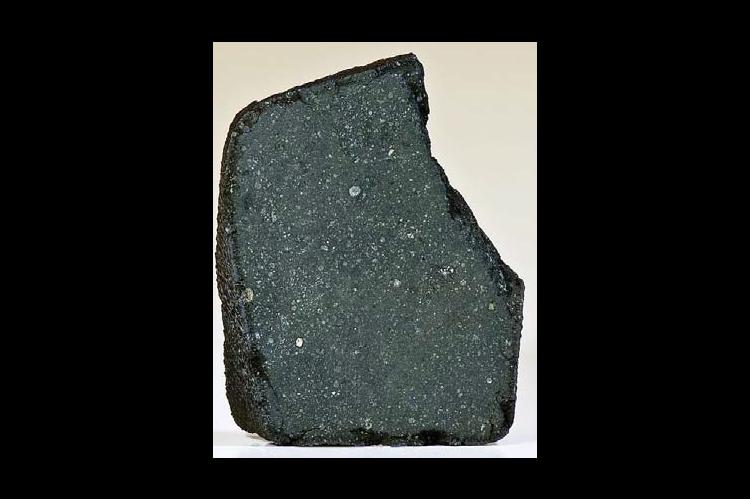
Turns out, meteorite fragments actually did fall to earth and were recovered, the first and largest being found by a 9-year-old boy near Crescent four days later.
The journal Popular Astronomy contained this account in an article published later that year: On the evening of 1936 August 17, at about 7:07 p.m., a fireball moved through the sunlit sky across central Oklahoma. It was very well viewed in most of Oklahoma and was also seen from points in Kansas and Texas, and as far south as Waco and Tyler, Texas.
A field survey of the fireball was made immediately by Robert Brown of the Texas Observers at Fort Worth, Texas, and in addition to securing observations which will be of considerable value in working out the fireball path, Brown was successful in locating the region of probable fall of meteorites, and in retrieving one meteorite from the fall four days later.
Strictly tentative results indicate that the fireball first became conspicuous over the region of Tecumseh, Pottawatomie County, Oklahoma, perhaps a few miles south thereof at a height of about 26 miles.
The fireball traveled roughly northwest at a low slope (about 11°), and underwent several (perhaps three distinct) explosive flares. Detonations were heard in a region along much of the primarily observed path, in a strip at places almost 100 miles wide.
A terminal explosion cloud was formed by the final flare at a height of about 13 miles just northwest of Guthrie, Logan County, and persisted with little drift for 15 minutes or more.
The meteorites were recovered beyond the terminal cloud, not far from the town of Crescent (for which they eventually were named). The first one was picked up on the third day after the fall, in fresh condition, by a boy of almost 9 named Eddie Gene Johnson, who was rabbit hunting.
(A picture of the Crescent meteorite found by little Eddie appears on Page 1 .)
While the meteorite’s discovery was not reported in the local newspaper, the Kingfisher Times did report that the meteor sighting happened during a period of several weeks when “the sky at night has been filled with shooting or falling stars.”
Modern skygazers would probably recognize that the newspaper was describing the Perseids meteor shower which can be seen over Oklahoma every August.
But lacking such knowledge in 1936, “some serious minded residents believe it is the beginning of the end and Gabriel’s trumpet will soon be heard,” the Times reported.