
‘Goes with the neighborhood’
Well-versed in all things regarding flood, Walter takes it in stride
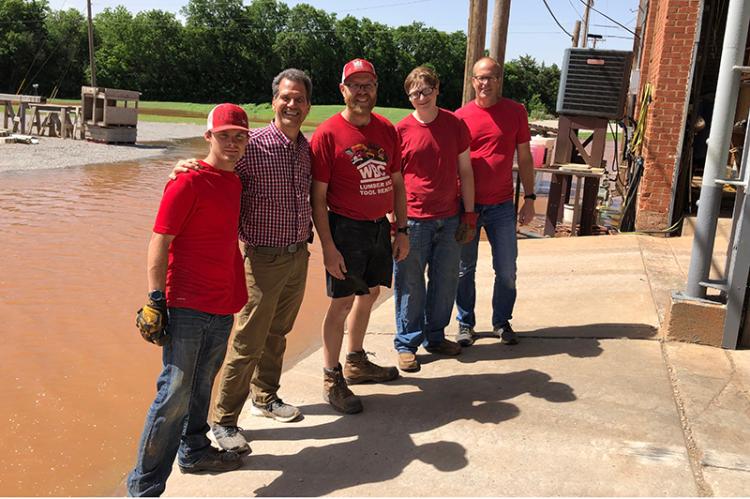
Last Tuesday’s flood was far from Kingfisher business owner Brian Walter’s first rodeo.
“Goes with the neighborhood, doesn’t it?” Walter said early Tuesday afternoon, pausing only briefly as he and his employees hustled to move merchandise at Walter Building Center to higher ground.
Located for nearly 25 years in the 400 block of North Main Street, the building center has seen its share of rising water.
Most memorable, by far, was the so-called 500-year flood in August 2007, when the water reached a depth of 42 inches inside the store.
Considering the building’s floor is constructed a couple feet above street level for the very reason that it’s located in a flood prone area, that was some mighty deep water.
That’s the flood that inundated more than a hundred of the city’s homes and businesses in low-lying areas, with water reaching nearly six feet in depth inside some buildings.
Along with many others, Walter worked every day for six months to get his building center back in business, shoveling out mud and debris, salvaging what merchandise he could and inventorying and storing what he couldn’t until he was reimbursed by insurance.
“I actually had to pay to put all that muddy merchandise in storage,” he said. “I couldn’t destroy it until the claim was paid.”
But it was after he was back in operation that the real work began. Walter launched a legal and political campaign lasting another three or four years to reduce the risk of future flooding.
“I felt like God put it on me that I was supposed to do something about that flood,” Walter said.
First, A Lawsuit
His first step came when another local businessman pointed him in the direction of a friend, Enid lawyer Brad Gungoll, who was taking on the railroad.
Turns out Union Pacific’s railroad bridge east of town was in violation of a law which requires such bridges to have a neutral impact in significant flood events.
Gungoll’s contention was that the water level was significantly higher on one side of the bridge than on the other during the August 2007 flood and that the bridge itself was acting as a levy to hold water in town, causing it to rise to higher levels and take longer to recede.
But Gungoll needed plaintiffs – local property owners impacted by the flood – to provide data and other evidence that supported his argument.
That’s where Walter came in.
“I went on a campaign to talk to those affected to convince them to pursue this claim,” he said. “In time, more and more people joined and it became a lawsuit.”
The court action ended in the railroad paying out several million in damages and reconstructing the bridge to triple the size of the opening underneath, Walter said.
A Political Solution?
While the wheels of justice are famous for moving exceedingly slowly, they don’t have anything on the ponderous machine of politics, Walter found.
“The court process seemed like a blink of an eye compared to what it took for the government to act,” he said.
With the support of fellow local businessman Mike Johnson, who was a state senator at the time, Walter and then-city manager Richard Reynolds lobbied the Legislature for flood control funding.
“The governor actually came to visit my shop after the flood,” Walter said, noting that he has a picture capturing his meeting with Brad Henry. “He said he was sorry about what Kingfisher was going through and I said ‘we don’t need sympathy, we need help.’”
Eventually, several million was allocated to Kingfisher for flood control as part of a larger omnibus spending bill, but before the funds were actually appropriated, the bill was challenged and overturned in court on procedural grounds.
Eventually, the money was awarded again in a new bill that passed constitutional muster and Walter became part of a Kingfisher committee to determine how it could best be spent.
He and Reynolds favored funding a system of dams and levies constructed in the Kingfisher Creek watershed, similar to the successful system built decades ago to control flooding along Uncle John Creek.
But updated state and federal government studies demonstrated construction of the number and size of lakes required to achieve even a slight reduction in flood levels was cost prohibitive and possibly risked lives and property downstream if the dams should malfunction, Walter said.
Property Buyout Begins
Instead, the city maximized its state allocated money by using the majority of it as matching funds for a series of Federal Emergency Management Agency disaster mitigation grants that financed the voluntary buyout of qualifying flood-impacted properties, allowing residents and businesses to move to higher ground.
To date, 82 parcels have been purchased from property owners choosing to participate, allowing those structures to be demolished, and another nine acquisitions are in progress.
Based on its flood history and the amount of damage sustained, Walter Building Center was among one of the first groups of properties qualifying for the buyout, an option Walter gave very serious consideration.
“I drew up blueprints and picked out a lot and had it all worked out, but in the end it was just going to cost too much money,” he said.
While several owners of commercial properties did participate in the buyout, Walter noted that most of them were landlords with
UNDER WATER - Above is an aerial shot captured from a drone video shot by Kelly Kopp, who documented much of the flood damage in Kingfisher. Below is a closer look of the flood waters as they rose up on the southwest corner of Walter Building Center. [Photos provided]
commercial tenants, not the actual business operators.
“Although many commercial buildings are now gone (from the flood zone), not a single owner-operator who wanted to remain in business took the buyout and then bought or built a new building,” he said. “For me, there was nothing else available to buy and the buyout offer was really not enough to build something new.”
Walter said he also has “an emotional attachment” to his location in addition to the sheer economic value of having a Main Street storefront that is readily accessible to his existing customers and attractively visible to new ones.
Vigilance Required
As part of his calculation to stay put, Walter knew he had to prepare for the possibility of future flooding and be willing to put in the effort to protect his financial investment.
That means starting as soon as the possibility of high water is forecast to move merchandise and equipment either up or out of harm’s way.
It’s a drill he knows well and one he and his employees have run a dozen times or so when floods threatened but never materialized.
But twice more – in 2015 and 2017 – flood waters rose in town again, stopping both times mere inches from Walter’s Main Street storefront.
When conditions ripened for a repeat event last week, Walter and his employees went back into action once more, starting Monday by moving or elevating equipment and lumber stored in the yard behind his shop and then working all day Tuesday to protect merchandise inside.
To accomplish that, Walter customized sawhorses to extend their height from the standard 36 inches to 48 inches, laid plywood on top and then emptied all his merchandise shelves onto those makeshift tables “just like a big rummage sale.”
Meanwhile, he carefully monitored the rising water throughout the afternoon.
“I began tracking it about 4 p.m. and the water was rising about eight vertical inches an hour and then slowed to two vertical inches per hour at 5:30 p.m. and at 9 p.m. it appeared to have crested,” he said.
Once again, the water stopped rising just inches from the top step leading into the store.
Those Critical Inches
Every flood event is different, Walter knows, and any number of factors could have contributed to the last three being less severe than the 2007 disaster.
But he also thinks the railroad’s three-fold enlargement of its bridge opening is one of those factors.
“If it caused a drop in water levels by 12 or eight or even six inches, that can make all the difference,” he said.
And while his business didn’t directly benefit from the buyout program, Walter knows the city as a whole is reaping rewards from that effort.
“I’m really happy for the community that so many homeowners have moved out of the flood zone,” he said. “It was much nicer to look out over all that water where all those homes used to be and know those lives and property are no longer at risk.”