
An ace in the hole and up his sleeve
Qualifying for pro tour, NCAA ruling gives Mason Overstreet options after senior golf season was cut short
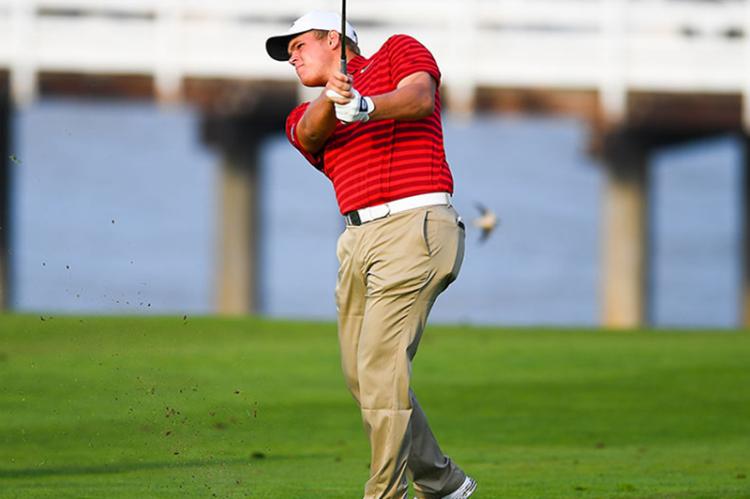
Mason Overstreet’s college and professional worlds crossed paths late last week.
One has the Kingfisher High School graduate excited and the other beyond disappointed.
But, for now, both have him questioning what his future holds.
Overstreet shot an evenpar 72 last Friday at the Robert Trent Jones Golf Trail at Highland Oaks in Dothan, Ala., to solidify his spot in the upcoming MacKenzie Tour of PGA Canada.
A senior on the University of Arkansas men’s golf team, Overstreet’s final day gave him a 4-under-par 284 over four rounds, good for seventh place overall in the MacKenzie Tour Qualifying Tournament.
Wake Forest University’s Cameron Young won the tournament, which gave him a full year’s exemption on the Tour, which is 12 events.
However, second-14th places are exempt for half of the events, meaning Overstreet could feasibly turn pro when the MacKenzie Tour begins May 28 with the Canada Life Open in Vancouver, B.C.
“The biggest thing I can take away (from the qualifier) is the confidence that I have the ability to play professional golf,” Overstreet said. “That’s a pretty big confidence booster for me.”
Unfortunately for Overstreet, he doesn’t yet know if he’ll be taking full advantage of last week’s accomplishments.
Just minutes after finishing his third round on Thursday, Overstreet was hit with some sobering news by college teammate Luis Ge Garza, who was also playing in the qualifier.
“’They just canceled our season,” Overstreet recalls Ge Garza telling him. “’We're going to online school.”’
Overstreet quickly learned his friend was telling him the truth. The NCAA had announced that day that it was canceling its winter and spring national championships in an effort to help curb the ongoing spread of the coronavirus.
“It’s gotten progressively worse,” Overstreet said.
Conferences, such as the SEC followed suit and then the individual universities.
Spring seasons, such as Overstreet’s senior year of golf at Arkansas, were done essentially before they began.
“Obviously we were all really disappointed,” said Overstreet, who was the NCAA runner-up individually as a freshman in 2017.
Within days, however, there was some hope restored.
The NCAA let member schools know they were strongly considering offering an extra year of eligibility to athletes in spring sports who lost their entire seasons.
That’s good news for Overstreet, who could return to Arkansas for another season or opt to turn pro.
Or somewhere in the middle.
“It’s nice to have options,” he said.
Overstreet said he met with his college coach to discuss the myriad of options on Monday.
“The NCAA’s move would give me a chance to come back and play in college another year and work on things I need to improve on,” he said. “You can’t replace the college experience and having all the stuff from your senior year taken away leaves a bad taste in your mouth.”
Then there’s realizing the dream of turning pro.
Overstreet is guaranteed six events in Canada and possibly more if he performs well enough.
However, he could play in just a couple of the events as an amateur, retain his amateur status and still return to Arkansas for a final year.
“I’m not sure which direction I’ll go yet,” he said.
And, then again, the decision might be made for him.
“Right now we’re not sure what’s going to happen with the MacKenzie season,” he pointed out. “Hopefully they’ll still be on and I’ll have that chance to play.”
He earned that right with four solid rounds in Alabama.
If he headed southeast last week with any doubts, he wasn’t feeling them after his practice round.
“To be honest, that course might as well have been designed for me,” he said.
Overstreet said he’s currently struggling off the tee, but the course was mostly wide open, which helped him out.
“And I’m hitting my putter and wedges really well right now and you have to be able to do that there,” he added. “After my practice round, I thought I was going to play well and have a chance to get in that top-14.”
Overstreet shot 2-under 70s in each of his first two rounds.
That led to what he called “one of the weirdest eighthole stretches I’ve ever had.”
The third round began on the back-nine for Overstreet and he promptly birdied his first hole.
He got abad lie on the next hole and ended up bogeying the par-511th.
Two more bogeys followed and he was sitting at 2-over through just five holes in his round.
His spirits lifted on the 15th hole when he buried a 30-foot putt for birdie.
Then, on the 17th hole, the wildness continued... even accelerated.
Overstreet carried an 8-iron onto the tee box for the 160-yard par-3.
His shot landed 15 feet short of the pin and started rolling toward the hole.
And it dropped.
Hole-in-one.
“I tossed my club and raised my hands in the air,” Overstreet said.
But that was the extent of the celebration.
“Normally when you make a hole-in-one, someone yells,” he said. “But the guys in my group were so laidback and nobody else was there.”
The ace, Overstreet’s first in a competition round, put him at 1-under through eight holes despite three bogeys.
“I didn’t know if I was going to make a par the whole day,” he said.
Overstreetleveled out and finished his day at even-par, then finished the tournament with another 70 Friday, the day after most of the sports world shut down.
“My scores weren’t quite as low as I was expecting,” Overstreet said. “There were some tough pins and the greens got firm, so it was tough to hit it quite as close.”
Overstreet said he was surprised he and his fellow competitors took to the course Friday.
“I couldn’tbelieve we still played the final round,” he said. “It was the day after the PGA Tour canceled and we were basically the only sporting event still going.”
There were stories posted by media on each of the first three rounds, but none after the last day.
“There were no interviews or anything like that,” Overstreet said. “I think everyone was ready to just get out of there.”
Overstreet returned to Fayetteville, Ark., and will soon be in Kingfisher.
That’s because there’s “nothing for me to do” at his college home.
Athletes can’t use collegiate facilities to practice, work out or even have a team meeting.
“The only things open for us here are the dining and academic areas,” he said.
So he’ll return “home” to the place he became Kingfisher High School’s first male state champion golfer in 2015 and earned All-State in 2016.
“It’s going to be weird being home for about six weeks when school and golf are normally going on,” he said. “This is pretty unprecedented what we’re dealing with here.”