
Airport board, city talk funding issues
City approves lease renewal, hangar painting; declines additional funding
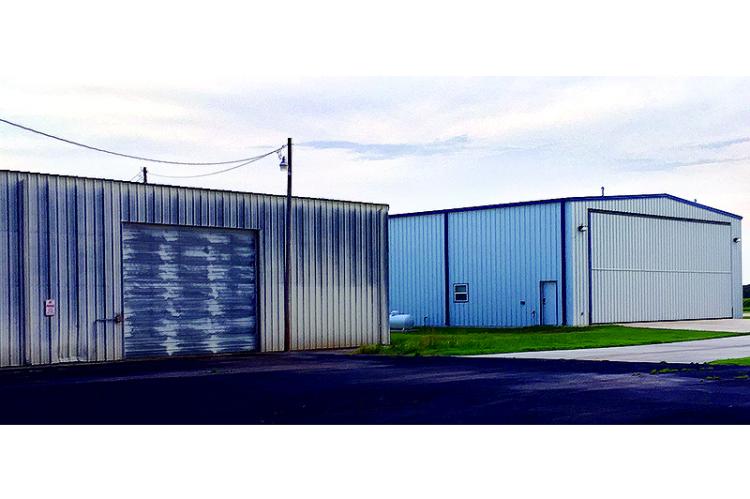
Kingfisher city commissioners voted Monday night to renew a five-year lease with the Kingfisher Airport Authority for the municipal airport but refused the authority’s request for additional funds for cosmetic improvements for aging hangars.
Airport authority chairman Bill Reitz addressed the commission at its regular July meeting to answer questions raised during a lengthy airport discussion during budget talks at the June city meeting when no authority representatives were present.
Unique Public Trust
Created five years ago, the airport authority is the only one of the public trusts established under the auspices of Kingfisher city government that has a separate board of trustees.
City commissioners serve as trustees for all the other public trusts, including the Kingfisher Public Works Authority, Kingfisher Recreation Authority, Special Projects Authority and Kingfisher Hospital Authority.
In addition to Reitz, the airport authority board of trustees includes Mike Rosen, Tanner Farrar, Tom Feagins and Randy Pritchett, all of whom were present Monday night.
While the airport trustees have independent authority to approve airport projects and set rules and regulations governing airport operations, the airport account is set up as a subaccount with the city’s general fund, so that expenditures must also be approved by city commissioners.
Recent Improvements
Most of the airport authority trustees began as members of an advisory group 12 years ago when the city began seeking grants to pave its then grass runway and fund other improvements.
Out of the state’s 77 counties, Kingfisher was the last without a paved runway, making it difficult for fully-loaded spray planes or larger planes to land there in inclement weather.
“When we started 12 years ago, we had about three airplanes out there plus a couple more that weren’t flying,” Reitz said. “Today we have 15 airplanes based there.”
Through grants from the Oklahoma Aeronautics Commission, the city and airport have constructed a lighted, concrete runway, installed automated fuel tanks and developed surrounding properties to lease for hangar development.
Three private hangars have been constructed by Feagins, local pilot Mike Matthews and Craig Michael, who operates a spray plane service for Wheeler Bros.
Michael and Matthews also attended Monday’s meeting.
Michael pointed out that a locally-based spray plane service has benefited county farmers by increasing crop yields.
“The airport provides a lot of hidden economic benefits to the area that a lot of people don’t think about,” he said.
Additionally, Farrar operates a flight school and is currently training nine students at the airport, one of whom recently earned a private pilot’s license.
The facility also attracts a number of visiting pilots who stop to refuel and then take advantage of the courtesy car the city makes available to visit local restaurants before flying out again, Reitz said.
In response to concerns expressed last month by City Manager Dave Slezickey and some commissioners that the airport is missing opportunities to generate revenue, the authority has raised its monthly rental for city-owned hangars to $100 each for four spaces in the community hangar and $125 each for six T-hangars, Reitz said.
All hangar space is currently rented except for one $100 space in the community hangar, he said.
He also corrected what he said was a misconception that the airport authority kept its fuel prices artificially low to draw business from other area airports.
Reitz said the airport sells about 9,000 gallons of fuel a year and adjusts its prices about every four months when it purchases new fuel.
“We take the cost we pay for fuel, including freight charges, add 25 percent plus another 6 percent to cover credit card fees,” he said. “We don’t even look at what other airports are charging.”
Since 2015, the city has provided $10,000 annually for airport fuel purchases, with revenue from fuel sales going into the airport fund, according to documentation City Manager Dave Slezickey distributed to commissioners after Monday’s meeting adjourned.
After commissioners voted to renew its lease with the airport authority for the airport property, Reitz requested additional funding from the city to repaint all the public hangars and replace guttering on the community hangar so that the aging buildings more closely match the new hangars.
He said the airport obtained three estimates for the painting and an additional estimate for the guttering and the total cost would be a little over $26,000.
“You’re the authority. If you want them painted, you can have them painted,” Mayor Steve Richards said. “I’m not opposed to helping you, but we’re a business too and our funding needs are just as valid.”
“We have about $51,000 in our fund currently and we’re looking toward getting another grant from the aeronautics commission to repave our approach apron in 2021 so we’ll need $20,000 or so for matching funds for that,” Reitz said.
He said he understood from a previous conversation with Slezickey that matching funds for the grant will have to come from the authority’s account, but Slezickey said Monday night that wasn’t correct.
“We’re not going to leave free money on the table when a grant is available,” he said. “We wouldn’t hesitate to provide the matching money.”
Commissioner Wendell Prim made a motion to split the building refurbishment cost 50-50, then Rosen asked from the audience if the city would make the split 75-25.
“Sure, we’ll be glad to consider paying 25 percent instead of 50,” Richards quipped.
“Up the hangar (rental) rates another $25,” Slezickey said.
“The hangars have never been improved. The doors may work or they may not. Water stands in them when it rains,” Feagins said. “It’s hard to justify going up a lot more because of the condition of the hangars.”
Rosen noted the hangars were in their current state of deterioration when the authority first leased them from the city five years ago and suggested that the city should bear some of the cost of the cosmetic enhancement.
“Yes and we’re also looking at five years when you never raised the (rental) rates,” Richards said.
Prim’s motion died for lack of a second and was followed by a motion from Commissioner Bill Tucker to approve the repainting project, with the entire cost coming from the airport fund.
“If their funds get low later on, we can make adjustments (by transferring money into the account from other city funds) but they’re generating revenue now,” Tucker said.
Commissioners voted unanimously to approve Tucker’s motion.
Reitz said the authority might consider painting just the large hangar this year to keep from draining too much from its operating fund, adding that decision will be made at a future meeting of the authority.
Authority members also requested to have input in next year’s budgeting process so that they could provide an estimate of needs and projected revenue for the airport for Fiscal Year 20-21.
Reitz and the other authority members left the meeting at the conclusion of the airport discussion.
After the city meeting adjourned some time later, Slezickey distributed a spreadsheet to city commissioners showing the airport revenue and expenses for the last 10 years and a second chart showing city transfers to the airport fund, which he also made available to the Times and Free Press.
According to the chart, the city has transferred $1.376 million to the airport fund from 2006 to 2020, including fuel costs and matching funds for aeronautic commission grants that paid for runway construction and lighting.
Slezickey told the Times and Free Press the handouts were “an informational distribution to quantify the city’s contributions” to the airport improvements listed in Reitz’s presentation to the commission.