
Bad BLT makes for busy retirement
10 greenhouses later, Don Blehm grows makings for perfect sandwich
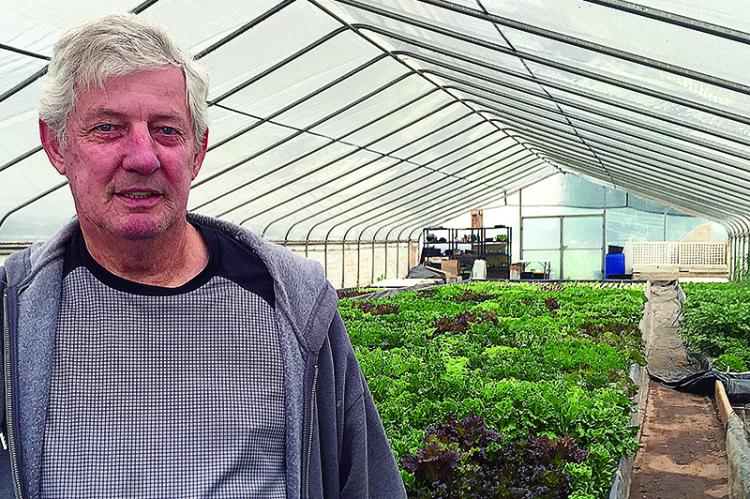
If you get bored by retirement, Kingfisher resident Don Blehm has a suggestion:
Build a green house, or in Blehm’s case 10 of them.
Blehm blames a BLT sandwich for causing him to launch a more than full-time business in his retirement years.
Blehm recalls thinking a few years ago he would like a bacon, lettuce and tomato sandwich.
So he bought the ingredients and made the sandwich.
When he sat down to eat it, first he threw away the tomato; then he threw away the lettuce and thought, “I can do better than that.”
After that’s when he built his first greenhouse on the farm his grandfather, Sam Blehm, bought in 1923 in the Omega community.
Don grew up helping his granddad on the farm as time permitted.
Although he was born in Oklahoma City, his parents later moved to Kingfisher and he graduated from Kingfisher High School in 1968.
Blehm began his horticultural enterprise three years ago, after retiring from Chisholm Trail Technology Center.
The idea had been growing for some time before he retired.
Since then, he has built 10 growing houses in which he grows a wide range of vegetables.
He built his first four buildings with the help of a grant through the National Resources Conservation Service (NRCS), a division of the Department of Agriculture.
A 30 by 96-foot hot house costs about $8,000 to build. He has four of those at his facility, along with five 20 by 96-foot houses and one 30 by 198-foot house.
The wooden frames are covered by 6-millimeter plastic. Four were damaged by high winds after he opened. He has repaired two of them, putting them back in service, and is still working on the other two. In the meantime he has added additional buildings.
Strawberry Season Ending
Strawberry season is coming to a close. Tomatoes will be ready around the first of June.
Because of his climate-controlled greenhouses, he can produce vegetables earlier than traditional gardeners.
He starts the seedlings in the cold weather months before transplanting them to the growing stations overlaying the soil on the family farm.
While it is not a totally organic garden, he uses no pesticides or herbicides in the greenhouses.
The vegetables run from lettuce and tomatoes to spinach to peppers (from Bell to Jalapeño), carrots, and squash.
His hydroponics house alone holds 17 varieties of lettuce and two of celery.
He sells most of his produce at present to a company in Oklahoma City, Urban Agrarian, but also has a number of county customers who buy from him at the greenhouses, northwest of the Lomega High School.
Blehm has had a varied career in several states, retiring from Chisholm Trail Technology Center just prior to starting the greenhouse-produce business.
Blehm said after he retired from Chisholm Trail, he decided he needed something to fill his time. He had been a part-time farmer up to that time.
The greenhouses more than fill the need for something to do, often requiring dawn-to-dark workdays – and beyond. He admits to working 60 to 80 hours a week.
While he doesn’t have a local outlet for his vegetables at present, he is considering opening one in the future.
Langston Doing Research
As a Times and Free Press news representative visited the site, representatives from Langston University’s agriculture department arrived to begin a tomato research study at his facility, comparing various factors related to tomatoes grown in a greenhouse setting as opposed to outdoor production.
Keisha Watson-Scott and Micah Anderson of Langston University received full access to a fresh greenhouse for their study just as Blehm’s Greenhouse employees, Eva Bierig and Debby Taylor, completed the finishing touches to a greenhouse for them, laying timed watering equipment to each plant station.
Blehm waters tomatoes three times a day. Frequent watering keeps the ripe tomatoes from splitting, he explains.
He also uses an all natural ingredient bug killer, featuring jalapeño pepper juice. No insecticides or other chemicals are used inside the buildings.
Sticky plastic strips, like old-time fly traps, are placed strategically among plants to trap insects before they can attack the vegetables.
Weeds inside the greenhouse are removed by hand.
Blehm has no definite idea of the number of the types of plants growing at any one time because the mix keeps changing…and expanding.
Through trial and error he has learned a number of varieties that work best in the operation.
He attends numerous clinics and conferences in Oklahoma and elsewhere to help keep himself updated on the industry.
He says he has never failed to learn something useful at any clinic he attended.
Besides, he picks up tips talking to other growers.
It’s a never-ending learning process, he observed.
The operation evolves constantly.
For instance he has begun growing flower planters because of customer requests and he is preparing to initiate an herb building.
His hydroponics building has section after section of lush lettuce floating in their growing containers on a bed of water.
He no longer farms the rest of his land, leasing it to a neighbor.
The water for his plants comes from a rural water district.
Propane provides controlled heat for the houses.
He explains that the heaters keep the buildings just above freezing in cold weather – just enough to keep the plants alive and healthy, not like a sauna.
Maybe the biggest advantage to him personally is the healthy diet it helps him maintain. Much of his food comes directly from his own greenhouses.
Besides, it beats sitting around – or trying to find the just right ingredients for a BLT.