
Blood Platelet Champion
Roy Fisher completes donation of 18th gallon and still going strong
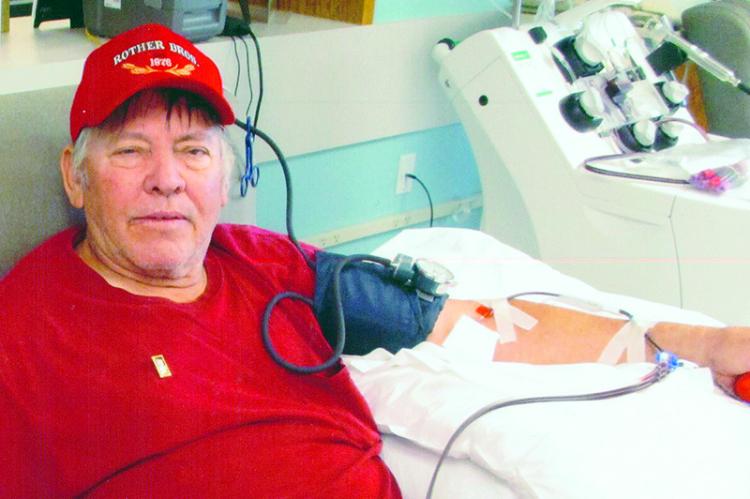
Roy Fisher of Loyal is known as the blood platelet champion by the Oklahoma Blood Institute Donor Center at Enid.
He received a pin Saturday from OBI designating the donation that completed his 18th gallon of blood platelets giving.
The OBI tells him that each pint of platelets saves five to seven lives.
That 18-gallon mark came over a span of several years and 144 trips to the OBI center in Enid.
More than that, he gave three gallons of his O+ whole blood in California where he worked for a number of years in the drilling business before returning to Kingfisher County in 2007.
Occasionally the OBI calls him when it has a special need – like the time he was on a deer stand.
A member of the First Baptist Church in Kingfisher, Roy never charges for his gifts of life. (OBI doesn’t pay for blood donations, but some agencies do.)
“I think this is what God wants me to do,” he explains.
Giving blood platelets requires two hours of time hooked up to the machine that removes platelets from the whole blood – as opposed to the minutes it would take him to donate a pint of whole blood, thus each excursion to OBI requires at least half a day of his time, including drive time.
Platelets are the smallest cell-like structures in the blood and are important for blood clotting and plugging damaged blood vessels.
Fisher has an unusually high number of them, making his donations important to OBI and to the patients that get them.
“Platelets are the cells that circulate within our blood and bind together when they recognize damaged blood vessels,”explains Dr. Marlene Williams, assistant professor of medicine at Johns Hopkins Bayview Medical Center in Maryland “When you get a cut, for example, the platelets bind to the site of the damaged vessel, thereby causing a blood clot. There’s an evolutionary reason why they’re there. It’s to stop us from bleeding.”
Platelet sorting is completed by a machine while the donor is hooked up on the IV.
Platelet donations are limited to once in a seven-day period and 24 times a year.
Fisher’s arm is dotted with scars from the many needles used to take the blood.
It hasn’t always been easy for Fisher to make his regular visits to the blood center. Sometimes he had to scramble to find the money to buy gas for his trips to Enid in the early days when he first began giving after returning to Oklahoma.
Now semi-retired after a career of working in the oilfields as well as drilling environmental monitoring wells in California, New Mexico and other states, he spends his time now helping his cousin, Clark Vilhauer, with farm work when he needs it, attending services at the First Baptist Church, singing in the Federated Church Choir and hunting as the various seasons roll around.
He also sings with the Kingfisher County Community Choir when it performs concerts.
The son of the late Marvin and LaVaughn Vilhauer Fisher, he grew up on a farm in the Loyal area and graduated from Kingfisher High School in 1969.
The OBI tells him he has the highest blood platelet count of any of its donors.
Now 68, he takes no medicine and leads an active life.
He says he smoked some in his earlier years but gave it up because he didn’t like the coughing it caused.
Clean living and a calling to help others provide an ideal situation for both Fisher and the Oklahoma Blood Institute.