
Bone-chilling Arctic blast puts February in state record book
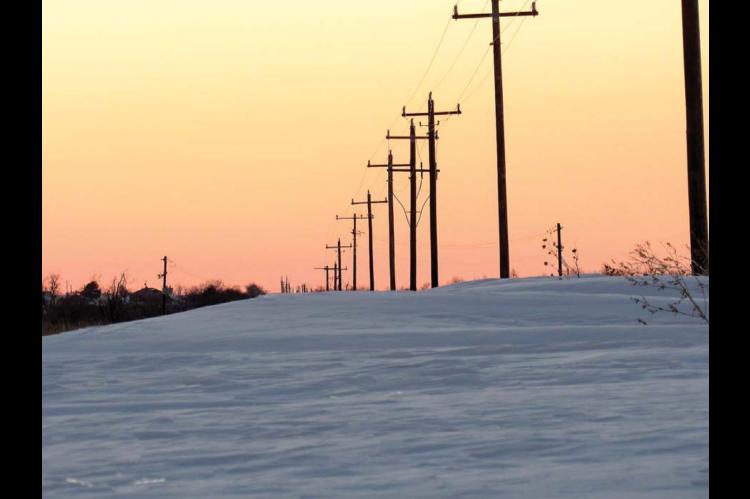
Oklahoma experienced a historic cold air event during February, boosting the month into the company of other legendary frozen periods from calendar pages long torn away and discarded.
February 1895, February 1899, and January 1930 all suffered through exceedingly long cold spells. More recently, December 1983 still lives in the minds of many Oklahomans as the bellwether of cold months, which followed those winters of the late 1970s when bone-chilling cold was simply a way of life; but those cold times were more than 37 years ago.
Even February 2011 and its all-time state record low temperature of minus 31 degrees at Nowata, and all-time low wind chill of minus 47 degrees at Medford, still managed to finish only 2 degrees below normal. All the more shocking then to see the return of a generational winter blast, complete with ice, snow, and plenty of misery.
A seasonable first few days of February soon gave way to a preliminary blast of Arctic air on Feb. 7, dropping temperatures across the state into the 20s and 30s. Several rounds of freezing drizzle provided treacherous travel conditions across the state.
Temperatures continued to plummet over the next seven-10 days, culminating with historically cold air Feb. 14-16. The statewide average temperature on Feb. 15 was minus 0.7 degrees, more than 40 degrees belownormal and the single coldest day statewide since at least 1915.
Sparse station coverage prior to 1915 prevented accurate statewide estimates for comparison.
The previous record coldest day was Dec. 22,1989, with an average of 1.9 degrees.
Feb. 15-16 and Feb. 14-16 also set records as the coldest two-day and three-day periods at -0.1 degrees and 2.1 degrees, respectively. Lowest minimum and maximum temperature records fell throughout the state over those days. The records for four-day through seven-day periods were all set in December 1983.
Unlike many of the state’s garden variety cold spells, this event extended to Oklahoma’s southern border and beyond. Ninety-six of the Mesonet’s 120 sites recorded their alltime record low temperature on either Feb. 15 or Feb. 16. Mesonet temperature data go back to 1997.
Overnight on Feb. 16, all 120 Mesonet sites were below zero for the first time in its history. The Mesonet site at Broken Bow reached a low of minus 9 degrees on Feb. 16, topping the town’s previous all-time record low of minus 5 degrees set at the National Weather Service’s cooperative observer site on both Jan. 12 and Jan. 22, 1918.
The cooperative site at Idabel reached a low of minus 12 degrees the morning of the 16th, breaking the previous all-time record low of minus 11 degrees from Feb. 2, 1951.
Healdton’s minus 17 degrees from the 16th now tops all its record lows dating back to 1894. Oklahoma City’s minus 14 degrees on Feb. 16 is its second lowest temperature on record behind minus 17 degrees from Feb. 12, 1899.
Tulsa’s minus 14 degrees, also on the 16th, is its fourth lowest temperature dating back to 1905, with a top mark of minus 16 degrees from Jan. 22, 1930.
At least eight long-term NWS sites with periods of record of more than 70 years broke their all-time record lows during the event. Even the high temperatures were extraordinarily cold, at times below the record daily low temperatures.
Medford and Billings both recorded high temperatures of 1 degree, on the 15th and 16threspectively, whichwould have broken the previous record low temperatures for the day at those locations. That feat was repeated across the state numerous times between Feb. 14 and Feb. 16.
The Oklahoma Mesonet’s 120 stations recorded wind chill values of minus 10 degrees or lower 439 times between Feb. 12 and Feb. 19, bottoming out at minus 36 degrees at Boise City on the 15th.
The state’s all-time record lowest wind chill is minus 47 degrees on Feb. 10, 2011, at Medford. There were 38 wind chills of less than minus 30 degrees, and 251 less than minus 20 degrees. Temperatures slowly climbed back to something akin to seasonable by Feb. 20 when every site in the state broke the freezing barrier, many for the first time since Feb. 7.
That 13-day span matches what many locations experienced in the deep freeze of December 1983. The Mesonet site at Lahoma spent the most time under the freezing mark at 334 hours from the afternoon of Feb. 6 through the afternoon of Feb. 20.
Even locations in far southeastern Oklahoma spent over 200 hours below freezing.
Another key similarity to past extreme cold events was an abundance of frozen precipitation.
Snow shovels were still busy clearing sidewalks and driveways after the first storm over Feb. 14-15 when the second storm hit on Feb. 16-17.
Between the two snowfalls, totals of 5-15 inches were common across the main body of the state, with a bit less in the far northwest and the Panhandle.
The NWS cooperative observer at Roosevelt in southwestern Oklahoma led the state with an official report of 17 inches of snow, although unofficial reports of higher totals were scattered around.
Strong winds gusting to over 40 mph pushed the dry snow into piles several feet high, drifting roads shut and creating hazardous driving conditions.
The frosty two-week span took a tremendous toll on Oklahoma.
A state of emergency was declared by Gov. Kevin Stitt on Feb. 12 for all 77 Oklahoma counties, and President Joe Biden declared all 77 counties as federal disaster areas on Feb. 18 at Stitt’s request.
The Oklahoma Department of Emergency Management and Homeland Security reported a total of 750 weather-related injuries, with 538 of those being due to slips or falls.