
As the Caissons Go Rolling Along
Brother’s burial at Arlington brings new appreciation for Veterans f Day
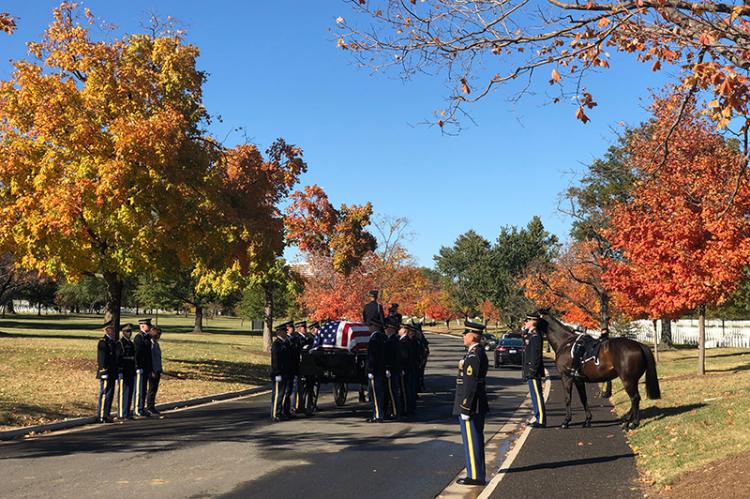
I have always observed Veterans Day and honored those who have fought or are fi ghting to maintain the freedoms and privileges we enjoy, but this year my understanding of Veterans Day became ever more personal and far more meaningful.
Although my family is filled with veterans and I grew up as an “Army Brat,” it is this year that brought a true understanding and appreciation of the word Veteran and the true meaning of Veterans Day.
This year I saw Arlington National Cemetery for the first time and buried my brother in its hallowed ground.
For the first 25 years of my life, saying goodbye to family and friends was the “norm” rather than the exception, for as the child of a military family and until I married a wonderful Okarche farmer I met at Oklahoma State University.
I was what most would consider a nomad, making home wherever my family was stationed at the time. My father, brother Mike and his wife Janet, my sister Jo Ann’s husband Jerry and my sister Mary’s husband Howard are all career military, Army, and have traveled the world serving our nation.
After the death of my mother and father, my husband Dennis and I became the “home base” for my family. Between their tours of duty, my family and I were blessed with visits fi lled with wonderful stories of family and foreign places and introductions to their children born while they were away from us. Although short, these visits were the bond that kept our family ties strong.
On Oct. 24, however, I said my final goodbye to my brother, retired U.S. Army Col. John Michael
Retired U.S. Army Col. John Michael Hutchison, active duty, right, and the last time he wore his uniform, left.
Hutchison, age 72.
My brother was in the army for 27 years and we laid him to rest with full military honors in Arlington Cemetery in Arlington County, Virginia, across the Potomac River from Washington, D.C., in whose 624 acres the over 400,000 dead of the nation’s confl icts have been buried, beginning with the Civil War.
Arlington is an enduring tribute to those who have dedicated their lives to defending the ideals of our nation.
My sisters, our spouses, John Michael’s wife and children and their families had the honor of celebrating his life, a life filled with service for his country. This ceremony, a solemn and humbling experience, reinforced our belief that on this consecrated ground, loyalty, honor and bravery are recognized and valued.
Although my brother passed away in April of 2019, he was not buried until October because in-ground burial at Arlington National Cemetery is the most stringent of all U.S. national cemeteries.
A fully operational national cemetery since May 1864, Arlington conducts fi nal farewells to fallen heroes. Arlington is one of the few cemeteries that offers graveside burials with military funeral honors with escort. For families, a service at Arlington is the time when the United States military bestows the honors befitting the service and sacrifice of their loved one.
Our family began this emotional roller-coaster at the reception center where the family gathers. The magnitude of the surroundings and respect shown at the ceremony made a deep impression on all who were there. As solemn as it is, Arlington is also a place of beauty, grace and tranquility.
The extensive, green landscapes of hundred-year-old trees, rolling hills and beautiful gardens are intended to be a place of peace for both visitors and those laid to rest. The beautiful symmetry of the cemetery of the tombstones’ perfect rows bring order and dignity from the chaos of death and this perfect order is seen in every direction one looks.
The entire ceremony was very regimental, each movement carried out in strict military precision. My brother had the honor band, the caisson with the horses, the horseless rider with boots on backwards, the 21-gun salute, and the bugler, all the military honors he deserved.
However, the most meaningful moment of this day was when we could fi nally say good-bye and let him go home to his final resting place among his military family.
The Caisson Platoon is part of the Third Infantry Regiment, known as the Old Guard, the oldest infantry unit in the United States Army. They conduct one of the most solemn activities in the U.S. – carrying the remains of a U.S. serviceman to his or her fi nal resting place.
Involvement of the Caisson Platoon is an honor reserved for officers of the United States military who are eligible to be buried in Arlington Cemetery. The Platoon traces its heritage to a time when horses were relied upon to both carry the wounded and dead back to the military hospitals and morgues.
For officers of the Army and Marines who reached the rank of colonel or above, as well as Presidents of the U.S., a riderless horse, with an empty saddle and boots turned backwards, is included. The riderless horse is from the ancient tradition when a dead warrior was buried, his horse was sacrifi ced and buried alongside him, so that his soul would be able to ride in the afterlife. Today, it serves only as a symbol of this ancient practice.
While laying our brother to rest with dignity and honor, we, the family, were treated with respect and compassion.
As we walked through the cemetery behind the horse-drawn caisson carrying my brother’s American fl agdraped casket, I was a little taken aback by the respect shown by those visiting the cemetery. There was complete silence and all movement came to a stop as the caisson passed by. The silence and respect transfixed us all. Some viewers saluted while others placed their hands over their hearts, but all showed respect.
I know this may sound like a cliché, but as the chaplain voiced his fi nal prayers, a cool breeze lifted the falling leaves around us and it was as if my brother was saying I am home now and at peace.
The three rifle volleys in the distance and the lone bugler playing the 24 lingering notes of Taps preceding the folding of our nation’s fl ag and the presentation of this symbol of “Service to Country” to his widow brought our journey and the time-honored ceremony to a close.
As any member of a military family knows, growing up in “the service” of our nation is difficult. Although one spouse (but in my brother’s case both) usually serves in the military, the family also serves in a unique capacity.
Our family moved around from military base to military base, shuffling four kids into new schools, constantly meeting tons of new people, losing friends, making new ones, and enduring heartbreaking goodbyes.
My father was a veteran of World War II, Korea, and Vietnam and instilled in us a deep sense of patriotism and of service for others. Because my mother worked when my father was home and when he was deployed, the four of us children were extremely close.
As the oldest, my brother became the stand-in father figure. He took his duty very seriously, overseeing all activities and boyfriends, much to our annoyance and frustration at times.
Through posts in Germany, Washington state, Texas, Colorado, and Oklahoma and my father’s deployment to Vietnam, my brother gave us the “dad’s” emotional support and guidance we needed.
Although my brother knew the hardships of military life, he felt the call to serve his country, so after high school he went to OSU and enrolled in the ROTC program. He was commissioned in 1969 as a Second Lieutenant following graduation from OSU with a bachelor’s degree in education.
It served him well as an Air Defense Offi cer, commanding at all levels from a small Nuclear Detachment in Northern Germany in the early 1970s to a battery at Ft Campbell, Kentucky, (where he met and married his wife of 45 years who was an Army Nurse) to a Battalion in Germany.
His active duty service culminated as the Commander of the 11th ADA brigade where he commanded over 3,000 soldiers in Patriot air defense battalions stretching from Saudi Arabia to Korea.
During the intervening years, Mike became the Army’s operational expert in the training, fielding and deployment of the Patriot Missile system.
He was instrumental in the successful deployment of these missiles to Israel during the first Gulf War, and after retiring from active duty in 1997, he continued to serve our country as a Patriot Missile operational expert through his work in the defense industry as these systems were deployed to the middle east during the Iraq War and continue to be the backbone of our Air Defense system today.
Mike completed a Master’s degree in International Relations from the University of South Carolina and was a graduate of the Army War College at Carlisle Barracks in Pennsylvania.
His numerous awards included three Legions of Merit and a Bronze Star for his impact on the Gulf War during his deployment to Israel.
Mike’s wife, Janet, also retired from the military. Even after retirement, Janet felt a need to continue her military service and returned to active service in 2009 for two years as the commander of a combat stress control unit which deployed to Northern Iraq and provided mental health services to soldiers in Norther nIraq.
Janet, who is a PhD trained psychiatric nurse practitioner, continues to work with the homeless and indigent people in Florida.
Mike and Janet have three children, Elizabeth Hutchison Taff, 36; Michael E, 33; and John , 30, and one grandchild, Conrad James, 16 months.
All three children are pursuing successful careers in business or education.
Mike was able to attend the baptism of his grandchild the week before he died.
I now see veterans as they truly are: fathers, mothers, sisters, brothers, children, wives, and husbands.
Veterans are those who felt a calling to dedicate their life to something bigger than themselves. Although they had homes, other jobs, hobbies, and other duties in life, they chose to serve so they leave their homes and families behind.
The families of these veterans understand the true meaning of sacrifi ce.
They represent this country, and we should honor them and Veteran’s Day is the day our nation has set aside to honor them.
They make the absolute greatest sacrifice as an American, and they deserve our utmost respect for doing so.