
Can Democracy Be Saved?
Woman with local ties was in the room where it happened
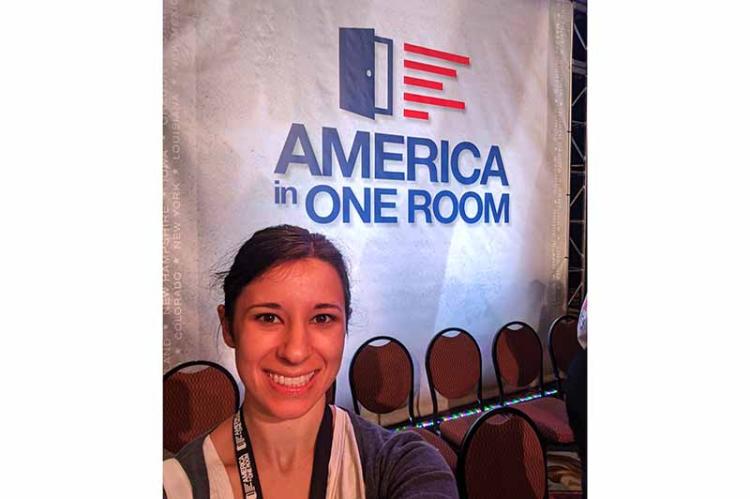
Maybe America is not as polarized as national politicians, talking media heads or the chattering masses on social media would suggest.
And maybe if you could bring the entire country together in one place and expose everyone to all the viewpoints on key issues, civil, deliberative debate is still possible.
That’s the hypothesis tested at the Gaylord Texan Resort in Grapevine two weeks ago at a four-day event called America in One Room.
And at least one of the 526 delegates went home believing that hypothesis just might be true.
“I came away with such an increased sense of hope for the country,” Kari Richter said. “It feels like we’re not so divided as we thought we were and it makes me want to continue these conversations.”
Richter, the wife of former Kingfisher High School student Caleb Richter and daughter-in-law of former longtime Kingfisher Church of Christ minister Ken Richter, was one of the 526 delegates specially selected to provide a cross-section of America to participate in the experiment.
Richter, a registered nurse at Mercy Hospital in Oklahoma City, has been an active online survey-taker through NORC (formerly known as the National Opinion Research Center) at the University of Chicago since her college days.
“I was randomly selected and have been completing one or two surveys a month for about three years on lots of different topics,” she said.
“I completed one of those random political surveys last spring and at the end of it I was notified that I was selected to participate in ‘America in One Room.’”
The notification provided a brief description and links to more information. Participants were paid for their travel and meals were provided.
“I talked to my mom and Caleb and decided ‘why not?’” she said.
NORC is only one of the collaborators on the project, which also includes the Stanford University Center for Deliberative Democracy and By the People Productions.
The concept for the long weekend is called “deliberative polling” and is described in a Stanford undergraduate course catalog like this:
“When a representative, random sample of a population – be it a city or an entire nation – is brought together to deliberate, while being polled on their opinions before and after deliberation, new insights emerge about what decisions ‘the people’ collectively might come to if they could talk in one room together as fellow citizens.”
One of the most helpful parts of the experience for Richter, who said she did not consider herself particularly politically aware before participating, was a booklet she received ahead of time which included information on the five topic areas that would be discussed, all key issues in the current presidential campaign: health care, economy and taxes, the environment, foreign policy and immigration.
“The booklet was nonpartisan and gave some background on all these issues and the different viewpoints,” she said. “I was coming into this with no interest in politics and not very strong opinions so it was very helpful to have that background.”
Richter and her husband both traveled to the Grapevine hotel convention center for the event. She was allowed one guest in the hotel room, but her husband could not participate in the event itself, which was comprised of four 12-hour-long days.
“Poor Caleb,” Richter said. “Every night when I got back to our hotel room, I tried to go over everything that I’d done and said and learned to help me process it all.”
The event started with a get-acquainted reception where participants were seated at a table with the 13-to-15-member small group they were assigned to for the weekend.
“Nothing was off limits during that conversation,” she said. “We could talk about politics, the issues or our personal life. They really wanted us to get to know each other.”
Richter said her group included people from 13 different states and ranged in age from 23 (Richter) to 72.
“We were all different political leanings, different interests, different socioeconomic status, just all over the board,” she said.
Over the next couple of days, each small group met with a moderator and spent an hour and a half discussing each issue.
Those discussions had no rules, other than the moderator would direct them back to the issue at hand if they wandered too far afield, Richter said.
Even though interactions among those with varying viewpoints on social media would suggest these small group discussions would quickly degenerate into heated and polarized free-for-alls, Richter said that was never the case.
“I was very pleasantly surprised with how civil our conversations were,” she said. “Everyone was kind of nervous that it would get a little more heated because we had some people who were pretty far right and others who were pretty far left.
“We voiced our disagreements and opinions but it remained very civil and friendly.
“It was a lot of ‘I see where you’re coming from but here’s why I disagree.’”
She also was surprised that most people within her group identified the same problems and often had the same goals, but with different ideas of how to get there.
“Another thing kind of cool with our group, on 80 percent of the issues, there was more common ground than there was disagreement,” she said.
All of the small group sessions were audio recorded and some of them were videotaped as well.
At the end of the discussion, each group came up with two questions they wanted asked during five of the plenary sessions, where an expert in each area would present more information to the entire 526-member delegation, Richter said.
Three other plenary sessions included appearances from current presidential candidates.
During breaks in between each session, delegates were encouraged to circulate outside their groups and meet as many other people as possible.
Roving videographers captured some of those conversations as well, Richter said.
“I know a documentary is planned about this, but there were national news media cameras there too,” she said.
Statistical data also was collected in the form of a survey that participants took before the event and then after, to see if and how their answers changed.
Results are expected to be released later this week and will be emailed to all participants, Richter said.
Like many Americans who find themselves in information overload, Richter said she had no idea before the event how to parse the truth from the constant digital bombardment.
“For someone who wants to become involved in politics, there’s so much background you have to know,” she said. “If you just wanted to research it yourself, everything is so slanted. Just to form a foundation for your opinions is so hard.”
The broad-based, nonpartisan information she and other delegates were provided on the five key issues has given her a starting place to becoming more informed.
“I feel like I am more prepared to join the conversation and get involved,” she said. “I feel like I’m not so different from ‘the other side’ and I feel like I have a voice.”
She also came away with longterm connections among the 13 members of her group, all of whom exchanged email addresses and plan to stay in touch.
“I think everyone in the U.S. could benefit from this and just to foster these conversations could be so beneficial to everyone,” she said. “I think it would really make a big difference to our future as a nation.
“Now that I’m a few days out, I can definitely see what a valuable process it was and I’m glad I went,” she added.
“It was a once-in-a-lifetime opportunity.”