
Capturing the Spirit of the West
Award-winning local artist focuses on authentic portrayal of ranch life
Plen’y of air and plen’y of room, Plen’y of room to swing a rope! Plen’y of heart and plen’y of hope!
The lyrics to the song “Oklahoma” represent the cowboy way of life and the iconic lifestyle of the American West.
And it is still alive today on the large cattle ranches of the American great plains.
From the vast grasslands and mesquite trees of Texas to the wideopen rolling prairies of Montana, cowboys still ride horseback to care for their animals and the land they love. Kathryn Leitner, local western
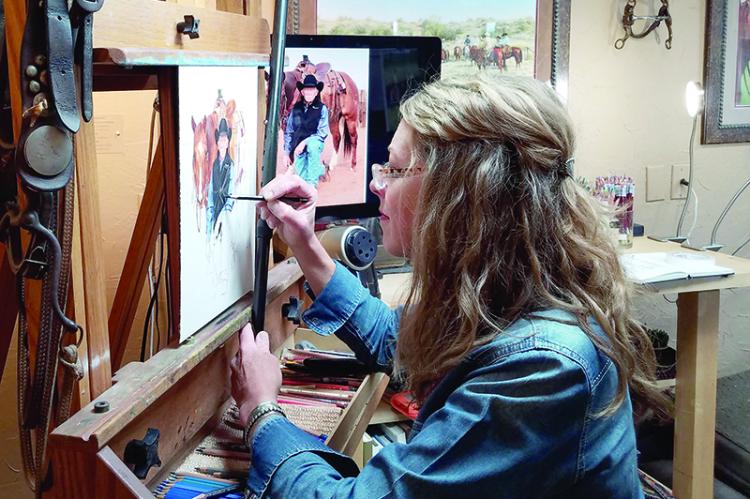
Kathryn Leitner, local western artist, has been using her artistic talent for the past two decades to honor and tell the stories of the horse and rider on today’s cattle ranches of the great plains.
“I want to tell the story of their lives and the good, honest, hardworking people they are and the horsemanship and skill they have developed,” she said.
Leitner was recently selected as the Horse in Art signature artist for the America’s Horse in Art Show this year at the American Quarter Horse Hall of Fame and Museum in Amarillo, Texas.
“Kathryn uniquely captures the strength and beauty of the working American Quarter Horse and western lifestyle,” American Quarter Horse Chief Foundation Officer Anna Morrison said on the AQHA website.
The showcase piece is titled “Jingling the Wagon Horses,” and Leitner said it’s a reference to the band of horses used to bring the cattle in from pasture to “work” the herd.
The original piece was completed in colored pencil using reference material from photographs taken during the “fall gather” at the Tongue River Ranch near Paducah, Texas, she said.
Leitner usually travels to the ranch, which encompasses almost 90,000 acres, once a year to take pictures of cowboy life and returns with over 2,000 pictures to use as reference for future drawings or paintings.
From expansive acreages, cowboys round up the cattle on horseback during “spring works” and “fall gather” for separating, branding, castrating and vaccinating.
Each cowboy generally uses one horse in the morning and then takes a fresh horse out in the afternoon, Leitner said.
The cowboys camp in teepees for the duration of the work, sometimes two to three weeks, and are served meals from the chuck wagon.
“I’m there taking pictures and watching the horses work all day,” Leitner said. “It makes it more enjoyable to complete the artwork, but it also makes the artwork have a lot more feeling to it and be more authentic.”
Sometimes she will use seven or eight different photographs for one work of art to get all the horses in good position, but does everything possible to make sure the painting is authentic and correct, she said. Most of her work is done in either colored pencil or oil paint.
Her passion for horses and the ranching lifestyle began as a little girl on her grandparents ranch in Montana.
“We lived on the ranch until I was 9 years old and would often visit after we moved, but not as often as I would have liked,” she said.
After her grandfather passed away, her grandmother, Viola Estes, moved to Kingfisher.
Leitner was 18 years old when she followed her grandmother to Kingfisher a few years later, in 1989.
She met and married Jack Leitner, her husband of 26 years. They have a son, Justin, who lives in Austin with his wife Hannah.
Leitner is also a hairstylist and operates a salon west of Kingfisher, which doubles as an art gallery for her work.
She said she has always loved horses and the ranching lifestyle, but never had her own horse until her husband gave her one after they married.
She and Jack also show their horses in AQHA versatility ranch horse shows and AQHA limited working cow horse and ranch riding.
When her son was young, she didn’t spend much time on her art, she said, but the last 15-20 years she has focused more on developing and improving her artistic talent.
She started taking oil painting classes with Bob Faust in Kingfisher and later studied life drawing with Dennis Parker in Oklahoma City. She also utilizes books and online resources, as well as going to occasional workshops, she said.
Her work has been displayed – and garnered multiple honors – in America’s Horse in Art Show in Amarillo, Texas; Trappings of Texas in Alpine, Texas; Cowboy True in Wichita Falls, Texas; Rusty Gables Spring Stampede in Oklahoma City and various other venues.
Last summer she was also honored with an exclusive showing of her art at the AQHA Hall of Fame and Museum.
She only uses her own reference material primarily from photographs she has taken at the Tongue River Ranch during ranching activities, she said.
“I have met all the people and seen all the horses I paint, except for commission work I do for people,” Leitner said.
Through her western art she is able to do what she loves on two fronts: Experience the ranch lifestyle and share it with others in her art.
“I enjoy the experience and it is unlike anything I would have been able to do if I hadn’t had my art,” she said. “I would have had no other reason to get to ride all day at the Tongue River Ranch.
“It’s a dream come true.”
Through the years she has sold over 100 original paintings or drawings, as well as numerous prints and commission works.
Leitner said she has also started providing a certificate with each original or print documenting the story behind the painting.
“I’m so glad the lifestyle is still alive and I can tell their story,” she said.
The ranching lifestyle is a hard life, but a good life, she said.
“Many of the people who live on the ranches are very good Christian people and they appreciate nature and God’s creation,” Leitner said.
She also enjoys sharing her love of art and the skills she has developed with others.
Leitner has taught drawing to children at the AQHA fall field trip education days for three years, taught oneday classes to elementary students in Oklahoma and Texas and is scheduled to teach her first workshop this summer in Pawhuska.
To aspiring artists, she said, “I would tell them, just practice.
“My drawings didn’t start out like they look now; they started just like yours look.
“Just keep practicing and learning. Don’t ever stop learning.”
Leitner said she is honored to be able to share her art documenting contemporary ranch history.
“My passion is for the horses, but also for the people and the lifestyle as well,” Leitner said.
“It is a privilege to be around people with deep roots and strong core values and be able to honor them in my work.”