
The Color of Money
Pappe’s ‘Red Seal’ bill not just family heirloom; collector pays $45,600
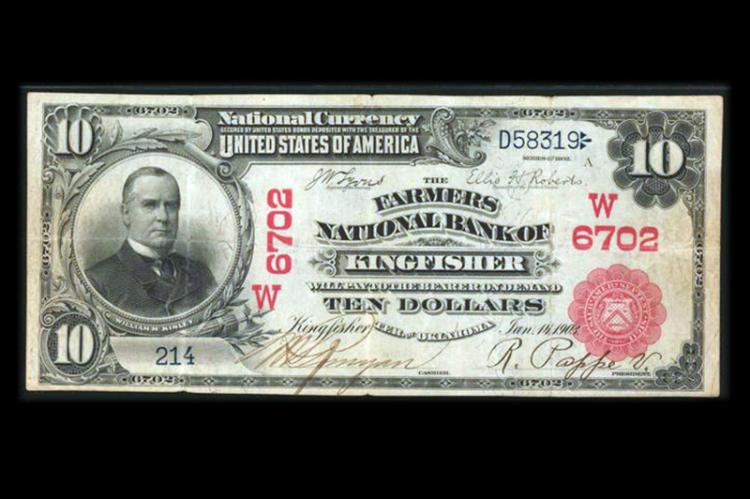
When the children of the late George and Mary “Dawn” Pappe came across the oversized $10 bill while going through their parents papers, they thought they’d found an interesting family keepsake.
The bill was issued by Kingfisher National Bankcorp and featured the signature of George Pappe’s grandfather and one of Kingfisher’s early settlers, Richard Pappe.
“When we first noticed the bank note, we really didn’t fully understand what we had,” Johnny Pappe said. “It was much more of a family heirloom to us.
But after a little investigating with the help of an Edmond coin and currency appraiser, the Pappes discovered they may have something more valuable on their hands.
Place in History
After the Land Run of 1889 created the town of Kingfisher, one of the initial settlers was Richard Pappe, who was described in a family history as “a German immigrant and baker, with a knack for real estate and business in general.”
Pappe bought and sold farmland and also provided loans for a variety of business ventures.
His own initial business was the Rock Island Saloon & Vienna Bakery, located just south of the current Times & Free Press Building on the 300 block of North Main Street.
The saloon was established in 1889, in a former ice cream parlor, according to family history.
When 1907 brought Prohibition along with Statehood, the business was converted to a cafe, but it was just one of many ventures embarked upon by the industrious Pappe.
He was an early player in the oil business and served as trustee of the Quadrangle Oil Co.
Working with partners,
he drilled a 3,500-foot well less
than a
mile from town.
Although that well missed the mark, a larger well was brought in and struck oil at 7,500 feet, according to family lore.
Pappe built the first opera house in Kingfisher, which was also used for Kingfisher College graduation ceremony for 20 years and later converted to a theatre.
He also took on a public service role, serving as a city commissioner from the third ward and was one of the signers of the original Kingfi sher Charter.
And, in 1902, Pappe served as vice president of a local bank.
Banknotes Explained
Manning Garrett of Stack’s Bowers Rare Coin Galleries in New York City provided this brief history of banknotes to the Times & Free Press:
National banknotes could be issued by any bank in the country between 1863 and 1935, as long as that bank had a national charter with the federal government, and 12,365 banks chose to issue their own money.
The banknotes were printed in Washington, D.C., with the name of the issuing bank and then mailed to the local banks, where they were signed by the cashier and a bank offi cer.
The money was circulated throughout the town and beyond, just like money is used today.
Because it was commonplace and just a part of everyday life, very few people thought to save these banknotes. Today, many of them are extremely rare and worth thousands or tens of thousands of dollars to the collectors who specialize in them.
In 1928, all U.S. paper money changed to its current size. Before that, money was about 40% bigger than it is today.
When paper money changed sizes, people tried their best to get rid of the old, oversized money because they were worried it would be devalued.
That never happened. In fact, oversized banknotes are still legal tender at their face value, but is worth much more to collectors.
The most sought after notes are from small community banks like Farmers National in Kingfi sher.
Known as a Territorial Red Seal because it was issued before statehood and features a bold overprint red seal and issue number, the Pappe bill is one so rare that it was thought to be nonexistent.
The Kingfisher bills were only printed between April 1903 and October 1905, and only 884 were ever issued, in $10 and $20 denominations totaling $11,050, before the bank was liquidated in 1905.
Most of the outstanding bills in circulation were subsequently redeemed and by 1916, only $170 worth of notes from the bank remained outstanding.
More than 100 years later, the remaining bills were presumed destroyed.
Until the Pappe fi nd.
An Unexpected Surprise
Richard Pappe’s entrepreneurial spirit was passed down to subsequent generations.
Grandson George Pappe also was involved in the oil business and began several local businesses of his own.
One of them was Johnny’s Fast Gas on North Main Street, which was operated by George’s son Johnny.
Public service is another family trait that has been passed down.
Johnny Pappe served as mayor of Kingfi sher as well as more than two decades in the fire department, and two of his sons are firemen as well.
And although Johnny shares his father’s passion of collecting antique coins and currency, the focus for Johnny and his sisters Donna Thomas and Anita Hoskin after George’s death in 1996 was making sure their mother Dawn was cared for.
So George’s extensive collection remained tucked away in family safes, safe deposit boxes and closets until last May, when Dawn died at the age of 92.
Casey Tilford of Edmond Coins was brought in to help evaluate the collection.
“Casey has been in his business since he was 9 years old, and is as good a person as you could meet,” Johnny Pappe said. “We appreciate the many hours he has spent with us, explaining delicately how Dad did or did not make a good decision with some of his collections.”
But even Tilford did not immediately recognize the value of the banknote at fi rst glance.
“It brought back memories of Dad and his many stories about Kingfisher and Kingfi sher businesses,” Pappe said. “But we now realize that it is a wonderful piece of both Oklahoma and American history.”
The Auction
When the family realized its potential value to collectors, the banknote was consigned for auction with Stack’s Bowers Rare Coin Galleries in New York City, which estimated its value at between $40,000 and $60,000.
It was rated by the gallery as “very fine,” due to its “excellent color, wonderful signatures and no detracting features whatsoever.
It was auctioned live online on Nov. 14, and the one-of-a-kind bill the Pappes didn’t even realize they owned less than six months ago sold for $45,600.
Garrett of Stack’s Bowers told the Times & Free Press he did not know the name of the winning bidder but said the person had no connection to Kingfisher, or even Oklahoma.
“A few times a year, we get to auction rarities like this and they are usually bought by very wealthy individuals who appreciate history and have a background in numismatics,” he said. “I wish I knew more.”
Garrett said the winning bidder was one of three individuals who bid more than $30,000 for the banknote.