
County man is also cattleman
Commissioner’s life more than roads, bridges and pipeline crossings
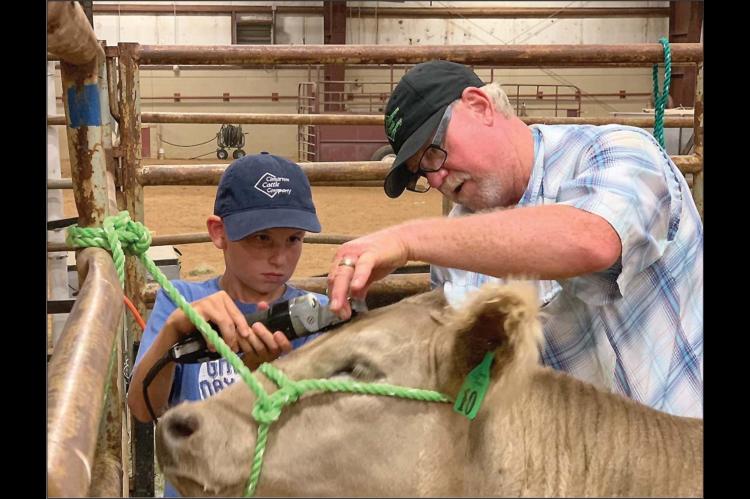
Most people know Jeff Moss as Kingfisher County’s District 1 county commissioner, serving the southeast third of the county.
But he has a sideline that is almost as demanding as his job as county commissioner. He’s also a cowman, producing quality club calves – the type that 4-H and FFA members use as club projects.
As District 1 County Commissioner, Moss, who lives at the east side of Kingfisher with his wife and cattle business partner, Jacque, spends a majority of his daylight hours personally working on and overseeing maintenance of his district’s one-third of the county’s 1,500-mile road system.
It’s demanding but something he considers vitally important – keeping the district’s roads and bridges in good shape for county residents and business users.
But when he isn’t working with his road crew or attending to the other duties commissioners are required to do, he’s often working with his cattle herd, a collection of high quality cows with royal genetics.
They are the reason he starts his day at 5:15 every morning and is often still working after dark.
He started as a county employee in District 3 in 1996 when Henry Senn was county commissioner.
He recalls that Senn offered him a position on the road crew when he was between jobs as a cattle exhibitor.
He expected to work for the county only a short time but the temporary job turned into a career. He worked as an employee in District 3 until he won the District 1 county commissioner position in 2015.
He and Jacque married in 1996 and the county job allowed them to have a family life.
Jacque, when asked about Jeff leaving the road to stay home, provided this explanation:
“I got to thinking … about why Jeff quit going over the road for cattle. I was curious as well, so I called him.
“He said all his friends quit, got married and started having babies. He went to work for Express (Ranch), had a job offer to move way up by the Great Lakes and asked me to go – too cold for me, so he was offered another job in Missouri.
“We moved there, were married, and he said it’s been a fairytale ever since – hahahaha! We were in Missouri just over nine months and he had enough of the hobby rancher and came home one day and told me to start packing.
“We moved back home and that’s when he went to work for the county.
“There ya go! It wasn’t all my fault.”
Moss, a Loyal native, grew up raising and showing calves, first as a member of the Loyal 4-H Club and later as a member of the Lomega FFA Chapter.
His folks, stepdad Virgil, and mother, Ida Lou Homier, helped him get started in the cattle business as a 9-year-old 4-H member with the purchase of a Shorthorn heifer.
His folks ran stocker calves on their place but let Jeff have the purebred show calf.
When that heifer produced a calf, also a heifer, they let him keep her, too, and pretty soon the whole family was engaged in the show-calf production business.
While they branched out into crosses by carefully introducing other breeds – Angus, Simmental, Charolais and Maine-Anjou – into their program to stay in the club calf game, Moss’ current herd still shows Shorthorn influence.
“It’s what I started with and I still have an appreciation for them,” he says.
He observes that it is easy to get too caught up in fads in the club calf business and those who do often wind up with animals that are not what people want.
The key, he believes, is always concentrating on quality animals no matter the breed whose genetics will improve the calf crop of a commercial breeder.
More and more, his sales have been to commercial cattlemen for use as herd bulls.
That plan works for Moss; he’s been doing it for more than 40 years now, including the time he was in partnership with his folks.
One of the cattle traits he is always conscious of in any breed he uses in his program is temperament.
“I work with these animals mostly by myself so I want a gentle animal I can trust, whether at home or on the (Cimarron) river pasture, (near Loyal)” he explained.
It is also important to 4-H and FFA members who show cattle (some of whom aren’t big enough to deal with a rambunctious show calf) and to other club calf seed stock producers and commercial cattlemen who are among his most frequent bull customers.
A walk through his lots where he keeps heifers due to calve for the first time (the maternity ward) and other lots for young bulls being conditioned for herd bull service later on shows the wisdom of that practice.
The cattle are calm and quiet even when a stranger walks among them (this writer, for instance).
The young bulls are happy to stop for a little petting, also from a stranger.
Moss teaches all his calves to lead at an early age, including those going back into the production herd.
Paint Brush, an almost 2-year-old Shorthorn-Maine crossbreed bull in whom a number of breeders have purchased an interest, welcomed a visitor into the bull pen by casually walking over for a scratch on the back from someone he’d never met.
Paint Brush displays the careful genetic mixing necessary for a show quality animal – meaty, sound and eye appealing.
Maybe not too surprisingly, Paint Brush is the calf of a cow that died 10 years ago.
Moss said the cow was probably ahead of her time but fits today’s standards.
Moss still has a number of frozen embryos from that cow that he continues to use in his program.
The majority of his calves are produced by artificial insemination, using semen from high quality bulls that are not on his place, and embryo transfer.
He is proficient in much of the technology and has the equipment to keep the frozen embryos in-house.
A key part of the breeding program is treating cows that are to be bred with a shot that causes them to enter estrus concurrently with a flush of high quality eggs.
This is done partially for the benefit of the veterinarian so that he can make one trip do for the embryo transfers to recipient cows (often grade cows which are not the calves actual mothers).
Embryo transfers allows a high quality cow to produce many more than the one calf a year she would produce naturally.
An added benefit of flushing cows is increased conception rates.
Moss got infected with the cow “bug” early.
His grandad, Clyde Moss, a Loyal farmer-stockman, began taking him on his farm-livestock tours early, sometimes including a stop at a favorite fishing pond. Family, church, farming, cattle and fishing were Grandfather Moss’ greatest loves.
Jeff Moss’ successes with livestock showing as a 4-H and FFA member led to an early career on the livestock show circuit, fitting and showing cattle for a number of nationally-known breeders.
He started his career working with a number of county families who were active in cattle showing. Second generations of some of those families continue to buy Moss’ calves and rely on his fitting and showing tips.
He also worked on several ranches throughout Middle America.
One event he recalls vividly from the earlier days was playing on snowmobiles with some fellow employees on a South Dakota ranch. The owner, Orin Lamport, saw him and shouted to him to cover his face and ears.
“It’s 50 below,” the rancher yelled to his southern-born and raised employee. “You’ll freeze your face and ears.”
“He must have thought I was a total idiot,” Moss said. “There was no wind and it didn’t seem that cold.”
He showed cattle for people from Canada to South Texas during his early years.
A benefit of that career is that people from all across the central U.S. still call him, or even drop in for a visit if they are driving through the area.
Jeff and his brother-in-law, Greg Fuxa, work together in the family farm and cattle business, Moss working mostly with the cattle and Fuxa with the farm, but both make themselves available to help the other when needed.
Moss gives credit for his cattle project to his wife, Jacque, the daughter of Charlie and Aileen Boyd of Kingfisher.
“She’s a full partner. If it weren’t for Jacque, I couldn’t have done this.”
Jacque is employed in the business office of Farrar Construction Co. at Dover.
Moss praises his county road crew members for their dedicated work to keep county roads in shape.
“They’re a dedicated bunch, willing to work even on holidays and weekends when necessary,” he said.
He recalled recent events which tested their loyalty to the job – the damage to roads caused by heavy equipment used in the local wind farm construction, then the oil boom, followed by a 100-year flood in 2019, which washed out bridges and ruined roads throughout the county.
“You’d better not ever say, ‘it can’t get worse than this,’” Moss mused. He’s seen it happen.
Then there’s always the cows to feed after the daylight is gone.
As the saying goes, if he didn’t love it (the cow business), he couldn’t stand it.