
DEEP FREEZE DELIVERIES
Ranchers struggle to save fragile newborn calves through lengthy cold spell
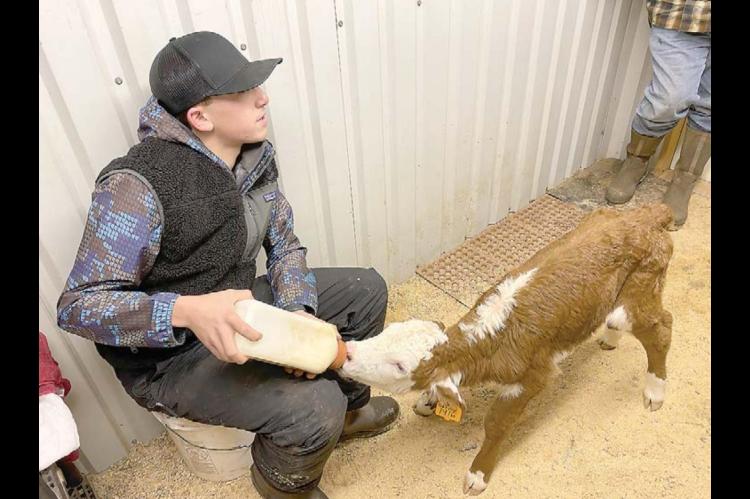
Subfreezing temperatures during the early spring calving season are nothing new for county farmers and ranchers.
But a string of more than 11 straight days of below freezing daytime temps plunging to subzero overnight merits that dreaded 2020-21 adjective.
Unprecedented.
“We’ve never seen anything like this,” Loyal cattleman Brad Uhlenhake said. “I don’t remember it ever being this bad.
“We’re just not set up or prepared for this kind of extreme cold for so long compounded with the snow.
“It’s been pretty rough on all the farmers and ranchers.”
“We’ve had cold weather every year at this time, but never this cold or this long,” Hennessey rancher James Hayek said. “I’ve never seen this many days of cold or this much snow and ice.”
Ranchers are far from the only local workers struggling to do their primarily outdoor jobs under brutal conditions over the last two weeks.
But they are among the few whose actions literally mean the difference between life and death for fragile babies in their care.
And it’s a responsibility neither of the two farm families who spoke with the Times & Free Press last week take lightly.
“Whether you have one farm animal or 300, there’s still that attachment,” Brad’s wife Billie said.
“If you are in charge of taking care of something that has only you to keep it alive, you’re going to do everything you can.”
The Uhlenhakes, along with Brad’s father Greg Uhlenhake, have about 200 head of beef cattle west of Loyal and Greg Uhlenhake has about 75 dairy cows.
Brad and Billie are aided in their operation by their two sons, Brooks, 16, and Brenden, 13, who attend Lomega schools.
Deep, prolonged freezes pose a risk to cattle operations, even when it’s not calving season.
Besides limiting their drinking supplies, iced over stock ponds lure adult livestock looking to find water.
“They can walk out to the center of the pond where the ice isn’t as thick and fall through,” Uhlenhake said. “We have’t lost any that way so far, but we’ve heard of other guys having that happen.”
But the real risk is to fragile newborn calves hitting the ground wet and warm and not being immediately discovered.
“If you’re not there when a calf hits the ground, chances are it’s not going to make it,” Brad Uhlenhake said.
“We’ve had some we’ve missed by an hour or less and found the calf already dead.”
Uhlenhake said that between him and his dad’s operations, about 20 babies have been lost so far this year.
For calves which are discovered immediately or shortly after birth, the race is on.
“There’s been a handful that we’ve caught right when they were born,” Uhlenhake said. “You put them in the cab of the truck to warm them up and then we have a heated room at home that we put them in.
“We dry them off, get some colostrum down them and we try to do al that without getting their scent off them so their mama will take them back.
“As soon as their body temperature is back to normal, they’ve got some colustrum in their belly and they’re dry and doing good and the outside weather will alow it, we get them back with their moms.”
The challenge for Uhlenhake and so many local cattlemen is that farming and ranching is his second job, that he starts as soon as his daytime job ends.
He has a little more help this year than usual because his two sons have been home doing virtual schooling due to the weather and COVID restrictions, so they’ve had more time than usual to be hands-on with the cow-calf operation.
“Usually, our priorities for them is that school comes first, then farm work and then play time,” Uhlenhake said. “We hate that they’ve not been able to attend school, but it’s also been a huge help right now to have them available.”
Both boys are active in FFA and raise show heifers. Unfortunately, two of the calves that were lost were from those heifers.
“We hate that happened and they are really devastated,” Billie said.
Brad said he regretted the harsh lesson for his boys, but he also recognizes it as a character building opportunity.
“I told them the other day that this is the kind of challenge that really shows who you are as a person and how you can get through things, even the really tough stuff.”
And the boys have really stepped up, their parents said.
When a self-waterer blew up and pieces of it fell deep into the slushy, half frozen water, the problem of retrieving the parts without sustaining frostbite in the process became a head scratcher.
“Brooks had the idea to use the AI (artificial insemination) gloves that come up to your shoulder to get the pieces out” Billie said.
“It’s gratifying when you see that your kids know things like that and can work out problems for themselves.”
For Hayek and his wife Jill, a veterinary tech for Dr. James Matousek at Wheatland Veterinary Hospital in Kingfisher, calf rescue has been a fulltime operation throughout the cold snap.
Hayek raises his own cattle and also works for fellow Hennessey rancher Cris Pribyl.
“I’ve been going out every two or three hours 24 hours a day,” he said. “Any newborn I find, if it’s not up and moving, I throw it in the truck.”
The Hayeks have set up what they call newborn calf NICU (“it’s in our bathroom.”)
“We have blankets, a hair dryer, everything we need to get them dry and warm,” he said. “On the coldest day, we had five or six calves in our bathroom. That’s the only way we could keep them alive.”
The ability to give that much attention to his and his employer’s herds has allowed them to minimize losses.
“We’ve lost five head and we feel really blessed that it’s only been five,” he said.
Hayek said three of the calves were lost in a single night and he had only missed their births by 20 minutes or less.
Like the Uhlenhakes, the Hayeks operate as a team.
When the weather shut down the vet clinic, Jill was able to stay home and tend to the babies that her husband was rounding up.
That allowed him to get right back out to the pasture to look for more.
After calves were warmed and revived in the NICU, they were moved to the “nursery,” a barn pen with hay bales stacked as windbreaks.
By Thursday night, the Hayeks said their NICU was “pretty empty” and they had nine or 10 babies in the nursery and three orphans in the barn they were trying to graft onto other cows.
“We have about 13 or 14 newborns we’ve seen through this so far,” Jill said.
Their effective system drew the attention of neighbors looking for help keeping their own newborns alive.
“We were taking care of our calves, neighbors calves and everyone else,” James said. “Word spread that we were pretty good at bringing calves back to life.
“We’ve been blessed to have the skills and the knowledge to help these calves and help other people out with theirs.”
Both the Hayeks and Uhlenhakes said that the tough challenge of the deep freeze brought out the best in the cattle community, both in requests and offers for help.
“We’re all a big family, so everyone helps everybody else,” James said.
“As much as it’s a struggle, it’s also a community builder,” Billie Uhlenhake said. “Living out here, you gotta be tough. You can’t let things upset you.
“We’re seeing so many neighbors offering or asking for help. It’s great to see everyone pitching in.”
Besides the heartache of losing newborns, the economic cost can be tremendous.
“There’s a guy out here who’s got 300 or 400 head all due to deliver at the same time,” Brad Uhlenhake said.
“If you buy a set of cows, spend money in AI (artificial insemination) and (embryo) transfers and you lose all or most of the calves, how are you going to make the payment on the cows?”
Even so, the Uhlenhakes and the Hayeks see plenty of reason to be thankful.
“Everybody’s safe and everybody’s healthy at our house,” Brad Uhlenhake said.
“We’ve got electricity and a warm house and there’s food on the table.
“We don’t have anything to complain about.”
The Hayeks joked that at their house food has consisted of “pop tarts and peanut butter crackers” when they’re too busy to cook, until a thoughtful neighbor brought a casserole.
But what James Hayek is most grateful for is to finally see the sun again.
“It’s going to get warm again. We’re ready for that.”