
Easter even more meaningful for local woman after touring earliest churches
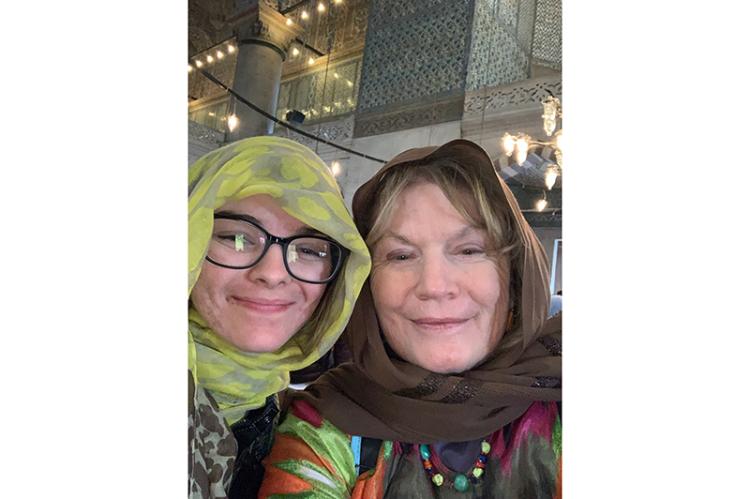
The Christian celebration of Easter likely was even more meaningful this year for at least one Kingfisher resident who just spent nine days in Turkey touring sites of the early churches of the New Testament.
Peg Kunneman, a member of the Kingfisher First Baptist Church, joined a group led by Oklahoma Baptist University professors Dr. Alan S. bandy and Scott Loyd on an international tour called “Seven Churches of Revelation and More.”
The tour included the churches at Ephesus, Laodicea, Philadelphia, Sardis, Smyrna, Pergamum and Thyatira.
“Biblical Turkey, known more than 2,500 years ago as Asia Minor, is actually the birthplace of Christianity, with the Apostle Paul, Peter and John all linked to the seven churches,” Kunneman said. “We learned on our tour that over two-thirds of the 27 books in the New Testament were written to or from Asia Minor.”
Despite the importance of the region to Christianity and biblical history, “faith tourism” in Turkey has been slow to develop, which Kunneman attributes to “Christians and Jews not being aware of the country’s rich biblical heritage.”
Kunneman said the tours through the beautiful, breathtaking vistas and remnants of the ancient church buildings, many of which were still in the process of being fully excavated, were augmented by in-depth lectures from the professors each evening.
“Dr. Bandy in particular has an astounding knowledge of the ancient Greek texts and was able to translate many of the inscriptions we saw each day,” she said.
Kunneman said the tour was as physical as it was cerebral, with three to four miles of walking each day up and down mountains and hillsides.
But rewards such as basking in the warm mineral waters at Pamukkale near the once wealthy church of Laodicea.
“We read that church’s letter in Revelation as we sat in the ruins currently being excavated there,” she said. “God’s words were harsh to the Laodicea church.”
The group also visited the terrace houses at Ephesus, which were home to royalty and included marble, tile and intricate carvings, as well as a library, town center, medical complex and baths.
Kunneman said Ephesus was her personal favorite of the sites visited, even though 70 percent of the site remains to be excavated.
Kunneman said when she asked Bandy how the Ephesian citizens could have constructed such intricate and advanced structures so many centuries ago, he responded, “Well, Peg, they had no Twitter, no internet, no Facebook, no iPhone. They made their own tools and carved their churches and cities out of marble.”
Members of the tour also saw evidence of the ancient religions that preceded Christianity, Kunneman said.
“The Greek and Roman gods and goddesses we once read about as sixth graders came to abundant life,” she said. “Aphrodiasias, the city of the goddess of love, is lavish, beautiful and amazing.
“The pool is over a football field long and this site was excavated to display a well-preserved stadium and theater.”
The tour also visited the city of Hierapolis, as well as Philadelphia and Sardis, two other of the churches mentioned in the Book of Revelation.
“Sardis was the capital of ancient Lydia, where the first coin of the world was invented,” Kunneman said. “The massive Artemis Temple remains there to overwhelm you.”
Pergamum, another of the churches in Revelation, boasts the steepest theater of the ancient world, the Acropolis, she said.
“Pergamum sits very high among the mountains and we road the gondola to reach the top,” she said. “We felt like we had discovered a hiden lush forest of treasure as we walked there.”
The last two days of the tour were spent at World Heritage sites in Istanbul.
“The Roman Square, the Blue Mosque with beautiful blue tiles, the Hagia Sophia church built by Constantine the Great in the Fifth and Sixth centuries, the underground cistern, the grand bazaar and the spice bazaar were the sights we toured there.
“My photos will never do what we saw justice. Most of the time, I was gasping for oxygen at the hikes, and I had tears at the beauty of the Hagia Sophia church and the other architectural marvels in Istanbul.”
Kunneman said the Hagia Sophia church was first a Greek Orthodox church, then a Muslim mosque and now a museum.
“Built by Constantine the Great and reconstructed by Justinian kings in the Sixth Century, this church is so massive, horses carried royal families to the top,” she said. “Frescoes of the Virgin Mary holding the Christ child adorn the highest arches.”
The churches of Smyrna and Pergamom were by the blue Aegean Sea, she said.
The tourists also visited Alexandrian Troas, founded by Alexander the Great, which the Apostle Paul visited twice.
“I appreciated our leaders from OBU and our Turkish guilde Macit Saszade for sharing where Christianity had its roots,” she said. “They also shared Turkey, its people, its food and its beauty.
“This was only a piece of Paul’s third journey to teach and share the good news of Jesus Christ,” Kunneman said. “Imagine four such journeys – and I do.”