
Engineering His Way Through a Crisis
After car parts, gifts and musical instruments, 3D printer now makes masks
Imagine a time when you could fabricate your very own new part to repair a broken car seat lever.
Or design and create a truly original gift for someone you love.
Or even develop a product to supply a need within your community or world.
That time is here as Hunter Bonham has created all that and more…on his 3D printer.
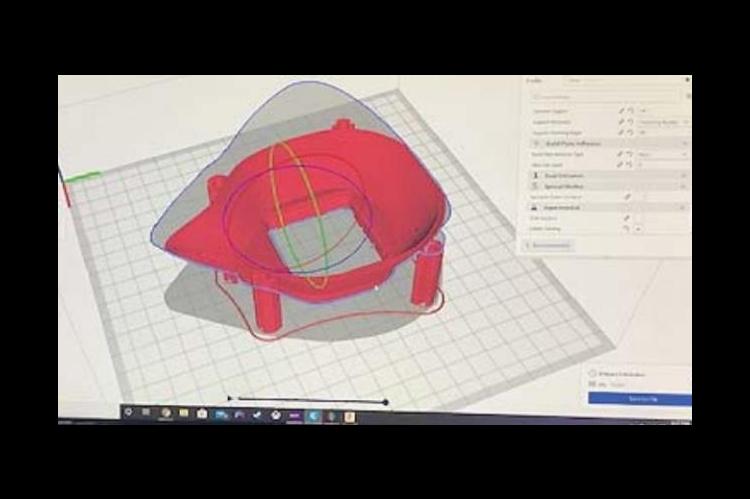
Recently he began making 3D printed protective face masks as an emergency option for protection against COVID-19 in the ongoing pandemic.
Bonham said he first became interested in 3D printing, also known as additive manufacturing, his freshman year of high school, but didn’t have the time or resources to pursue it.
He graduated from Kingfisher High School in 2013 and then began his pursuit of a mechanical engineering degree at the University of Oklahoma.
While at OU, he said, he took advantage of its 3D printing hubs where he designed and created some of his first projects.
“With limited resources as a college student, I decided to make original Christmas ornaments for my family,” he said. “It seemed like a creative and economical gift.”
After graduating in 2017 with a bachelor’s of science degree in mechanical engineering, Bonham accepted a job with ClimateCraft, a custom manufacturer of industrial air handling units in Oklahoma City. His responsibilities there include preparing preliminary and final designs for air handling units, as well as answering questions and solving any problems that might arise in the field.
Two years ago, Bonham purchased his first home 3D printer.
“I wondered what I could do with it and just started trying things out,” he said.
There are a lot of different materials available to print with, but the most common is polylactic acid filament (PLA), he said. It is fairly cheap and easy to use.
“The process of 3D printing can most simply be explained as creating an object in slices or layers that build upon each other,” he said. “The printer is continuously moving upward as it prints.”
The first step is to make a drawing/design using modeling software, which is converted to a 3D model, sent to the printer and the printer then produces layers to form the object, Bonham explained.
“I started printing parts with different materials, upgraded my printer and purchased another printer about a year ago,” he said.
Currently, he has made nine masks for his family members using a design created by a doctor that is available on the internet.
“I chose a very soft and flexible type of thermoplastic polyurethane filament (TPU), which helps it conform to the face,” he said.
The first mask took about eight hours to make on his 3D printer, but after purchasing a larger nozzle, he is now able to complete a mask in about three and one-half hours, he said.
After the masks are made, they are fitted with a removable filter. Bonham said medical grade HEPA filters are best when available, but as a substitute he used high efficiency filter material.
The masks have a limited lifetime and need to be disinfected and the filters changed routinely after use, he said.
Bonham said, after receiving feedback from his family about the masks, one of the concerns was there were no vents or valves for circulating the air and filtering out the expelled CO2.
So, he decided to create his own design, which he just finalized.
The design has inhale/ exhale valves improving the functionality of the mask.
For now, he said, he’s calling it the EZ Mask: The “E” stands for emergency and “Z” is the last letter of the alphabet, which is also symbolic.
“There is no foolproof mask that I am aware of, especially in 3D printing with so many variables and so the mask should be used as a last resort,” Bonham said. “But according to health officials, using some type of face covering is better than nothing to protect from COVID-19.”
After he made a post about the masks on Facebook, Bonham said, “I was really surprised about the amount of requests I received from individuals wanting masks.”
“My goal was to complete my design so I could start providing them free of charge to medical professionals who need them and then consider making them for others.”
Bonham has also combined his passion for music with his 3D printing hobby. He has produced a fully functional fiddle/violin and a mandolin. He initially created the fiddle and it took 16 hours just for the body to print and four days for all the printing to be completed, he said.
The mandolin he created from his own design and printed in three separate parts which were made to latch together. A carbon fiber rod was used for reinforcement and pivotal pieces were glued in place, he said.
“It sounded like a real mandolin, but there are some things I need to work on,” Bonham said. “It is an ongoing project.”
Bonham grew up in a musical family, playing instruments in a band with his two sisters, Shilah and Britney, and father, Virgil Bonham. He has not played in the band since he was in college, but enjoys playing guitar when he has time and also plays the mandolin.
As for his 3D printing hobby, he said, although it does have a slightly steep learning curve in the beginning, it is fairly simple once you understand the basics.
“It used to take me hours to get something ready and print it out, but now I have it where I just turn my printer on, load it to print, press the button and walk away,” he said.
In the last 20 years, not only have 3D printers increasingly been used in homes but they are making huge technological leaps in the medical field, automotive industry, architectural field and most other industries.
“I think it is important for people to know about the technology that is out there and could possibly help people and revolutionize things,” Bonham said.
“If I can make any sort of positive impact in someone’s life, then that’s a win for me.”