
Farm to Fork: CFL begins foray into culinary crops
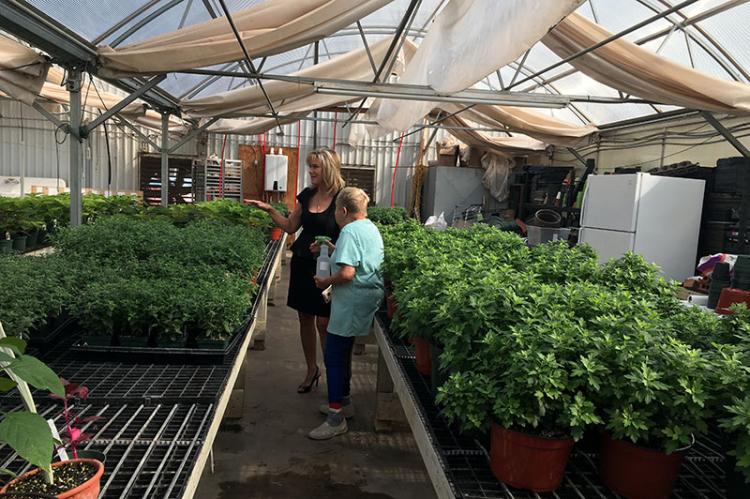
Because Center of Family Love residents soon will be eating as well as selling the fruits of their horticulture labor, they’ve got a catchy name for the planned expansion of their greenhouse program.
They’re calling it “Farm to Fork.”
After successfully operating a greenhouse for flowers and bedding plants since the 1980s the Center of Family Love is expanding its horticulture program to include “culinary crops” – produce and herbs that will be sold to restaurants and the public as well as being served up in residence hall dining rooms on the Okarche campus.
“What we’re looking at is just being able to expand what horticulture looks like for us, providing more opportunity for residents, more opportunity for program growth, more opportunity for income that comes back to the center and more opportunity to expand what residents are doing,” CEO Debbie Espinosa said.
The floriculture program has already spawned some programming offshoots, including a commercial flower and gift shop, where interested residents have been able to branch out beyond propagating seeds and tending growing plants to floral design, merchandising and delivery, as well as all aspects of retail store operations.
But natural growing seasons left portions of the greenhouse unused during the winter months and CFL staff members began to explore other options.
“Usually there’s some downtime in the greenhouse in January and February,” Chief Program Officer Marsha Smith said. “To keep production going and income flowing, we’re going to do culinary crops during that time.”
“We’ve got a huge number of folks working on gardening and that process of horticulture therapy,” Espinosa added. “It’s an amazing way to learn and to work on skills and also an amazing way to feed ourselves in good, healthy, nutritious ways.”
Another nearly completed addition to the campus horticulture program is an outdoor hoop house, a protected gardening area that is not climate controlled like the greenhouse.
The hoop house itself was designed by the Noble Research Institute, an Oklahoma City firm customized the layout and the horticulture department at Oklahoma State University helped design the raised planting beds to maximize the space.
“Most hoop houses are constructed right on top of the ground, but that was not a good fit for what we wanted out of it,” Smith said. “Ours is built on a deck to allow for walkers and wheel chairs.
“The different heights of the planting boxes are built to accommodate people who are standing, sitting or sitting in wheelchairs, so that the plants would still be within their reach.”
The hoop house will be used to grow produce for the residents’ own use.
“What grows in the hoop house will be whatever the season dictates,” Smith said. “As we are going into cooler months, probably we’ll be doing various forms of lettuces and a few other vegetables.
“The covering will allow us to go into November with cooler weather crops.”
Varieties of peppers, tomatoes and herbs will be grown in the spring.
“Outside of the hoop house, we have room to plant some larger spreading items,” Smith said. “We’re utilizing every bit of space that we can.”
The center already has established relationships with restaurants who are interested in purchasing produce, particularly fresh herbs and greens, as soon as commercial production is amped up, Espinosa said.
Every bit of the proceeds of those sales will go back to the local residents, both in the form of paychecks to those who work in the horticulture program and investment in other center projects, Espinosa said.
About 25 residents currently participate in the horticulture program in some fashion and Espinosa expects that number to grow as the program expands.
CFL also is in the process of registering with the USDA as a commercial farm, the first step in getting grants and other assistance through the Farm Services Agency.
The facility hosted a tour and meeting recently with State FSA Director Scott Biggs, Kingfisher County FSA Director Trista Costa, Canadian County Director Tyler Castonguay, District Director Jaramie Karcher,outreach coordinator Jarilyn Hannah and State Rep. Mike Sanders.
Other CFL representatives who participated in addition to Espinosa and Smith were Chief Philanthropy Officer Nellie Sanders, Vocational Director Stephanie Cotton and Joe Fleckinger, past president of the CFL board of trustees.
In addition to assistance from the state and professional firms and private foundations that have provided funding and design help, Espinosa said support from the community is another essential element in the success of this and every project the center undertakes.
“At every level we’ve always gotten help from the local community, from recommendations and expertise up to and including volunteer help and loaning equipment when we need it,” she said.
“We’ve got plenty of folks in this area who know all about farming and they’ve been invaluable.”