
Frozen II
Crop damage after late frost to be assessed
Kingfisher County wheat farmers were hit with another potential setback last week.
A prolonged freeze Wednesday night was expected to impact Kingfisher County’s wheat crop.
Kingfisher County Extension Director/Agricultural Educator Bryan Kennedy said the freezing temperature for an extended period overnight was enough to hurt the wheat as the heads began to emerge.
“We’ll know better in eight to 10 days how severe the damage is,” he said.
Kennedy said that the Kingfisher Mesonet site recorded a 32 degree temperature at 12:55 a.m.Wednesday, dropped to 29 degrees at 2:25 a.m. and read 29.9 degrees at 5:50 a.m. The temperature reached above freezing (34 degrees) at 6:25 a.m.
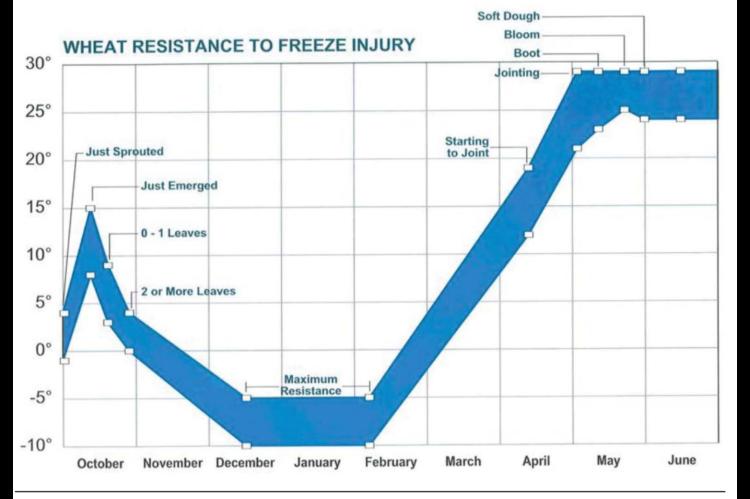
He said the five to six hours hours of below freezing temperatures were enough to damage the awns on the emerging wheat heads, which are critical to developing the wheat berries.
If the awns are not healthy, the wheat berries will be shriveled.
Producers can recognize the damage when they inspect their crops.
If the awns are twisted or curled, producers will face the decision of harvesting the field for grain or turning it into hay.
The hard winter freeze hurt crops across the Texas and Oklahoma wheat belt.
Kansas where wheat was not as far along was not thought to be impacted.
The local wheat price soared during the week, climbing by 55 cents a bushel from Monday through Thursday, closing then at $6.36 a bushel.
Kennedy said that producers who had planted milo or other summer crops could face replanting if the plants had already emerged when the freeze hit.
He said temperatures were colder southwest of Hennessey where he lives.
He reported inspecting a recently seeded alfalfa field along the Turkey Creek bottom east of his home at 6:50 a.m. and the thermometer in his pickup read 30 degrees.
He said the top four inches of the alfalfa plants were covered with frost.
The plants will survive, he predicted, but the first cutting of hay may be reduced.
Possibly the saving grace for the county’s wheat will be the abundant moisture available before the freeze hit.
Also, he pointed out, the wheat plant is tough and has significant recuperative ability.
“We’ll know a lot more by this time next week,” he said Friday.
The OSU Extension Service reported that an April 15 freeze in south central and southwestern Oklahoma caused damage.
A lot of wheat fields were at the flowering stage when the freeze came in, and the nearer the wheat is to flowering the more sensitive it is to freezing temperatures, according to an article written by Amanda de Oliveira Silva, Extension small grains specialist.
“Most of the damage we are seeing is death of the flower parts followed by head discoloration,” she wrote.
A Bloomberg News article said Midwest states have been slowed in planting summer crops because of cold soil.