Grant to fund drone project
The NSF has awarded a $1.49 million grant, part of its National Robotics Initiative 2.0 program, to OSU researchers He Bai, Rushikesh Kamalapurkar, Jamey Jacob and Matt Vance and former faculty member Balaji Jayaraman.
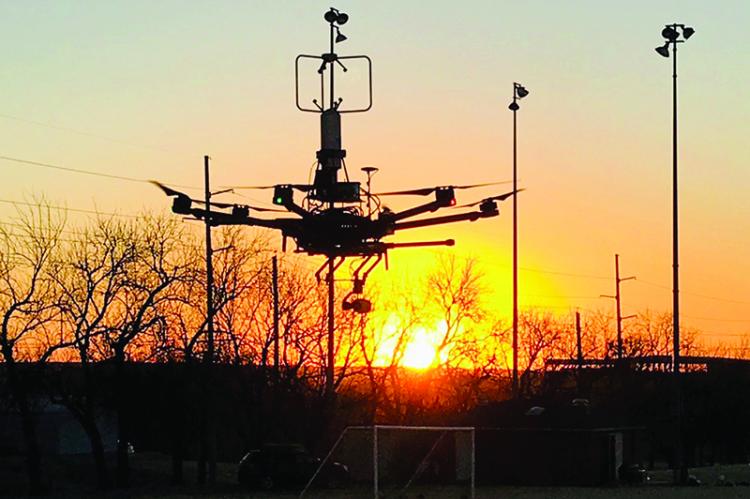
The only grant of its kind awarded in Oklahoma will fund research that will use drone technology to estimate wind conditions in differing environments. While the idea of attaching wind-measuring devices to an unmanned vehicle isn’t itself groundbreaking, making drones able to measure wind speeds without additional devices is new.
As part of the university’s Tier 1 Research Initiatives involving drones in public health and safety, the idea is that an unmanned vehicle on a set flight path can report wind conditions using the magnitude and direction of deviation from its preset flight path. The project will also investigate how to improve the safety and efficiency of drone operations based on wind estimates.
The research team has worked on relevant research projects for the National Science Foundation, NASA and Oklahoma Established Program to Stimulate Competitive Research (EPSCoR) and understands the need for better methods to model and predict wind and estimate UAV trajectory in different wind environments. These methods are paramount to the continued progression of UAV traffic in urban environments. With several companies experimenting with using UAVs to deliver packages, technology and methods like the one proposed by the OSU team will be vital to the future simultaneous deployment of multiple drones.
The idea of an aerial “highway” system in urban areas isn’t unfathomable. In fact, NASA is currently working on an unmanned traffic management system to provide virtual drone highways.
However, the weather data from those environments must be collected and interpreted efficiently in order to relay it to pilots and traffic management in real time so multiple vehicles can safely occupy the small spaces of urban environments.
The system will be useful for urban air mobility or air taxi applications, as well.
The team intends to focus on information that will be useful to unmanned vehicle pilots and how to use the vehicle, in collaboration with other nearby vehicles, to analyze and predict the wind phenomenon it is experiencing and relay that information back to the pilot for adjustments.