
THE HOUSE THAT LOVE BUILT
How a whole city responded to couple’s need
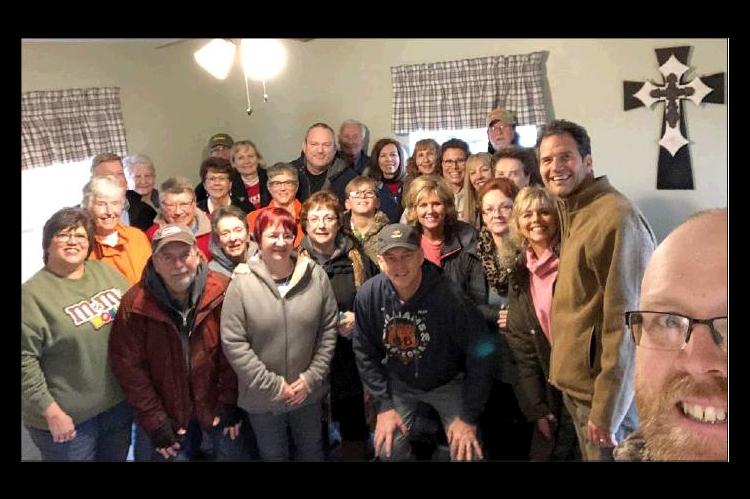
There’s no place like home for the holidays – especially when it’s a brand new home built and furnished with the love and compassion of an entire community.
Hard-working Pete and Connie Scott lived in a ramshackle house in Kingfi sher that has gradually advanced from dilapidated to unlivable.
Yet neither is the type to ask for help.
In fact, Connie is more likely to look for ways to help others, working as a regular volunteer at the Upper Room thrift store and other local organizations giving financially strapped families a leg up.
“I first met Connie through (the late) Judy Martinez,” Elise Morrow said.
Martinez founded This Too Shall Pass, a nonprofi t that distributed donated food, clothing and household items to those in need.
“I helped Judy keep the store open a few days a week after she got sick and whenever we would get a big donation in that I couldn’t handle by myself, Connie would always come and help.
“Connie is a very giving person.”
Need Identifi ed
But Morrow also knew about the Scotts’ own desperate circumstances and felt a growing burden on her heart to do something.
“The Lord just kept me awake thinking about it – every thought in my head was ‘Connie and Pete,” she said. “I just didn’t know what we could do or even where to start.”
So Morrow took the problem to the missions committee at Federated Church, where she is a member, which pledged its support to help the Scotts.
“They said sure, just go and run with it, but at that point I was still thinking ‘run where’?” she said.
The next stop was to talk to the Scotts to make sure they were on board with even accepting assistance.
“I asked them ‘what is your most pressing need?’” Morrow said. “And Pete said ‘well, we need a place to live because our house has been condemned.’”
Turns out that while Morrow was scrambling for a way to help the couple, their living situation had gone from horrible to unimaginably worse.
“Elise came home from talking to them and said we have to do something now because their sewer has collapsed and the city has condemned the house,” Fred Morrow, Elise’s husband said. “That’s what got us off high center.”
Options Limited
Located in the city’s fl oodplain, the Scotts’ house was eligible for the FEMA buyout program, but the $6,000 price offered was not enough for them to relocate elsewhere and would have required them to give up the lot as well as the house sitting on it – their only asset.
Originally renters, the Scotts were offered the chance to buy the house and property from their Oklahoma City landlords through a reasonable payment plan, Morrow said.
“We found out the abstract hadn’t been updated since before Statehood and what they own is actually three tiny 25-foot lots,” she said. “But they own it free and clear and have since about 1994.”
By now, a growing group of concerned citizens were on board to find a solution for the Scotts.
They identified a location on the property that was slightly higher elevation which could be built up enough to raise another house above the floodplain – but what kind of house would be affordable, go up quickly and be handicap accessible to accommodate Pete’s limited mobility?
“Several people suggested buying a trailer for them to live in, but the City Code doesn’t allow mobile homes to be located anywhere but inside an actual trailer park,” Fred said.
That left the option of a tiny house, a simple living option that has become so popular that plans and even kits are readily available.
Unfortunately, none of the prefab models or available plans met both requirements of being totally handicap accessible and fitting in the precise spot where the house would have to be located.
So Morrow designed his own plans and served as general contractor for the construction process.
But he is quick to say that the project would never have happened had the whole community not come behind it.
“No one person made this happen,” he said.
So Much Support, So Many Challenges
From their church’s mission committee, the Morrows went to their church governing board and received its blessing as well.
Elise sought the support of Debbie Bur-po, pastor of Frontline Ministries, who presented the project to the Kingfi sher Ministerial Alliance, bringing other local churches on board.
Dirtwork began last May, leaving open the possibility that construction might be completed by early fall – until it started raining.
Even after work resumed in late summer after June’s historic rainfall amounts, stumbling blocks continued to arise.
The relatively small amount of work on a 500-square-foot house didn’t justify the expense of bringing in manpower and equipment for most out-of-town contractors.
But in every instance where a problem seemed insurmountable, someone local stepped into the gap.
“Three local companies (S&J Heat and Air, Clayton Plumbing and Glen’s Electric) did the major contracting jobs at almost no cost for both labor and materials,” Fred said.
And Brian Walter at Walter Building Center provided a contractor who gave up his weekends to do all the framing work, with the help of growing groups of local volunteers.
“It is such a God thing – it would never have happened or sustained itself if the Lord wasn’t behind it,” Elise said. “We were down to the wire so many times and we said ‘OK, let’s pray about it,’ and it would be taken care of.”
In addition to all the man hours of donated labor, more than $30,000 was collected to cover the cost of materials and new appliances, and all the house’s furnishings were donated.
“Someone made quilts for the beds, another person made curtains,” Elise said. “It was a total community effort to get them a better place to live.”
The tiny house makes efficient use of all its space, with an open plan kitchen and living room area and a hallway leading to the bathroom, with a zero entry walk-in shower and bedroom.
Two exterior doors (in the living room and bedroom) eventually will have wheelchair ramps once all the dirt work is completed.
Although volunteers didn’t quite make their first goal of having the Scotts in their new home by Thanksgiving, they did make it by Christmas.
After a huge crowd attended a house blessing earlier this month, the Scotts moved in Dec. 20.
“I asked Connie after that first night how it went and she just had this slow smile from ear-to-ear and said ‘It was wonderful,’” Elise said.
Transformation Nearly Complete
Then on Friday, the old house came down, and a demolition contractor began the process of hauling away debris, another expense covered by the money donated by individuals, churches and businesses supporting the project.
“The city has been really great to work with us on this project all along the way and part of our agreement with them is that we would also take care of the demolition of the old house,” Fred said.
“Once we did that, (city building inspector) Jon Friesen said the city would take it from here and make sure the property continues to be maintained.”
Meanwhile, the Morrows said the generous community of volunteers who helped make the project happen deserve a collective pat on the back.
“We can get so busy living our own lives that we can look right past the serious needs of people living right here among us,” Elise said.
“But it’s gratifying to see when a need like this is brought to the community’s attention, people start stepping up in a powerful way.”