
Judge says state’s burden met
Steven Stricker, 62, to stand trial for girlfriend’s murder, dismemberment
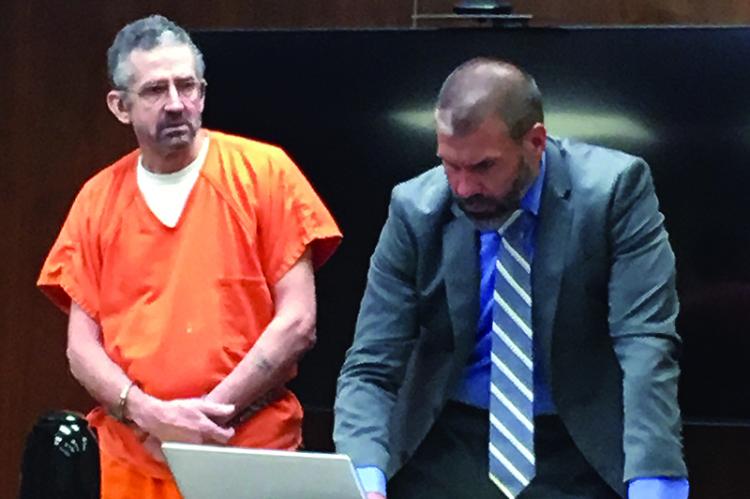
After six witnesses testified in a preliminary hearing Thursday, Kingfisher County Associate District Judge Lance Schneiter ordered Steven Kurtis Stricker bound over for trial on charges of murder and desecration of a human corpse.
Stricker, 62, is charged with allegedly killing his longtime girlfriend, Brenda Baber, and dismembering, burning and disposing of her remains in the backyard of their Kingfisher home and elsewhere.
While the state’s burden in preliminary hearing is much lower than at trial and presentation of its entire case is not required, prosecutors John Salmon and Eric Epplin presented new evidence not previously made public.
That evidence included testimony from another jail inmate about admissions Stricker allegedly made to him, testimony from a Florida woman who said Stricker talked about problems with his wife during a three-year online texting relationship and testimony that Kingfisher sanitation employees found human remains in the city’s sewer system alleged to have been flushed by Stricker.
The state amended the first-degree murder charge against Stricker to add alternative charges of first or second degree felony murder.
The original charge of first-degree murder requires the state to prove deliberate intent to kill, while the alternate homicide charges allege that the death, whether intentional or not, occurred during the commission of another crime, either kidnapping or domestic assault and battery.
Stricker allegedly admitted during a law enforcement interview that he did dismember Baber’s body and burn and dispose of her remains, but said he did so after she died accidentally by falling and striking her head on the bathtub during an argument.
Assistant district attorneys Salmon and Epplin contend that either Stricker killed Baber deliberately, or she died while he was confining her to the bathroom (kidnapping) or during the course of a physical altercation (domestic assault and battery).
Witnesses testifying for the state included Baber’s sister, Ellen Samuels of Cushing; Stricker’s sister, Julia Blanchard of Hastings, Neb.; a Florida woman who met Stricker through an online game app; a jailhouse informant; Kingfisher Police Sgt. Dustin Brodrick and Oklahoma State Bureau of Investigation Agent Rachell Savory.
Ellen Samuels
Samuels’ often tearful testimony described arriving at the Baber-Stricker residence at 421 E. Sheridan Ave. April 4 in a rented U-Haul truck, intending to help load up her sister’s belongings and move her to Cushing.
Samuels said that although it had been two years since she’d actually seen her sister, the two of them talked on the phone nearly every day of the nearly 10 years her sister lived with Stricker, a relationship Samuels described as “rotten.”
Samuels testified that Baber had started talking to her at the end of March about wanting to move out and asked Samuels for help.
Samuels said during a March phone call she could hear Stricker yelling in the background and that they were arguing about the title to her car, which he kept in his bag so she couldn’t take it with her if she left.
Samuels said Stricker also threatened to keep Baber’s dog Coco if she ever tried to leave him.
If Stricker was home when the sisters talked “he made her put the phone on speaker so he could hear everything. He was just ugly, calling her stupid, dumb, crazy,” Samuels testified.
The last time the sisters spoke was April 1, when they agreed that Samuels would pick up a U-Haul in Stillwater and come to Baber’s house the morning of April 4, while Stricker would be working at his job as a fry cook at Boomerang Grill in Kingfisher.
When Samuels arrived at Baber’s residence April 4, along with their dad and a cousin, they parked the U-Haul in the alley and Samuels went around to the front door and started knocking.
“I got no answer, so I started pounding and yelled her name. I went to the side door, the back door, the window, no answer,” she said.
Samuels said she also saw and heard the dog barking and then it got quiet, so she thought someone must be in the house.
Samuels said she sat on the front porch and began calling and texting the two cell phone numbers she had for her sister, but got no answer.
“It had been storming the night before, so I thought maybe her phone had died and she might be asleep,” Samuels testified.
Samuels continued calling and texting and circling the house pounding and knocking and calling her sister’s name for some time, she said.
Then Samuels said she went in through the garage door and looked through a screen door into the house and saw Stricker standing in a hallway.
“I saw Steven standing there, then I looked down and back up and he was gone,” she said.
Samuels ran around to the front door and looked through the window and saw Stricker standing in front of the couch, holding what she recognized as one of her sister’s cell phones.
“I yelled at him through the door,” she testified tearfully. “I asked him where is Brenda Lee? Where’s my sister?”
Samuels said she and her cousin walked back to the U-Haul where her father was waiting and Stricker walked out into the fenced backyard smoking a cigarette and holding a beer.
Samuels said she asked again about her sister and Stricker responded that she may have walked to a friends’ house “and pointed off to the south.”
Stricker also said that Baber did not want to talk to her sister and had cancelled the U-Haul reservation the night before, Samuels testified.
“I said ‘how could we have the truck right now if she cancelled it?’” Samuels said.
Samuels eventually called the police and Stricker went back inside the house.
When Epplin asked why Samuels called the police, she said: “Because my sister Brenda said if I ever came to her house and she did not answer to call the police because Steven had done something bad to her.”
During cross examination by Stricker’s attorney Jarrod Stevenson of Oklahoma City, Samuels said she never stayed overnight in Baber’s home and Baber and Stricker had stayed at her home only one time in 2016 or 2017.
Samuels said Baber actually did leave Stricker for about a month during that same time period and lived in an apartment in Cushing.
She said that was the last time she actually saw her sister in person.
Darlene Padgett
Padgett of Lakeland, Fla., testified that she got to know Stricker online about three years ago through a gaming app called “Yahtzee With Buddies.”
She said they were both part of a group of gamers who played against each other and also messaged each other online through the app, where their respective usernames were “DarleneP1968” and “Sparky”.
She testified that she later also started communicating with Stricker on Facebook Messenger and talked to him via cell phone “a couple of times.”
Padgett said she was married but “going through tough times” when she and Stricker first began communicating and they talked about “different stuff – my husband, his girlfriend.”
Padgett said she was still communicating with Stricker last April when he said he and his girlfriend were fighting and “he was worried about her taking stuff, vehicles and stuff.”
“How did he indicate he wanted the relationship to end?” Epplin asked.
“He said he wanted her out of the house,” she said, noting that he at one point commented that he needed to take care of a problem “and I don’t mean my dog.”
During cross examination, Padgett read from screen shots of the actual conversation Florida police retrieved from her phone where Stricker’s exact words allegedly were “someone in my immediate family and not talking about my dog.”
Padgett later asks in the same messaging exchange if Stricker is talking about Baber and his response allegedly was “I didn’t mention a name.”
Later when Padgett pressed for more information, Stricker allegedly wrote: “Someone needs to be gone,” Padgett said.
Padgett sent what she called a joking response that she could just call Baber and tell her that Padgett and Stricker were having an affair to make her jealous and Stricker allegedly responded: “I just want her gone.”
Padgett testified that in another conversation through the app about his relationship with Baber, Stricker texted: “Someone needs to go bye-bye.”
Padgett testified that in early April, Stricker disappeared from the online group and other members started asking “Where’s Sparky?”
She said when she and a friend started researching online, they found a news story about Baber’s death and Padgett located one of Stricker’s family members through Facebook and learned he was in jail.
Julia Blanchard
Blanchard testified that she missed a call from her brother on April 4, but then called him back just before 6:30 p.m. the same day.
After asking her briefly about an unrelated matter, Stricker told his sister that Brenda was gone and the police had been to his house looking for her and had “found a little bit of blood,” Blanchard testified.
“He said Brenda was missing at first, then later said ‘we’ve lost her, she’s gone,’” Blanchard said.
When Blanchard responded, “OK,” Stricker allegedly said, “You don’t understand, we’ve lost her. She’s gone.”
Blanchard said she then responded, “Well, we knew she was going to leave you,” to which Stricker allegedly said, for the third time: “No, we’ve lost her, she’s gone.”
Blanchard testified that she at first thought the whole conversation might be a joke, “like April Fool’s,” but after Stricker’s third repetition of “she’s gone,” Blanchard testified:
“I was thinking she’s literally not on this earth anymore.”
Blanchard said the conversation grew even more disturbing when Stricker allegedly began rambling about how if she ever had someone she needed killed, Stricker knew how to dispose of a body.
“He said he was very good at it and a fireplace works wonders,” Blanchard testified.
She testified that Stricker ended the conversation by saying that if Blanchard did not hear from him in a couple of days, he would be in jail.
Blanchard said she found the whole conversation so concerning, she immediately called the Kingfisher Police Department.
“I wanted to make sure that it was real, that she really was missing,” she said.
Sgt. Dustin Brodrick
Brodrick testified that he and another officer responded to Samuels’ call for a welfare check on April 4 and talked briefly to Samuels outside before knocking on the door at the residence at 421 W. Sheridan Ave.
Stricker opened the door and invited the officers inside and told them he did not know where Baber was, that she had been in bed when he left for work early that morning and was gone when he got back, Brodrick said.
Stricker allowed officers to search the house, where they found her medicine, walker and a cell phone that Stricker allegedly said was an old phone of Baber’s that she’d had shut off when she got a new phone, Brodrick testified.
Baber’s sister had told Brodrick that Baber would not have left her medicine or her dog behind, Brodrick said.
The police officer also testified that he noticed a spot on the counter between the dining room and kitchen that appeared to be a blood smear, but Stricker said it wasn’t blood when Brodrick pointed it out to him.
Stricker gave Brodrick the names of a neighbor and another friend who could have given Baber a ride and said she may also have gotten a ride with Cherokee Strip Transit, but Brodrick said he checked all those leads and none of them had seen Baber that day.
Brodrick said he initially told Stricker he was entering the case as a missing person but after returning to the police department and receiving the phone call from Stricker’s sister, he requested help from the OSBI to start a possible homicide investigation.
Kenneth Ray Gross
Kingfisher County Jail inmate Kenneth Ray Gross of Hennessey testified that he was already incarcerated awaiting trial on a felony offense when Stricker was booked into the jail in April.
Gross said he and Stricker were both in the same 16-man pod, along with other inmates, but the two of them began talking alone one night when the rest of the inmates were watching a movie.
Gross testified that Stricker told him that Baber died during an argument in the bathroom when Stricker pushed Baber and she fell and hit her head on the bathtub.
Stricker allegedly told him that he checked to see if Baber was breathing and she wasn’t. Gross testified Stricker told him he went into the living room and came back to check Baber again and she was dead.
Gross said Stricker told him the fight was “over her sister coming down and she was getting ready to leave him and he’d already been divorced before and didn’t want to get divorced for the third time.”
Gross testified that Stricker told him that he’d dismembered the body and burnt most of it in the outdoor burn pit, and flushed some of the remains down the toilet.
“He also said, if he had one more day, all would be good,” Gross testified, adding he didn’t know what Stricker meant by the statement.
Gross said he told the story to his attorney and then later to the OSBI but said he had not been promised anything in exchange for his testimony.
Stevenson at first objected to Gross’ testimony on the grounds that he had received no report about Gross’ alleged conversation with Stricker.
After discovering the DA’s office had just received the OSBI report on Gross’ statement Thursday, Schneiter called a short recess to allow Stevenson time to review the report before his cross examination.
Stevenson pointed out several inconsistencies in Gross’ testimony during cross-examination, including the fact that he told the OSBI agent that Stricker said Baber hit her head on the vanity, not the bathtub.
Stevenson also noted that Gross said Stricker used a sledgehammer to break up some of the bones before disposing of them, when Stricker himself told OSBI agents that he used a framing hammer and that he burned the remains in the fireplace and not the burn pit.
He also questioned Gross about his statement that Stricker had said he flushed some body parts “down the septic,” when Stricker’s house did not have a septic tank and was actually on the city’s sewer system.
He also questioned Gross about previous felony convictions for making false declarations at a pawn shop and writing bogus checks, crimes Stevenson said were based on lying.
Gross also agreed that he told his attorney about his conversation with Stricker after he learned that the DA’s only plea bargain offer on his pending charge involved 10 years in prison.
“And you don’t want to go to prison, do you?” Stevenson asked.
“No one does,” Gross replied.
OSBI Agent Rachell Savory
The state concluded its preliminary hearing evidence with testimony from Savory, the lead investigator in the case.
Savory said she and another agent met Stricker at his place of employment April 5 and “put him into investigative detention,” bringing him back to the police department for an interview.
She said Stricker read and signed a waiver of his Miranda rights and agreed to talk without an attorney present.
Savory testified that during the interview, which was recorded on both video and audio, Stricker said he awoke sometime between 2:30 and 3:30 a.m. April 2 when he heard Baber say something to him from the bathroom.
He said he went into the bathroom so he could hear what she said and she stood up from the toilet and they were “nose to nose,” Savory testified.
Stricker told investigators Baber tried to step around him in the doorway and fell and hit her head on the bathtub, Savory said. He allegedly told Savory, “I probably should have moved out of her way,” but said there was no physical contact between he and Baber before her fall.
Stricker said he went out of the room for a time and then came back in and Baber wasn’t breathing, according to Savory’s testimony.
Stricker told investigators he dismembered the body with a kitchen knife and burned the remains in the fireplace before using a framing hammer to break up the bones, Savory testified.
The agent also testified that a framing hammer was found when a search warrant was served, along with blood spatter evidence and charred remains buried in the backyard.
Savory testified that she asked Stricker about cuts, burns and “half-moon shaped” indentations she observed on his hands, arms and fingers.
She said Stricker told her the injuries were all work-related – the cuts and scrapes were from cutting up mushrooms and the burns from flipping eggs on a hot griddle.
Savory testified under cross-examination that the injuries she described as half-moon shaped appeared newer than some of the others and were red around the edges and appeared similar to indentations made by fingernails that could be consistent with an altercation.
She testified that a backpack belonging to Stricker and seized from his workplace contained keys, cellphones, chargers, a checkbook or register and two car titles, among other items, when searched pursuant to a warrant on April 9.
Savory testified that a hoodie tied on the outside of the backpack appeared to have a bloodstain.
She also testified that she was called to a city sewer facility on April 10 where city sanitation workers had found what appeared to be human remains in a clogged auger.
[Ed. note: Although further details weren’t provided in court, City Manager Dave Slezickey told the Times and Free Press Thursday afternoon that the remains were found at the sewer lift station at North Second Street. The remains were found in an auger used to lift waste from the lower elevation of the sewer main to a pump to push it out to the wastewater treatment plant, Slezickey said. Police Chief Dennis Baker also wrote in a text to the Times and Free Press Thursday that sanitation workers immediately contacted his office after observing the remains, which he described as “obviously tissue of some type and we were pretty certain it was likely of human origin.” The tissue was collected by the OSBI and analyzed by the state medical examiner’s office, which confirmed the remains were those of Baber, Baker said.]
After Savory testified, prosecutors offered court documents showing Stricker’s two prior misdemeanor convictions for domestic violence, both of them arising from assaults on Baber in 2011.
With two prior convictions, another physical assault on Baber would have been classified as a felony, qualifying her death as a result, even if unintentional, as second-degree murder.
Judge’s Order
Stevenson argued at the conclusion of the testimony that the state failed to prove that a murder had even occurred, much less that Stricker was responsible and also failed to offer evidence corroborating Stricker’s admissions to OSBI.
Stevenson also argued that the state failed to prove Stricker intended to kill Baber – essential for the first-degree murder charge, that he confined Baber in the bathroom against her will – essential for the kidnapping element of the first-degree felony murder alternative, or that she died during a physical altercation – essential for the domestic abuse element of the second-degree felony murder alternative.
Epplin responded that the state wasn’t required to corroborate Stricker’s admission at the preliminary hearing stage, but said evidence presented showed Stricker “clearly had a plan to get rid of her.”
He also said Stricker demonstrated “consciousness of guilt” in disposing of the body rather than calling an ambulance if Baber’s death had actually been accidental.
Schneiter said he found that the state presented evidence showing probable cause that the crimes alleged had been committed and probable cause that Stricker committed them, meeting its burden to bind him over for trial.
He ordered Stricker to be formally arraigned in front of District Judge Paul Woodward at 9:30 a.m. Sept. 11. Woodward will schedule and preside over Stricker’s trial.
Stricker remains jailed on $5 million bond pending trial.