
Legends of the Legion
How a sailor who couldn’t swim survived deployment on WWII destroyer
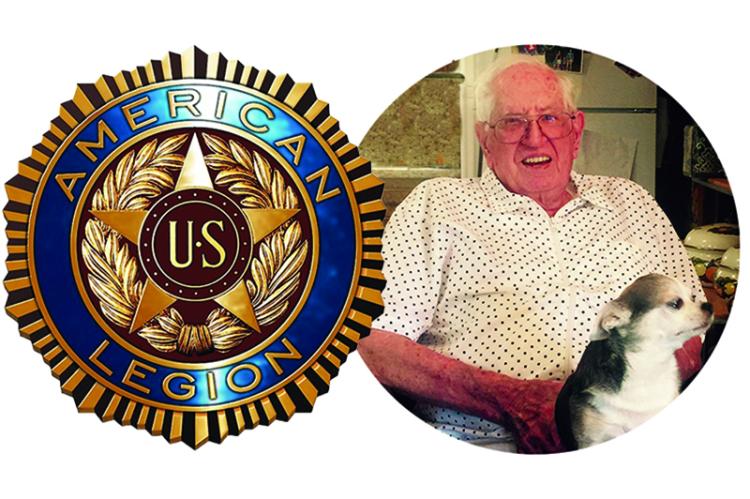
[Ed. Note: With this issue, the Times and Free Press is beginning a series of articles about members of the Kingfisher American Legion Post. The first is on WWII Navy veteran Raymond Reiswig, 93, one of its longest-term members.]
Kingfisher retired postmaster Raymond Reiswig is a sailor who never learned to swim.]
That information comes on the word of his great-granddaughter, Bella Tessman, who lists Reiswig as her hero, right along with George Washington, Laura Bush, Abraham Lincoln and Albert Einstein. Bella says she just calls Reiswig, “Papa.”
A calendar on the kitchen wall bears a photograph of Reiswig’s extended family available for frequent viewing.
Bella wrote her story of Reiswig’s life as a class project.
What makes Reiswig’s story of a nonswimming sailor even more amazing is that as an 18-year-old fresh out of high school, he served aboard the USS Ross, a U.S. Navy destroyer hit twice by enemy mines while deployed in the Pacific Ocean during World War II.
The ship was repaired by crew members enough to limp to anchorage at Homohon Island where Japanese planes continued making it a favorite target, strafing it and then sending a suicide bomber to strike it.
“We lost 17 boys,” Reiswig recalls, still showing the pain some 75 years after the event.
Reiswig, one of the senior members of the Kingfisher American Legion post, says the Navy must have needed new sailors pretty badly at that point in the war.
He was assigned to the Ross almost immediately after completing basic training.
The youngsters must have been ready for duty.
The Navy Department related the events this way in a news release on Aug. 9, 1945:
SOMEWHERE IN THE PACIFIC – A fighting ship that refused to give up, the USS Ross, a destroyer, is again on the prowl for enemy action after surviving two mine explosions, 286 air raids, a Japanese air strafing, a typhoon and a Kamikaze crash in a little more than a month.
So badly damaged was the rugged little ship that 806,000 man-hours of repair work were required … to put her back in fighting shape.
“Damaged twice by mine explosions while screening a minesweeping unit south of Homohon Island in the Gulf of Leyte, the Ross was towed to a “safe” anchorage. There she was immediately strafed and bombed by a two-engine Jap plane. Moved again to a safer place, the Ross sustained a hit on a forward turret from a Kamikaze pilot. She had shot down at least three Jap planes during the day and night attacks.”
The article reported that it was after a bombardment and a battle with several Jap planes that the Ross struck the first mine. Several men were killed and the forward engine room and fire room were put out of commission. About 20 minutes later, while all hands were working, another mine exploded aft, flooding living compartments, the after engine room and magazines.
“Although they knew the ship was drifting helplessly in the middle of a mine field that might provide unlimited further explosions, the crew calmly went ahead with damage control operations,” the Navy release stated, “They patched leaks, shored up weakened bulkheads and shifted weights to overcome a list that threatened to capsize the ship. Finally the flooding was halted, the list checked at 14 degrees and the Ross was towed to Homohon Island.”
The crew’s illusion that the ship had reached safety was quickly dispelled when a Jap bomber winged over a nearby hill, strafed the Ross and dropped a bomb so close beside her that two men were critically injured.
Reiswig served as a gunner on the top deck of the Ross.
He survived the attacks to return to Kingfisher and live a life of service to his community.
In addition to becoming the postmaster, he also served as commander of the Legion post and was a longtime member of the Kingfisher Lions club.
Reiswig made his start in life as the oldest of four children born to Reuben and Ida Reiswig, a farm family in the Omega community.
Great-granddaughter Bella added this tidbit about her Papa:
“Raymond Leroy Reiswig was born March 23, 1926, in Kingfisher, Okla., as a preemie.
“He weighed only two pounds and it was a miracle that he survived because back then there was nothing available to take care of preemies.”
While the family, including three sons and a daughter, was still young they moved to Kingfisher where Reiswig graduated from high school in 1944 as World War II was drawing to a close.
Reiswig says he got some good training for his later life by working at the local Texaco Station as a boy – after school, on weekends and summers.
Reiswig recalls standing on the stage following his high school graduation with eight other young men, all of whom were destined for immediate military duty.
After two years of military service, Reiswig returned to Kingfisher and found work.
He married his high school sweetheart, Charlene Rose Gender, May 30, 1947, and they became the parents of two sons, Dennis, a retired chemical engineer with Dow Chemical now living near Huntsville, Texas, and Kevin, now of Tulsa.
He started to work with the post office as a substitute clerk March 8, 1958, and became a regular clerk about a year later.
He was named acting postmaster following the retirement of Charles Taylor, who he credits as a great teacher and friend.
He retired after 25 years as postmaster, the 12th in the history of the Kingfisher post office.
“I’ve had a great life,” Reis-wig says.
He lost Charlene two years ago shortly after they observed their 70th wedding anniversary. She was a retired Pioneer Telephone Cooperative employee.
He continues to live at the family residence with the assistance of care-takers Tammy Jones and Jill Deatherage.
Still in good health at age 93, he uses a walker due to mobility problems, which prevent him from the wood-working hobby he enjoyed for years.
Great-granddaughter Bella says Reiswig was a master at making birdhouses, rocking horses for every grandchild and great-grandchild, including one for her named “Sugar Lump,” which was his nickname for her mother.
He made numerous doll-houses that he gave away to any little girl he thought needed one.
“He even built a barn for my cousin,” Bella adds.
“He has made 92 birdhouses, all of which he gave away except for those hanging from every fence post around the house.”
Although he doesn’t get around the community – where he knew nearly everybody at one time as he once did – he still enjoys hearing from friends and family. He especially likes the calls from his family on “face time,” where he gets to see them as well as talk to them by telephone.
His sons visit as often as possible and his sister, Veta Miller of Atlanta, Ga., the youngest of his siblings, calls him regularly.
Great-granddaughter Bella concludes her portion of this article this way:
“Raymond is very honest. He never has a bad word to say about anyone or anything. Raymond will always tell you the truth, even if the truth is not what you want to hear.”
Then she adds:
“He is the best great-grandfather anyone could ask for.”