
New purpose, same goal
C&A’s ERC plans to fill longstanding void for local tribal members
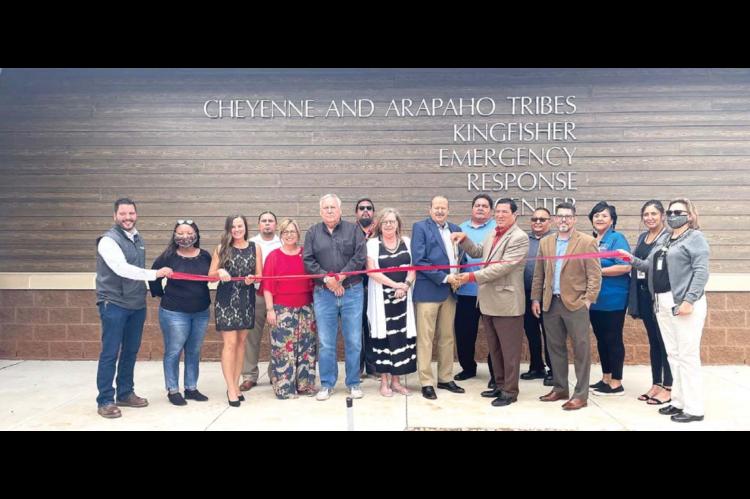
The Cheyenne and Arapaho center in Kingfisher is slated to open next month, two-and-a-half years after receiving city approval for rezoning at the former location of Kingfisher Regional Hospital.
But the building’s design, originally envisioned to be a community center for tribal dances and other events, as well as for public use, pivoted to become an emergency response center.
“The concept before the pandemic was to have a community center, basketball court and community hall,” Casey Peyton, acting director for the tribe’s planning and development program, said.
But when federal funding became available for tribes through the CARES Act, design requirements changed, she said.
“The three requirements for CARES funding are to prevent, respond and restore,” Peyton said. “It’s equipped with a command center so if a need arises for quarantine in the future.”
Therefore, it was the more recently-envisioned Cheyenne and Arapaho Tribes Kingfisher Emergency Response Center that was put on display last Thursday during a ribbon-cutting ceremony.
Whether it’s for its current purpose or for what it could be in the future, Cheyenne and Arapaho Gov. Reggie Wassana said it was much needed.
“Kingfisher has gone a long time without any type of facility,” Wassana told a group gathered inside the facility.
“The community hasn’t had any facility to actually meet or to have screenings,” Wassana told the Times & Free Press, noting some other services that can and will be offered.
“We feel we’ve created a good facility not only for our tribal members, but in the event there’s a catastrophe, we will try to assist the community as well.
Among its features are space to accommodate hospital beds, ventilators and a place to quarantine families, a full commercial grade kitchen to provide emergency meals, a clothing closet and food pantry and a conference room where doctors can provide telemedicine.
Other features include decontamination showers and a locker room for medical personnel.
Indian Health Services also can provide COVID-19 vaccinations and testing in the building.
“The building is also equipped with a computer lab for kids in the community to use for homework and virtual classes,” Peyton said.
“There’s a lot of potential in those rooms,” Wassana noted. “The people don’t have to go all the way to meet with the tribe. The tribe can come meet with them.”
The interior of the building also is constructed with safety and sanitation in mind.
“We created it to where we would not spread COVID or any other disease,” she said. “There are no drinking fountains, entries are all touchless, access is limited and materials that went into the building are easy to clean, very durable, with stainless steel fixtures throughout.”
Noted Wassana: “And there’s a generator, so even if there’s no electricity, we’ll be able to provide our services.”
There’s also a storm shelter outside the facility.
The Kingfisher response center is one of five the tribe has or will soon complete. Others are located in Clinton, Watonga, Woodward and Hammon.
Wassana said the building may be repurposed when the pandemic has ended.
“We’re really not through with this site,” he said. “We’d like to build some type of gym/community center where we can have activities for this area as well.”
The ceremony included an invocation by Patrick Spottedwolf, Arapaho chief.
Fred Mosqueda, Guy Hicks, Michael Watan, Max Bear and Whiteeagle Watan performed the tribe’s Flag Song.
Also speaking at the ceremony were Lt. Gov. Gilbert Miles, multiple tribal legislators as well as representatives of New Fire Native Design and RedHawk Construction.
Also among those in attendance were Kingfisher Mayor Roxie Alexander and Chamber of Commerce Director Shauna Rupp.
“It’s a beautiful facility,” Alexander said after taking a tour.
“I’m really excited to see the benefit it will bring to us.”
“We are thankful for the Cheyenne and Arapaho tribes’ commitment in the community,” City Manager Dave Slezickey said. “We congratulate them on the success of this project, and look forward to future projects benefiting the community”
(Ed. note: KT&FP Managing Editor Michael Swisher contributed to this article.)