
NO FEAR NOW
Once afraid of flying, Kretchmar now a pilot for major U.S. airline
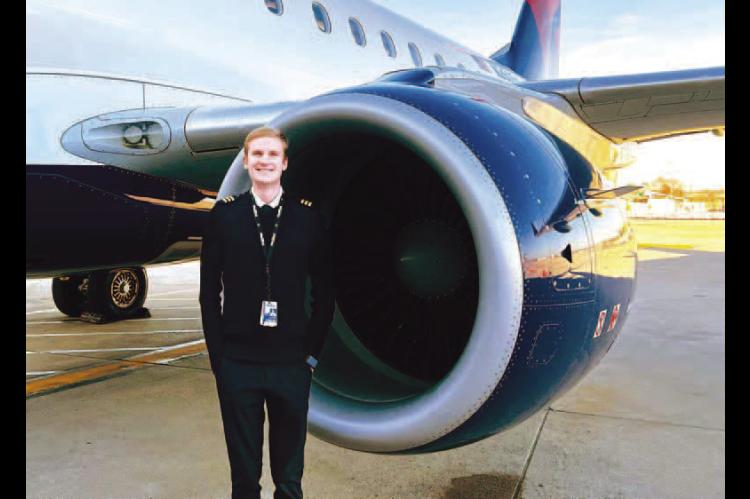
As a child growing up in Okarche, Zac Kretchmar enjoyed taking trips with his family….as long as there was no air between himself and the earth.
Then his parents, Mike and Laurie Kretchmar, made the decision it was time for a family trip aboard an airplane and time for their son to face his fears.
In the seventh grade at the time, Kretchmar said a few months before the flight, his aunt purchased a flight simulator computer program for her nephew in hopes of allaying his fear of flying.
“It came with a joystick and was very realistic,” Kretchmar recalled. “I enjoyed learning that on the computer and became interested.”
The day of the trip came and went with no problems, but Kretchmar said he had no particular interest in becoming a pilot or no knowledge of how that would even be possible.
Fast forward to his sophomore year of high school, a relative offered to take Kretchmar and his parents up in his airplane at Sundance Airport. As they flew around, Kretchmar said they discussed what it would be like to take a discovery flight, in which a flight school provides the opportunity for individuals to go on a flight to help determine if they’re interested in becoming a pilot and information about the process.
In March 2015, Kretchmar took the discovery flight and decided he would work on getting his private pilot’s license and take up flying as a hobby (unaware of the expense involved).
Contemplating a possible career in architecture at the time, that flight would change the course of his life.
After enrolling in flight school in Bethany, Kretchmar said his first flight instructor explained how he had earned an aviation degree through a university, piquing his interest.
“That’s where I first learned about that possibility and what it would be like to have a career in aviation,” Kretchmar said.
Earning his private pilot’s license when he was 17 years old, Kretchmar began to consider a career in aviation.
Entering his senior year at OHS, Kretchmar made the decision to attend the University of North Dakota, which has one of the most comprehensive aviation programs in the U.S.
Graduating in May 2020 with a bachelor’s in aeronautics, Kretchmar had received his certified flight instructor certification in the process and was working as a flight instructor for the university, eventually taking on a management role supervising other beginning flight instructors.
Earning his airline transport pilot certification in December 2021, Kretchmar began his career as a commercial pilot flying the Embraer 175 for a regional airline.
Completing his training to become a captain on the Embraer 175 in June of this year, Kretchmar submitted his resignation a day later to accept a first officer pilot position with a major commercial airline in which he will be flying the Boeing 717.
Currently in training for his new position, Kretchmar said once he completes his work in the flight simulator and passes his evaluation, he will soon be back to crisscrossing the skies taking passengers to their destinations.
With two pilots, the captain and first officer, always in the cockpit, Kretchmar said it’s a common misconception that the first officer doesn’t fly the aircraft, but that’s not the case.
“We actually fly an equal amount with the captain,” Kretchmar said. “We might fly four legs in a day and we will trade off each leg.”
With both pilots involved in the decision making and operation of the aircraft, he said the main difference is the captain has more responsibility and final authority for safe operation of the flight.
Questioned on what it’s like, Kretchmar said they go through so much training and repetition, it’s a lot of muscle memory and just doing the job.
“When you’re going through a flight, you’re just doing everything sequentially… every time is a little different with different airports and weather, but it’s basically following the same procedure every time,” Kretchmar said.
“Of course we always have a plan A, B and C in case anything goes wrong.”
Takeoff and landing obviously require more direct involvement in flying the aircraft and are more engaging than when the plane is flying in autopilot…often just monitoring the systems and talking to air traffic control, Kretchmar said.
Faced with a challenging airport or weather, Kretchmar said the pilots always talk about the situation beforehand and have a plan.
“We have a plan about what we’ll do to mitigate all the threats and when you actually go through it and get on the ground, it’s a good feeling to be able to open the door and say good-bye to all the passengers getting off the plane as you’ve gotten them to their destination safely,” he said.
“Sometimes you get to talk to them and see where they’re going, what they’re doing..whether it’s a vacation they’ve been looking forward to, a wedding or another important event… taking them places they need to be.”
At the age of 24, Kretchmar has flown over 2,000 hours and said he always gets passengers who think he’s too young to be a commercial airline pilot.
“One person told me, ‘You need to go back to high school,’” Kretchmar said. “I didn’t have the heart to tell her the other pilot up there was younger than I was.”
Another rewarding aspect of the job, Kretchmar said, is also being able to show kids, or adults, what it’s like in the cockpit.
“We always enjoy it when people want to come up to the cockpit and say ‘hi’ or look around before or after the flight,” Kretchmar said. “Unless we are in a major rush, most of us enjoy it, because it breaks up our day a little bit.
“We get to meet people and we’re always happy to talk about airplanes.”
Flying out of a variety of different airports, Kretchmar said he really enjoys the west coast as the weather tends to be better and the scenery is beautiful and he’s also enjoyed having the opportunity to fly with many of his colleagues from the university.
A special moment for Kretchmar was when he had the opportunity to fly his parents from Birmingham to Denver.
“I had my parents on a flight, which was fun,” Kretchmar said. “It was actually one of my worst landings though, so we need to have a do-over.”
If an alarming situation arises while in flight, Kretchmar said they’re trained to think logically and methodically, enabling them to respond without fear.
“One of my professors at UND said, ‘Pilots don’t get scared, we just get very interested in what is going on,’” Kretchmar said.
In agreement, Kretchmar said going through flight training in general, and especially airline training, changes how you view things and how your brain works.
“We have to always be thinking ahead and about what’s next,” he said.
An extensive amount of training is required to become an airline pilot and the training continues throughout a pilot’s career.
“The life of an airline pilot is constant training and evaluating along the way,” Kretchmar said.
Currently, Kretchmar is also in the process of obtaining a master’s of business administration from UND.
Residing in Minneapolis since December 2022, as Kretchmar begins his new pilot duties, he will initially be flying on reserve out of Detroit, Mich.
During his free time, Kretchmar said he enjoys playing the piano and finds fulfillment volunteering with Navigating MSP (Minneapolis- St. Paul International Airport), a program which connects airline crew members with children or adults who have disabilities or a fear of flying to show them the process.
“They come to the airport and we take them through the check-in process, security and actually board the aircraft where flight crew volunteers sit down and talk with them about traveling and answer their questions,” Kretchmar said.
Working with several people in the program, including an apprehensive young boy and his father, Kretchmar has been able to share his own experience with a fear of flying as a child.
“I think the program is really helpful because you can see how it directly impacts them,” Kretchmar said. “It’s been very rewarding.”
Looking back to how it all started, Kretchmar said it’s been an interesting journey and one that he never would have guessed he would be on, but wouldn’t want to do anything else.
Thinking back on how teachers would sometimes say, “‘Nobody’s going to pay you to look out the window,’” Kretchmar said, “I do get paid to look out the window and it’s a nice job to have.”