
Officials facing tough decisions
Rising costs have the new fire department price tag much higher than initial estimates; the city now has the dilemma of trying to cover the funding gap or make critical cuts to the structure
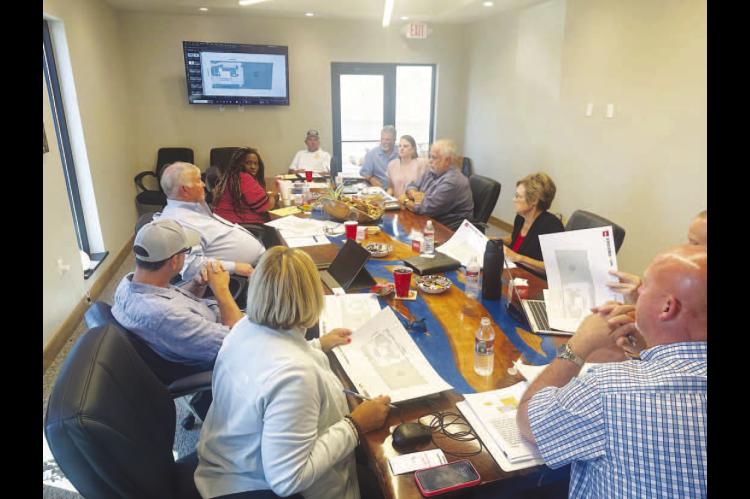
City leaders are at a fork in the road when it comes to the construction of a new fire station.
It’s still up for debate which direction - or directions - they’ll choose to go, which may include delaying the construction process and/or asking the citizens to extend the sales tax they passed three years ago to fund the new facility.
Commissioners met Thursday afternoon with architects from the firm tasked with designing the new station.
The gathering was a special meeting held at the Kingfisher Chamber of Commerce and it also included City Manager Jim Thomas, City Clerk Brittney Hladik, Fire Chief Ryan Gibson and former Chief Tony Stewart.
Ray Holliday, a principal with Brown Reynolds Watford Architects (BRW), told commissioners he has “about 20 percent” of the plans for the new fire station complete.
However, said Holliday, he’s seeking more direction before moving forward.
Essentially, the city has requested a space of about 16,000 square feet for just over $8 million.
To get a station the proper size and within that budget, said Holliday, means some scheme changes will have to be made, which includes eliminating what some feel are necessary components of the new fire station.
“That’s the reason we asked to have a workshop meeting to bring it to the table and tell you guys we’ve kind of got some deficiencies here,” Holliday said. “You tell us to move forward, we’ll move forward.
“We’ve cut all the fat out of this building. We’ve done multiple layouts and can’t find anything to cut other than some critical spaces.” BACKGROUND
As the city’s population grew, so did the need for a larger fire department staff.
Those needs outgrew the current facility, which is in its fifth decade of use.
The city proposed a 10year, one-half cent sales tax and voters overwhelmingly approved it 159-66 (71 percent approval) in May 2021.
The tax went into effect that October.
Early conservative figures estimated the tax would generate about $6.5 million. Early estimates also had a new station costing about $5 million to build.
As part of the tax proposal, any leftover funds from the tax would be used for city infrastructure improvements.
Unfortunately, sales tax collections have dipped in recent months. Kingfisher’s August 2024 report showed the city collected about $70,000 less than for the same time in 2023. (Note: The August distribution of collections primarily represents local tax receipts from June business.)
The July report showed about $66,000 less than the year before.
However, the good news is estimates of the revenue generated from the tax were quite conservative.
Thomas told commissioners that both he and City Treasurer Anita James forecasted what the tax will generate by the end of the 10 years.
First, he said, the tax has generated about $2.1 million through its first 33 months.
Using that average and projecting about 2 percent growth over the term of the tax, the two came up with a figure of about $8.4 million to $8.5 million generated.
Back to the unfortunate: The figures for a new station were far too conservative.
Pushed largely by a post-pandemic rise in construction and labor costs, even the $8.5 million wouldn’t cover what most felt would be an adequate facility for firemen.
The gap, according to Holliday’s presentation at the meeting, was about $1.5 million.
Noted Mayor Geoff Covalt: “In regards to this additional tax that was passed, it was passed with the thought that we would also do infrastructure improvements. We’re not going to touch infracutusre improvements with this.”
BUILDING OPTIONS
In showing commissioners the early plans for the station, Holliday laid out what he called a “base scheme” and then a “better scheme” for the new station.
The “better scheme” included such options as a direct capture vehicle exhaust system, which Stewart said he felt was a necessary feature. “Safety of my firemen was always the top priority,” said Stewart. Both he and Holliday noted studies that show firemen are more likely to develop cancer than the general population due to the exposure to dangerous carcinogens in diesel exhausts at stations. The proposed system would extract most of those dangerous carcinogens, but the system isn’t included in the “base scheme.” Other features of the “better scheme” with the “base scheme” option listed after it are: • Generator – no generator
• Bi-fold garage doors with less maintenance – lower grade folding garage doors and track
• Metal roof – Asphalt shingle roof
• All or more masonry on exterior – minimal masonry with majority being fiber cement
• Commercial grade windows and doors – Residential grade windows and doors
• More durable cabinetry and millwork – Pre-manufactured cabinetry
• Built-in furniture – No built-ins
• Quartz counters – Plastic laminate counters
• Tiled showers – Fiberglass shower enclosures
• Acoustical insulation – No sound insulation
• Alerting system – No alerting system
• Commercial door hardware – Residential door hardware
• Commercial lighting – Residential lighting Holliday told commissioners the options on the right would get the station within budget.
“We were given marching orders of $8 million and not to exceed it,” he said. “We live within your means. We’ve done things to kind of get you in budget. If that’s what you want, we’re good with it, but I think there’s going to be some maintenance elements that go with it. We just want to make sure you guys are aware of that.”
REACTION
A committee was designated to work with BRW throughout the process.
It includes Gibson, Stewart, Hladik and Thomas.
“We’ve worked hard on this so far and Ray’s done a good job of keeping us at the price,” Gibson said at the meeting. “Some of the stuff, we (the committee) don’t like it, but we also understand we only have so much money. So Ray’s working hard to get us the best for our money in my opinion.”
Gibson said there is no “fluff” in the design.
“You’ve got to remember, the fire station is also the emergency operation center for the City of Kingfisher,” Gibson said. “So it’s built to be that and we’ve got what we need for that except a generator, which we’re trying to get.”
Stewart had mentioned previously he was working toward a grant that would help with the purchase of a generator, which carries a cost of upwards of $300,000.
Vice Mayor Jeff Wittrock asked for a price breakdown of each of the options, which Holliday provided.
“Some of this holds more importance than others,” Wittrock said. “I’m not a big fan of some of these (changes). Residential windows and doors. That would be asinine. It would be stupid to build an $8 million fire station and put a residential window in it.
Commissioner Kyle Mecklenburg said he wants to make sure a facility is built to last 25 to 30 years.
“I don’t want to use subpar materials now and then we’re spending $2 million later to fix the roof,” he said, noting he was being “dramatic” with his figure, but trying to make a point.
Commissioner Debbie Burpo also expressed reservations about the less expensive options.
“I’m not OK with this base list,” she said. “A big part of this, I’m not OK with it.”
Gibson said he wants a facility that will last as long as the current one. In designing the new 16,500 squarefoot structure, they’ve allowed for growth, whether it be additional firemen on each shift or room to build extra bays.
If the city continues to grow, he said, building another main station won’t be the priority.
“We want this to be a 50-year building,” he said. “That’s what we’ve got now and that’s what we should have…and in the future, we should be building another smaller station somewhere else, not another main station.”
Gibson said he knows it comes with a price tag.
“I know it’s a lot of money,” he said. “But it’s cost versus price. If you don’t pay the price now, it’s going to cost us more in the long run.”
HOW TO FUND IT AND WHEN TO MOVE FORWARD Thomas spoke for about the first 15 minutes of the nearly two-hour-long meeting.
In offering the sales tax projections, he noted the city will have to borrow the difference in what it has collected to date and the final cost of the project.
He said 4.5 percent interest on a loan over 15 years will cost the city some $3.8 million.
As far as covering the gap in what’s needed to build the “better scheme,” Thomas has worked behind the scenes for other funding.
“There are a number of avenues we’re going down,” Thomas said. “I’d asked through Congressman Lucas’ office for a direct appropriation for this fire station of $2.5 million,” Thomas said.
“We’ve made the first cut, but you know how politics are. It would be nice for us to get it.”
Thomas said his request was supplemented by several letters of support and that some local/state leaders are also pushing for the federal appropriation.
However, Thomas won’t know for several months if the city will be approved for the funds.
“If I could say today we have a 99 percent chance of getting this direct appropriation, we wouldn’t be having this meeting,” he said. “We would just proceed along.”
But Thomas is cautious about proceeding too quickly.
In fact, he mentioned multiple times about delaying the bidding process.
As it stands, the plan is to go out for bids on the station in January or February 2025.
“I’m seriously considering trying to slow this thing down a little. My concern is interest rates aren’t coming down as fast as I had projected in January. I think unemployment is higher and I think we may be in the early stages of a recession,” Thomas said.
“And that’s irregardless of who gets elected president (in November).
“We’re on the verge of some real strange waters. I don’t want to make a mistake. I’ve been in this business over 30 years and I know you guys rely on my expertise and my knowledge and I don’t like surprises and I’ve had a couple of surprises in the last few months.”
Commissioner Dawn Terrell said she’s not a proponent of delaying the process.
“I do not agree we should put this off,” she said. “There’s always going to be something (reason for delaying).”
Covalt said he preferred the design portion move forward, but wasn’t against delaying the bidding process.
He said there are a lot of unknowns that make the decisions difficult, including the status of the federal appropriation, the upcoming presidential election and other factors.
“I think we’ve got to let it play out. Let’s see what happens this fall,” Covalt said. “We’re going to continue to design and get this thing at the level we believe we can afford, but it may be such that we don’t bid this until next summer or something. Who knows?”
Burpo is the pastor at Frontline Ministries, which has numerous outreach programs.
“Timeline wise, I do feel, based on the economy and what I see in my line of work and the way people are struggling, I’m leaning more toward what Jim said, bumping it out there a little bit,” she said. “That might be wisdom at this point.”
Another option for closing the funding gap is going back to the citizens of Kingfi sher.
“I think we need to consider that we educate the city and say the numbers don’t make sense,” said Mecklenburg. “What we need to build and the money we’re going to get from the tax is not lining up because of unforeseen material costs, labor costs and so forth.
We need five extra years on this (tax) and let the citizens decide if they want and are willing to continue to be taxed.
“I’m not saying I’m in favor of this; I’m just putting it out there as an option.”
Thomas reacted to Mecklenburg’s suggestion.
“I’m leaning seriously to what I shared with the committee three weeks ago of just slowing this thing down until after the election or at least until I get a firm commitment from Congress that they’re going to appropriate $2.5 million,” Thomas said. “I don’t disagree with what you’re saying, Kyle. I think we do need to extend it another five years, but right now the public is focused on so many other things that I don’t want to cloud their judgment.”
Stewart suggested an informational campaign to educate citizens, much like was done prior to the initial vote.
“We put out a lot of good information the citizens needed to see and know and I think it helped pass the first one,” Stewart said.
He added he felt it was important to keep people up to date on the status.
“Keep the people involved,” he said. “Give them knowledge of where we are generally. Let them see the process.”
MORE MEETINGS
The agenda didn’t call for any action on the subject at this meeting.
Covalt said he felt commissioners needed to call for another special meeting soon to make more concrete decisions and be able to provide Holliday and BRW more direction.
He said another special meeting could be called as early as this week.