
O&G group tags local purge as key issue
Bollenbach discusses problem at State Capitol luncheon Wednesday
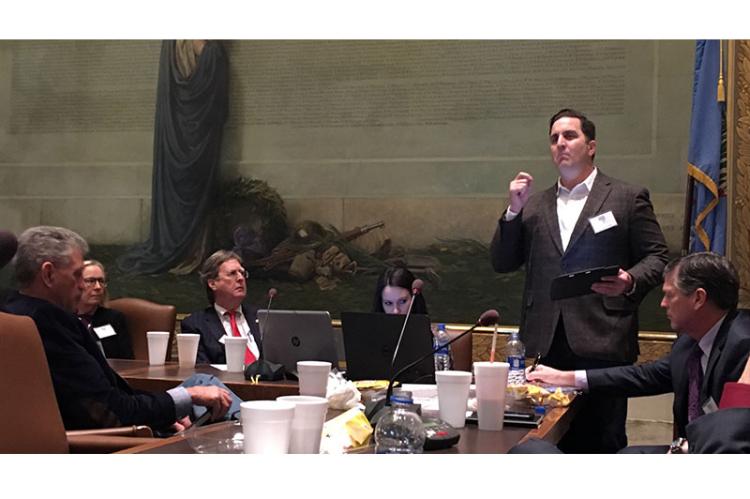
The saltwater spring still bubbling up in a field southwest of Omega featured prominently in a legislative briefing hosted by an oil and as trade association at the tate Capitol Wednesday.
The Oklahoma Energy roducers Alliance named he saltwater purge and o-called “frac bashing” of vertical wells by horizontal wells drilled in too close proximity as its two most rgent issues at the lunch eeting.
OEPA represents some 00 small-medium sized, tate-based energy producrs engaged primarily in vertical rather than horizontal drilling.
Lawyer and oilman Kurt Bollenbach of Kingfisher spoke to the gathering of Legislators and energy leaders about the risk the purge poses to the environment and Kingfisher’s water supply.
Located in the middle of a field owned and farmed by Ronald and Donald Schweitzer just west of the Blaine County line, the saltwater purge was first reported last May when trees started dying across the road.
Bollenbach said Wednesday he’d measured the flow of water from the ground that morning at a rate of about five and a half gallons per minute.
“It’s averaged about eight and a half gallons per minute, about enough to fill an average swimming pool every day,” he said. “The salt content is just shy of the salinity level of the Dead Sea.”
Although the working group formed by the Oklahoma Corporation Commission has yet to identify a specific source for the water, it’s being treated as an oil and gas issue.
Bollenbach said Wednesday he first learned of the purge when contacted by the OCC about a problem at one of his oil wells a mile east of the Blaine County line.
“There was a pinhole leak in the surface casing that normally would have been a simple fix,” he said. But the well was actually hut in due to its proximity o the purge location and ollenbach said he is now being told that it must be plugged.
“It’s expensive and danerous to plug it,” he said. I’m not only concerned bout the financial impact but also the environmental mpact to the community.”
Bollenbach said the well s located just a quarter ile from Kingfisher Creek nd he’s concerned that the dded pressure created by plugging the well could force ainted water into the creek.
He said Wednesday that wo conclusions have arisn in his own discussions with more seasoned energy producers.
“One, the purge is not aturally occurring, and wo, it’s a symptom of forcng too much disposal water nder too much pressure nto too shallow of a zone,” he said.
The OEPA and others all the purge an “unintendd consequence” of state bans on deeper injection wells, which were linked to swarms of earthquakes occurring across the state.
Disposal wells near the purge inject water about 2,000 to 3,000 feet deep, compared to wells linked to earthquake activity, which were 6,000 feet deep or deeper.
“Shallow disposal in and of itself is not dangerous. It’s the volume that we have now and the inadequate regulation,” Bollenbach said.
“The purge is a foreseeable and avoidable symptome of overdisposal of produced water,” he said. “Oklahoma has a culture [toward oil production] of ‘get it out of the ground at all costs’ and we have to change that attitude.”
Bollenbach attributed part of the problem to insufficient resources at the corporation commission, which is charged with permitting saltwater disposal wells in addition to every other facet of energy regulation.
“Applications are rarely denied and I think that’s because the OCC doesn’t have enough personnel, technical experience or time to review the volume of applications,” he said.
“They are underpaid, under appreciated, under staffed and under trained,” Bollenbach added. “They need the authority and the manpower to immediately enjoin bad actors.”
He said that the delays he’s seen in dealing with the purge is further evidence the corporation commission lacks sufficient resources to deal with its tremendous statutory responsibilities.
“Disposal activities were going on for months after the purge was reported because the OCC did not have the ability to stop it or believed that they didn’t,” he said.
OCC directives issued in October and November shut in eight total disposal wells and another November directive limited injection pressures on another 12 wells and no permits will be issued for new wells in a nearly 15,000 square-mile area.
“It also took months for steps to be taken to contain the saltwater coming out of the ground,” Bollenbach said Wednesday, while showing slides of the site.
The water was initially captured in an unlined borrow ditch via a trench dug from the purge site and then regularly trucked away.
Later the ditch was lined with black plastic and now a containment system is being built to transfer the water via sump pumps to above-ground frac tanks, then through underground lines to another storage site more accessible to the trucks that will continue to carry it away.
The containment system is being funded by a grant from the Oklahoma Energy Resources Board, released after an emergency hearing by the OCC finding a serious risk to the environment, which was followed by an emergency declaration signed by Gov. Kevin Stitt.
“The subject saltwater purge constitutes a serious threat to public health and safety and poses a serious risk to the environment if immediate action is not taken,” the declaration read.
The OCC has said the containment system is not a solution to the problem and its working group is continuing its investigation.
At Wednesday’s meeting, OEPA President Mike Cantrell said: “What they’ve done is not even a bandaid. It’s a serious problem that’s not being fixed.”
OEPA representatives said state standards that continue to encourage recycling of produced water would help alleviate the problem of overdisposal.
‘Frac Bashing”
The other major concern OEPA representatives discussed with legislators who attended the luncheon was damage being done to existing vertical wells by horizontal wells being drilled in too close proximity.
So-called “frac bashing” occurs when water and fracking sand forced underground at high pressure to complete horizontal wells slams into nearby vertical wells.
OEPA speakers said Oklahoma is the only state that allows horizontal spacing units to be placed over vertical spacing units containing producing wells.
Under Oklahoma law, a mineral owner refusing an oil company’s lease can be ordered to participate by the company’s application for forced pooling through the corporation commission.
That concept makes sense when a reluctant mineral owner is preventing production from going forward and thus tying up the rights of his neighbors to develop their own interests.
But the OEPA says the same concept has unfair consequences when used against vertical well owners who are trying to protect their producing assets from potential damage.
OEPA speakers said protests from vertical well operators are met with deaf ears by the corporation commission, which does not have the jurisdiction to assess monetary damages against horizontal drillers whose fracking activities interfere with producing vertical wells.
Additionally, speakers said, when damage from fracking activities cause a neighboring vertical well to leak or purge harmful substances to the surface, it’s the vertical well owner who is held financially responsible for cleaning up the mess.
The only route for relief currently available is in state and federal court.
A number of cases have been filed in Kingfisher County District Court and elsewhere by vertical well owners seeking monetary damages for alleged fracking damage caused by nearby horizontal well completions.
So far, all of those lawsuits are still wending their way through the court system and none have reached a verdict.
State Rep. Zack Taylor, himself an owner of a small oil company, has introduced legislation that would require offending oil companies to be held responsible for the damage they do to other wells, he said at the meeting last week.
His bill also would require oil companies responsible for damage to neighboring wells to also be liable for any cleanup costs for pollution that results, he said.
He introduced the same bill last year against heavy opposition from the Petroleum Alliance of Oklahoma and it never made it to the House floor.
Area state senators Darcy Jech of Kingfisher and Chuck Hall of Perry were among those at the meeting.